



5 Best AI Scribes for eClinicalWorks (2026)
Compare the best AI scribe for eClinicalWorks on integration, coding, trial terms, and pricing.
Written by the Commure Scribe Team
Published: April 3, 2026
•
10 min read
Updated August 10, 2026
What You Need to Know About the Best AI Scribe for eClinicalWorks
- Fit changes with practice size and how eCW is already configured. A solo practice running one specialty template needs less from a scribe than a multi-site group syncing structured data across dozens of provider workflows.
- Integration depth separates these tools more than anything else. A scribe that writes into named eCW Progress Note fields through the FHIR API saves more manual work per visit than one that hands back a block of text to paste.
- Hard evidence separates real products from marketing claims. Vendor-reported accuracy figures aren't comparable across companies, so this page relies on peer-reviewed research instead of self-reported numbers.
- Published pricing and real trial access change how confidently a practice can decide. A tool that's priced and open to self-serve testing removes the guesswork a sales-only model adds.
This guide covers five AI scribes that work with eClinicalWorks. Around 30% of US physician practices now use an AI scribe.¹ The tools on this list vary significantly in how they connect to ECW, what they do with that connection, and who they are realistic options for.
How we rank, and how we score ourselves
Commure publishes this page and sells Commure Scribe as a paid product. Commure Scribe is scored against the same criteria as every other product here, using the same weights, and the result is published whether or not it favours us.
Across our comparisons Commure Scribe places first on some pages and outside the top three on others. Where a competitor scores higher, the page says so and explains why. The criteria and weights are published below, so any placement can be recomputed.
Where Commure Scribe places here
Commure Scribe places first on this page, inside a five-way cluster that also contains Sunoh.ai, DeepCura, and Heidi Health. Positions one through five fall within 0.3 points and should be read as a cluster rather than an order.
Sunoh.ai has the deeper eClinicalWorks integration, because eClinicalWorks’ own affiliate built it. An ECW practice that wants the most native path available should start there.
DeepCura publishes more of its integration mechanism than we do, across seven named data standards, and it publishes a price that discloses the $50 per month ECW API access fee inside it. On pricing transparency it scores above Commure Scribe. Commure Scribe scores 5.0 against Heidi’s 7.0 on independent evidence.
Pricing and features per vendor documentation. Verified July 2026. Verify before committing.
How Do the 5 Best AI Scribes for eClinicalWorks Compare?
Positions 1–5 fall within 0.3 points and should be read as a cluster, not an order. DeepScribe’s score of 3.1 reflects no published pricing and no trial, not a weak product overall. But it can be viewed as outside practical reach for most ECW practices without enterprise procurement.
How Were These eCW AI Scribes Evaluated?
Each product was scored 0 to 10 in half-point increments against six criteria weighted for an eClinicalWorks practice. Weights sum to 100, and any placement here can be recomputed from the table.
Full Scorecard
Integration carries 40 points because an ECW practice has already chosen its EHR. A product that cannot reach ECW is not a candidate at any price.
One fact applies to every integration claim on this page, including ours. eClinicalWorks’ third-party API cannot write narrative notes, treatment plans, billing codes, or order linkages into discrete ECW fields. Vendors reach ECW through eCW’s own paste parser (the Scribe-It add-on), a Chrome Extension that fills the rendered page, a Vim overlay, or, in Sunoh’s case, a native integration built by eCW’s own affiliate. All of these work. None of them is what most buyers picture when a vendor says “API integration.” Where a mechanism is documented, the entry states it. Where it is asserted without one, the entry says that too.
Integration falls into two practical camps for ECW practices.
- Browser push or paste parser. The scribe drafts the note in its own interface. The note then moves into the ECW Progress Note through a Chrome Extension push or eCW’s Scribe-It paste parser. Setup is fast and needs little IT involvement. Commure Scribe and Heidi Health operate this way.
- FHIR resource connection. The scribe connects through specific eCW FHIR resource types. It can pull patient context before the encounter and send structured data back — within the limits of what those resources support. Setup requires an eCW admin and typically carries an API access fee. DeepCura documents this across seven resource types and discloses where the limits apply. Sunoh bypasses this entirely because it is built by eCW’s own affiliate.
Neither approach is best in every case. A solo clinician may value a five-minute setup over a deeper ECW connection. A multi-provider group running high visit volume may want the tighter integration. Fit decides.
How scores were assigned. Products are scored at the tier you can buy without a sales call. Independent evidence is banded: 10 for a ranked Best in KLAS win or peer-reviewed research, 7 for a Spotlight or First Look report, 5 for an attestation verifiable at source, 3 for one asserted but not verifiable, 0 for vendor self-report alone. Absence of a published price is scored as absence.
Five products were excluded because they document no eClinicalWorks integration on any vendor property: Suki, Abridge, Ambience, Microsoft Dragon Copilot, and Nabla. They are not weak options for an ECW practice. They are not options.
Vendor-reported accuracy statistics were excluded. No standard test exists across vendors, and self-reported figures cannot be compared. Independent research shows AI scribes have an error rate of roughly 1 to 3%, with omissions being the most common failure mode. Every product here produces a draft a clinician must review and sign before it reaches the chart.¹˒²
The buying decision deserves criteria a buyer can check. The six criteria and weights above are published so any placement in this guide can be recomputed.
What Are the 5 Best AI Scribes for eClinicalWorks?
The profiles below apply the methodology criteria to each best AI scribe for eClinicalWorks contender. Each one covers how the tool connects to eCW, what it costs, and where it fits.
1. Commure Scribe
Commure Scribe is an ambient AI scribe used by 75,000+ clinicians across 25M+ patient encounters annually. It supports eClinicalWorks among 60+ EHR integrations. Solo and small practices (1-5 providers) move notes into eCW by copy/paste, and medium and large groups can access one-click sync with the EHR.
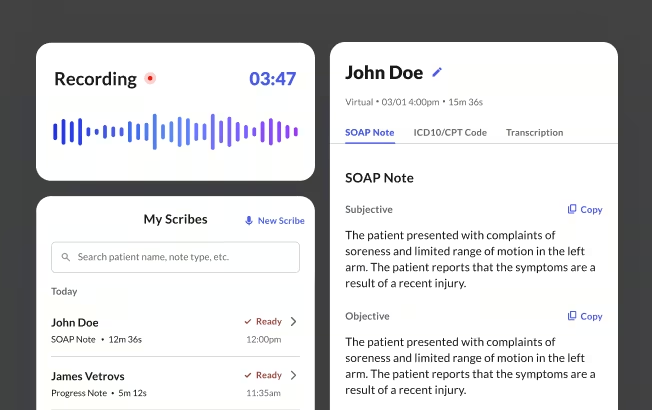
The workflow is Capture, Edit, Finalize. After the clinician clicks End Recording, a structured SOAP note appears within seconds, with suggested ICD-10 and CPT codes generated alongside. The clinician has the option to review the note before it enters the chart.
Commure Scribe detects 90 languages with no manual selection. That helps the multilingual panels common in eCW practices.
Pricing for this eClinicalWorks AI scribe is published. Solo and small practices pay $89/mo monthly or $59/mo billed annually, with a 7-day unlimited trial and no credit card. Medium and large groups get custom pricing with live onboarding and ROI analytics.
Pros
- Published pricing plus a self-serve trial. An eCW practice can start testing this week.
- Suggested ICD-10 and CPT codes come at the entry price. No upsell tier is needed for coding.
- Language detection covers 90 languages. No manual selection is needed.
Cons
- Solo and small practices use copy/paste with a chrome extension overlay, not direct write-back. One-click sync available for medium and large group practices.
- No ongoing free plan exists after the trial ends.
2. Sunoh.ai
Sunoh.ai is the native eCW AI scribe option, developed by healow, an eClinicalWorks company. It works in the eCW desktop EHR, eClinicalTouch for iPad, and eClinicalMobile.² According to eClinicalWorks, Sunoh drafts a dialogue flow, a SOAP note, labs, and orders, and the provider edits before importing into the Progress Note.²
Pricing is $149 per user per month at the current promotional rate.³ The trial is free with no contracts.³ Note that eClinicalWorks says more monthly charges may apply.²
Pros
- Tightest fit with eCW screens. It comes from the eCW family.
- Drafts import into the Progress Note directly. No separate paste step is needed.²
- Free trial with no commitment.³ Practices can test it inside their live eCW setup.
Cons
- Highest published per-user price in this group. The $149 rate is also labeled promotional.³
- Language coverage and coding depth are not published. Ask Sunoh before buying.
- Sunoh is tied to the eCW ecosystem. That matters if your group runs more than one EHR.
3. DeepScribe
DeepScribe offers a bi-directional eClinicalWorks integration; eCW is one of three EHRs the vendor names for two-way sync.⁸ DeepScribe supports ICD-10, HCC, and CPT coding, which suits risk-bearing groups.⁸ Its Clinical Moments feature lets a clinician highlight note text and trace it to the source moment in the conversation.
As an AI scribe for eClinicalWorks, DeepScribe is sales-led. There is no self-serve signup, no free trial, and no published pricing.⁸
Pros
- Bi-directional sync with eCW. Data flows both ways.⁸
- HCC support fits value-based contracts.⁸ Few rivals in this group match that.
- Notes carry an audit trail. Clinical Moments links text to the conversation.
Cons
- No trial and no published pricing exist. Budgeting requires a sales cycle.
- The model fits larger groups better. A solo eCW practice has faster paths to value.
4. DeepCura
DeepCura connects to eClinicalWorks through the eCW FHIR API and writes structured data back into note fields.⁴ According to DeepCura, its engine formats output for eCW's Scribe It parser. The parser routes content into Assessment, Treatment, Orders, and billing fields.⁴
Setup runs through Admin > Product Activation > FHIR APIs inside eCW. An activation code is entered, and an eCW admin enables each provider.⁴
DeepCura publishes its eCW AI scribe price: $129/mo total. The vendor says this includes the $50/mo eCW API access fee.⁴ A free trial is available.⁴
Pros
- Field-level write-back runs through the eCW FHIR API, per DeepCura.⁴ Drafts land in named fields.
- Published all-in price includes the eCW API fee.⁴ No surprise line item appears later.
- Free trial is open. Added agents cover billing and intake.⁴
Cons
- Setup requires eCW admin work. Per-provider app configuration adds steps.⁴
- The platform bundles many agents. That can be more than a notes-focused buyer wants.
- Integration claims come from the vendor. Validate write-back in your own eCW instance.
5. Heidi Health
Heidi Health connects to eClinicalWorks in Embed mode through Vim, with one-click push to patient charts.⁹ Heidi publishes scribe pricing at $110/user/month (Clinician plan, billed annually) and $180/user/month (Practice plan, billed annually), plus an ongoing free plan.¹⁰ An Evidence Plus plan at $30/month is also available but keeps scribe features at the free-tier level and does not include EHR integration. All paid plans include a 14-day free trial.¹⁰ It supports 110 languages, the widest published coverage in this group.¹⁰
Two limits matter when judging Heidi as an eClinicalWorks AI scribe. EHR integration is gated to team tiers, not the free or low-cost individual plans.¹⁰ ICD-10/CPT coding is an Enterprise-tier feature.¹⁰
Pros
- Ongoing free plan allows zero-cost evaluation.¹⁰ Clinicians can test note quality before any spend.
- Language support spans 110 languages.¹⁰ That is the widest published range here.
- Tier pricing is published across the range.¹⁰ Buyers can model cost without a sales call.
Cons
- The eCW push requires a team-tier plan. That raises the real per-user cost.¹⁰
- Coding is locked to Enterprise.¹⁰ Practices that bill on suggested codes pay more.
- The US footprint is newer. Heidi is an Australian company expanding into the US.
Why Does AI Scribe Integration Depth Matter Inside eClinicalWorks?
Integration depth decides how much of the drafted note lands in the chart without manual work. Some tools push finished text into one field, while others write structured data into Assessment, Treatment, and Orders through the eClinicalWorks FHIR API. The gap between those models shows up as clicks, copy-paste steps, and cleanup time on most visits.
An AI scribe with limited eCW integration can still save dictation time. The draft appears fast, but the clinician then pastes it, splits it across fields, and re-enters codes. A deep integration removes those steps, and the time saved compounds across a full day of visits.
Integration type, not note quality alone, separates the tools in this best AI scribe for eClinicalWorks comparison. Context matters here: eClinicalWorks ships its own AI features, and each third-party tool connects in a different way. The comparison ahead weighs the native options, each tool's connection method, pricing, and a low-risk pilot path.
What AI Does eClinicalWorks Already Include?
eClinicalWorks bundles several AI features into its EHR, but an ambient eClinicalWorks AI scribe is a paid add-on. According to eClinicalWorks, the lineup includes an AI Assistant for scheduling, charting, and record search. It also includes Image AI for faxes, PRISMA record summaries, and the Sunoh.ai medical scribe.¹
Three names cause the most buyer confusion:
- PRISMA and "Prism AI." PRISMA is the eClinicalWorks health information search engine. It pulls outside records into a searchable timeline. Its AI Assistant layer summarizes those records.¹ Third-party pages often use "Prism AI" as shorthand for eCW's built-in AI.⁴ Ask the vendor what your plan covers.
- Scribe It. This is a built-in text parser in the progress note editor, per DeepCura's integration guide.⁴ It reads formatted text and imports it into fields such as Assessment, Treatment, Orders, and billing codes. The parser demands exact ICD-10 descriptors. A stray colon can shift content into the wrong section.⁴ Scribe It moves text into fields; it does not listen to visits.
- Sunoh.ai. Sunoh is the ambient scribe developed by healow, an eClinicalWorks company. According to eClinicalWorks, Sunoh listens to the visit and drafts a SOAP note plus suggested labs and orders. The provider edits the draft before importing it into the Progress Note.² It is priced per provider per month, not bundled into the EHR fee.³
So "eCW already has AI" is true for search, faxes, and summaries. An ambient eCW AI scribe still carries a per-provider price. That holds whether you buy from healow or a third party.
How Should You Pilot an AI Scribe Inside eCW?
Pilot any best AI scribe for eClinicalWorks pick inside your live eCW setup before any contract. Trial terms make this cheap for most of the tools above. A pilot answers what demos cannot: how the tool behaves in your templates, specialty mix, and patient panel.
A sound eCW pilot checks five things:
- Field placement. Confirm where the draft lands. Text should reach the right Progress Note sections. One hand-split block is a red flag.
- Edit burden. Track edits per note for a week. The first randomized trial of ambient scribes found omissions were the most common error type.⁶ Check what the draft leaves out.
- Click count. Time the full path from End Recording to a signed eCW note. Include logins, pastes, and any app switching.
- Coding accuracy. If the tool suggests ICD-10 or CPT codes, have your biller review a sample. Confirm the descriptors match your eCW setup.
- Time recovered. Compare before-and-after note time. A multisite JAMA cohort of 8,581 clinicians offers a benchmark. Adoption was tied to 16 fewer minutes of note time per 8 patient-hours.¹¹
Set the bar before the eCW AI scribe pilot starts. In 2024, 20.9% of physicians still spent more than eight hours a week in the EHR outside work hours.¹² A pilot that does not move that number for your providers is a no, whatever the demo showed.
For a ranked breakdown of AI medical scribes across specialties and practice sizes, see the best AI medical scribes guide.
Frequently Asked Questions
eClinicalWorks scribe refers to Sunoh.ai, the ambient documentation tool built by eClinicalWorks and distributed through its mobile apps. Third-party AI scribes also work with ECW through browser-based push or bi-directional API integrations. The right choice depends on whether your practice needs coding automation, multilingual support, or integration depth beyond what Sunoh provides.
No, Sunoh.ai is a paid add-on for eClinicalWorks users, not a bundled feature. According to eClinicalWorks, the current rate is $149 per user per month, down from $199, with a free trial.³ The vendor also notes that more monthly charges may apply.²
"Prism AI" is shorthand many eCW AI scribe comparison pages use for eClinicalWorks' built-in AI features.⁴ The vendor itself markets PRISMA, a health information search engine with a searchable record timeline and an AI Assistant layer that summarizes records.¹ Confirm exact features with eClinicalWorks.
Yes, some can: Commure Scribe can write to 14+ fields, including Chief Complain and HPI. DeepScribe states it offers bi-directional eClinicalWorks sync.⁸ DeepCura states it writes structured data into Assessment, Treatment, Orders, and billing fields through the eCW FHIR API.⁴ Other tools, including Heidi Health, push or paste finished text into the chart instead.⁹
It depends on the eCW AI scribe's integration type. Copy-paste and browser-push tools need little from IT beyond an account. FHIR API tools need an eCW admin who activates the app, enters an activation code, and enables each provider, per DeepCura's guide.⁴
Several of the best AI scribe for eClinicalWorks picks do. Commure Scribe generates suggested ICD-10 and CPT codes, DeepScribe supports ICD-10, HCC, and CPT,⁸ and DeepCura includes AI billing.⁴ Heidi Health gates coding to Enterprise,¹⁰ and Sunoh.ai does not publish coding detail.
Sources
- eClinicalWorks, "Meet Your AI-Powered EHR," eclinicalworks.com, 2026. https://www.eclinicalworks.com/products-services/meet-your-ai-powered-ehr/
- eClinicalWorks, "Sunoh.ai – AI Medical Scribe Technology for Clinical Documentation," eclinicalworks.com, 2025. https://www.eclinicalworks.com/sunoh-ai-medical-scribe-technology-for-clinical-documentation/
- Sunoh.ai, "AI Medical Scribe Pricing," sunoh.ai, 2026. https://sunoh.ai/pricing/
- DeepCura, "Best AI Scribe for eClinicalWorks (2026)," deepcura.com, 2026. https://www.deepcura.com/resources/ai-scribe-eclinicalworks
- Topaz, M., et al., "Beyond human ears: navigating the uncharted risks of AI scribes in clinical practice," npj Digital Medicine, 2025. https://www.nature.com/articles/s41746-025-01895-6
- Lukac et al., "Ambient AI Scribes in Clinical Practice: A Randomized Trial," NEJM AI (via PubMed Central), 2025. https://pmc.ncbi.nlm.nih.gov/articles/PMC12768499/
- HL7 International, "FHIR: Fast Healthcare Interoperability Resources," hl7.org. https://www.hl7.org/fhir/
- DeepScribe, "DeepScribe AI Medical Scribe," deepscribe.ai, 2026. https://www.deepscribe.ai
- Heidi Health, "Integrations," heidihealth.com, 2026. https://www.heidihealth.com/en-us/integrations
- Heidi Health, "Pricing," heidihealth.com, 2026. https://www.heidihealth.com/en-us/pricing
- Rotenstein, Holmgren, Thombley, et al., "Changes in Clinician Time Expenditure and Visit Quantity With Adoption of Artificial Intelligence-Powered Scribes: A Multisite Study," JAMA, 2026;335(16):1408-1417. https://jamanetwork.com/journals/jama/article-abstract/2847319
- American Medical Association, "Burnout on the way down, but 'pajama time' stands still," ama-assn.org, 2024. https://www.ama-assn.org/practice-management/physician-health/burnout-way-down-pajama-time-stands-still




.jpeg)

.jpeg)

.jpeg)