



Freed AI Review 2026: Is It Worth It? Pricing, Limits & Better Alternatives
A review of Freed AI for independent and group practices
Written by the Commure Scribe Team
Published: March 11, 2026
•
6 min read
Updated March 11, 2026
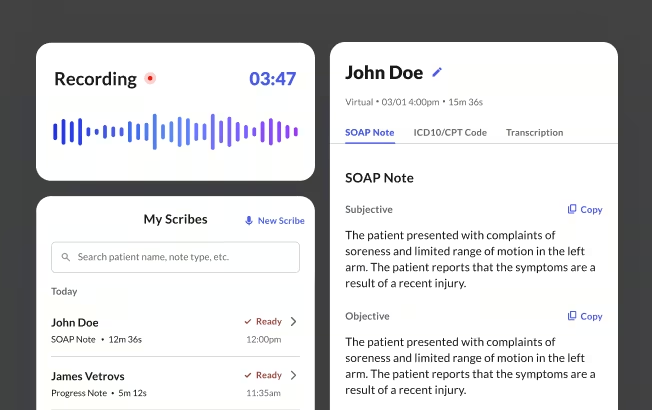
Freed AI is usually worth it for solo clinicians and small practices with routine outpatient visits. Buyers should also be able to work with copy-paste. Plans run from $39 a month with a 40-note cap to $119 a month for Premier. Premier adds one-click EHR push through a Chrome extension and suggested diagnosis coding. Group practices may find its limits costly. Templates are set per clinician, suggested procedure coding is in beta, and shared templates need the custom-priced Groups plan.
What You Need to Know About Freed Ai
- Freed AI is an ambient scribe for outpatient clinicians who want fast, accurate notes.
- It transcribes in 90-plus languages, adapts to each clinician's documentation style over time, and offers HIPAA-compliant audio handling on every plan.
- Limitations surface at the practice level: template setup is per clinician rather than shared across a team, EHR push runs through a browser extension rather than a native application programming interface (API), and suggested coding is still in beta.
- Practices should weigh those constraints against their specific workflow before committing.
Documentation burden has grown for clinicians in recent years. A 2016 study in Annals of Internal Medicine found physicians spent 49.2 percent of their time on EHR and desk work, against just 27 percent on direct patient care. By 2024, 27 percent of practices had lost a physician to burnout, per MGMA Stat data. Ambient AI scribes emerged as a direct response: they listen to the clinical encounter, generate a structured note, and hand the clinician a draft ready to review.
Freed AI is one of the most-discussed options among solo clinicians and small practices. This review covers what it does, what it costs, where it performs well, and where it falls short. See the complete guide to AI medical scribes for a full evaluation framework.
What Is Freed AI?
Freed AI is an ambient AI scribe built for independent and small group practices. It focuses on speed and ease of use: no IT setup is required, it works on any device, and clinicians report being up and running within minutes.
Key facts:
- HIPAA compliant, System and Organization Controls 2 (SOC 2) Type II certified, HITECH compliant. BAA available.
- Supports in-person and telehealth visits.
- 90-plus languages with automatic detection. Final note in English.
- Clinician reviews and signs off on every note before it enters the record.
- Copy-paste on all plans via website, app, or Chrome extension. One-click EHR push to browser-based EHRs on Premier only. Confirmed EHRs: Athenahealth, Practice Fusion, SimplePractice, Elation, Tebra.
- Suggested ICD-10 coding on Premier. Suggested CPT in beta. Not included on Starter or Core.
- Patient instructions, referral letters, and visit summaries on Premier.
- Pricing: Starter $39/month (40-note cap), Core $79/month (unlimited notes), Premier $119/month or $104/month annually, Groups: custom.
Freed's Groups plan is newer and still growing. Admin dashboards, SSO, and a dedicated account manager are available, but pricing requires contacting Freed directly. For a practice starting out, Premier is the most complete plan with a published price.
Note Quality
Freed produces high-accuracy notes that clinicians report reviewing quickly. Performance is strong on routine visits, though complex encounters tend to require more editing. Independent peer-reviewed accuracy data specific to Freed is not currently published.
Freed generates notes in SOAP format by default, with configurable section headers and ordering. The platform learns from edits: when a clinician rewrites a section consistently, the Learned Templates feature updates future notes to match, reducing the editing burden over time.
Clinicians on Core and Premier can build custom templates from scratch, adding boilerplate text, reordering sections, and defining specialty-specific fields. Each template is configured per clinician, and there is no mechanism to push a shared template across multiple accounts on Core or Premier. A team template library for shared deployment is available on the Groups plan only.
EHR Integration
Copy-paste notes are available on all Freed plans via the website, app, or Chrome extension. On Premier, one-click EHR push moves the finished note directly into chart fields in any browser-based EHR. Confirmed compatible EHRs: Athenahealth, Practice Fusion, SimplePractice, Elation, and Tebra.
This approach does not use a native API: it requires the EHR to be open in Chrome with the Freed extension installed. Compatibility with eClinicalWorks is unconfirmed as of early 2026, so verify your EHR directly with Freed before purchasing. One-click push remains in beta as of early 2026.
For a practice, the key question is whether your EHR runs in a browser. If yes, Freed's push covers the manual transfer step on Premier. If your EHR needs a native API or runs outside Chrome, confirm support with Freed before committing.
Coding Automation
Suggested ICD-10 coding is available on Premier ($119/month or $104/month annually). Suggested CPT coding is in beta as of early 2026. Confirm current status before factoring it into your evaluation. Starter and Core plans do not include coding.
Coding output is meant for clinician review before billing use. Freed does not present these as final billing codes without clinician sign-off.
Multilingual Support
Freed supports 90-plus languages with automatic detection and no manual selection required. The final Subjective, Objective, Assessment, Plan (SOAP) note is always in English, regardless of the language spoken during the visit, and mid-conversation language switching is supported by design. Test your specific language during the 7-day free trial.
Pricing
Freed AI offers four plans. Starter is $39 per month with a cap of 40 notes. Core is $79 per month with unlimited notes, a template builder, and an AI assistant. Premier is $119 per month or $104 per month billed annually. It adds one-click EHR push, suggested ICD-10 coding, suggested CPT in beta, patient instruction letters, visit summaries, and referral letters. Groups pricing is custom and requires contacting Freed. Across the market, self-serve AI medical scribe pricing starts at $39 to $89 per month, and enterprise platforms run $400 to $700 or more.
A 7-day free trial is available with no credit card required. Confirm current figures at getfreed.ai before budgeting.
HIPAA and Compliance
Freed is HIPAA compliant, SOC 2 Type II certified, and HITECH compliant. Audio is not stored after note generation, and a Business Associate Agreement is available. Patient consent for AI-assisted recording is a legal requirement. Consult your legal or compliance team for the right disclosure language.
Freed offers live support through a Clinician Success team on all plans. Specific support channels and hours are not detailed on the public pricing page, so practices that need phone-accessible support or a defined SLA should verify current options directly with Freed before purchasing.
What the Research Says About AI Scribes
Documentation burden as a driver of burnout is well-established. A long-term study of 141 primary care physicians at UW Health tracked EHR workload from 2019 to 2023. Total EHR time per eight-hour clinic day rose 28.4 minutes, and order time rose 58.9 percent.² The 2016 Sinsky study observed 57 physicians across four specialties and found they spent nearly two hours on EHR and desk work for every hour of face time with patients.⁴ American Medical Association (AMA) data shows 20.9 percent of physicians now log more than eight hours per week on EHR outside normal work hours.⁵
Several studies have reported burnout reductions after AI scribe adoption, though effects vary by tool and setting. One study across six U.S. health systems found burnout fell from 51.9 percent to 38.8 percent after 30 days of AI scribe use.⁶ The Permanente Medical Group deployed AI scribes across 7,260 physicians and 2.5 million encounters. An estimated 15,700 hours of documentation time were saved, with 84 percent of physicians reporting positive outcomes.⁷
The first randomized controlled trial of AI scribes, published in NEJM AI in 2025, enrolled 238 outpatient physicians across 14 specialties at UCLA Health. One tool (Nabla) showed a modest but meaningful reduction in documentation time, while the other (DAX) showed no meaningful reduction. Both tools improved burnout and task load scores compared with control,¹ and the trial found occasional inaccuracies in both, reinforcing the need for clinician review before note sign-off.
Patient acceptance is generally high. A UC Davis survey found 48 percent of patients viewed AI scribes favorably, and documentation accuracy was the top concern, cited by 39 percent.⁸
Where Freed Falls Short
Templates are per clinician, not shared across a practice. Each provider builds and adjusts their own templates. Practices that need a standard format deployed across a team cannot do so on Core or Premier without manual duplication per provider, and the constraint grows as practice size increases. A team template library is available on the Groups plan only, requiring an upgrade beyond the published individual pricing tiers.
EHR push depends on a browser extension, not a native API. One-click delivery works only in Chrome, only with browser-based EHRs, and only through DOM interaction rather than a direct connection. Practices using desktop EHR clients or systems not on the confirmed list must copy-paste on all plans. The feature also remains in beta as of early 2026.
Suggested coding is limited by plan and development stage. Suggested ICD-10 codes require the Premier plan, and suggested CPT codes are in beta on Premier. Neither is available on Starter or Core. Practices that need coding support at a lower price point, or outside of beta, are not served by the current setup.
Support channel details are not published. Freed advertises live support through a Clinician Success team on all plans. However, specific support channels and hours are not detailed on the public pricing page. Practices that need phone-accessible support or a defined SLA should verify what is currently available before purchasing.
Commure Scribe: An Alternative Worth Evaluating
Commure Scribe is an ambient AI scribe built for practices from small groups to large health systems. The platform serves 75,000-plus clinicians across 25 specialties, including Family Medicine, Internal Medicine, Psychiatry, Pediatrics, Behavioral Health, and Dentistry.
Commure Scribe offers a 7-day free trial with no credit card required. Solo and small practice pricing starts at $89 per month or $59 per month billed annually ($708 per year). Larger practices use custom pricing. (View the most up-to-date pricing here)
Key facts:
- 99.4% transcription accuracy.
- 43 seconds average chart close time (clinician-reported).
- 90 percent of clinicians reported less time on documentation and reduced fatigue.
- 90-plus languages, automatic detection, no manual selection required.
- Suggested ICD-10 and CPT codes on paid plans. Not gated to a top plan or in beta.
- AI Copilot: patient emails, work excuse letters, prior authorization requests.
- Copy-paste on all plans. One-click EHR sync on the largest-practice plan.
- 60-plus EHR integrations: AdvancedMD, eClinicalWorks, Athenahealth, Elation, SimplePractice, WebPT, Practice Fusion, Tebra, Cerbo, Kipu.
- Live customer support on every plan.
- HIPAA compliant, SOC 2 certified, onshore data storage, no third-party data sharing.
EHR integration uses native connections, not a browser extension. Commure Scribe connects to 60-plus EHR systems via bidirectional API or DOM-based connection, depending on the system. Major platforms use FHIR and HL7 native API connections. Bidirectional integration pulls patient context before the visit, including demographics, problem list, medications, and prior notes. After the encounter, the finished note goes into the correct chart sections. One-click EHR sync is available on the largest-practice plan.
Suggested coding is included on paid plans and not in beta. Suggested ICD-10 and CPT codes appear at the point of note generation, within seconds of ending the recording. They are available for clinician review before billing use. The feature is not gated to a top-tier plan.
Shared templates are available to practices that need them. Higher-plan practices can deploy a standard template across all clinicians from one central setup. This directly addresses the per-clinician-only limit present on Freed's Core plan.
Verdict: Which Fits Your Practice?
No tool is right for every practice, and the decision depends on your EHR, your coding workflow, team size, and primary need.
For solo clinicians and small practices handling routine outpatient visits, Freed AI delivers fast, accurate notes at a competitive price, with a well-regarded mobile experience and minimal setup.
For practices that need shared templates, bidirectional EHR integration without a browser extension, or suggested coding outside of beta, Commure Scribe addresses each gap directly and is a solid alternative to Freed. It is validated at health-system scale.
Choose Freed AI if:
- Your practice does not need shared templates or one-click EHR push, and copy-paste works for your team.
- Your coding is handled separately and suggested code generation is not a priority.
- You want to start at Core and upgrade to Premier only if you need EHR push and coding.
- Confirm current features and group pricing at getfreed.ai before deciding.
Choose Commure Scribe if:
- You run a multi-provider practice where shared templates and coding consistency matter at an operational level.
- Your patient panel includes significant multilingual volume and manual language selection is not viable.
- You need suggested ICD-10 and CPT code generation built into the documentation workflow, not as a separate billing step.
- You need AI Copilot features: patient emails, work excuse letters, and prior auth requests generated from the encounter.
- You want onshore data storage and live phone support alongside HIPAA compliance for your BAA and procurement review.
- Your evaluation focus is note quality at scale across a team, not just individual time savings.
How to Run a Fair Trial
A 7-day structured trial is often enough for an initial evaluation. The steps below use your own patient visits: the only context that matters.
- Select two to three clinicians across different specialties or visit types to trial each tool.
- Record five consecutive patient visits with each tool. Do not select easy cases only.
- After each visit, score note quality on: accuracy, plan detail, suggested coding, time to review.
- Attempt EHR transfer with your primary EHR through copy-paste or one-click integration.
- Have a non-trialing clinician or practice manager review three notes per tool for completeness.
- Compare total post-visit editing time per note across both tools.
- Decide: which tool lets you leave the building with charts closed?
Both Freed AI and Commure Scribe offer a 7-day free trial with no credit card required. To evaluate Freed, sign up and use it across a mix of routine and complex visits. To evaluate Commure Scribe, start a trial and request a workflow review to check EHR options for your system before the trial begins.
For a broader comparison of available tools, see our guide to the best AI medical scribes.
Frequently Asked Questions
Most AI scribes in this category offer a time-limited trial rather than ongoing free access. Freed AI offers a 7-day free trial. Confirm current trial terms. Commure Scribe offers a 7-day free trial requiring no credit card. Paid access continues through Scribe Pro after the trial expires.
Freed is built for simple per-visit documentation. Commure Scribe adds automated ICD-10/CPT coding, 90+ languages with automatic detection, and US-based live phone support. For group practices where coding and EHR workflow consistency matter, those differences are material.
The scribe listens to the encounter, transcribes the conversation, and generates a structured note. The clinician reviews and finalizes before it enters the record. Commure Scribe uses a Capture, Edit, and Finalize workflow, with ICD-10 and CPT codes populated on paid tiers at the point of note generation.
AI scribe pricing varies depending on whether coding automation, EHR integration, and multilingual support are included in the base plan or require a higher tier. Freed AI's pricing tiers start at $39/mo with a cap of 40 visits/month. Confirm current figures before budgeting. Commure Scribe offers a 7-day free trial. No credit card required.
Support models vary significantly between vendors and are not always published on pricing pages. Ask whether contact goes through a ticket queue, a chatbot, or a direct phone line. Commure Scribe offers US-based live phone support. Verify any vendor's support model before signing a contract.
Sources
- Lukac et al. First randomized controlled trial of ambient AI scribes. NEJM AI, 2025. https://pmc.ncbi.nlm.nih.gov/articles/PMC12768499/
- Arndt et al. Longitudinal EHR workload study in primary care, 2019–2023. Annals of Family Medicine, 2024. https://pmc.ncbi.nlm.nih.gov/articles/PMC11233089/
- MGMA Stat Poll. Physician burnout turnover data. 2024. https://www.mgma.com/mgma-stat/physician-burnout-still-major-factor-even-as-unexpected-turnover-eases
- Sinsky et al. Allocation of physician time in ambulatory practice. Annals of Internal Medicine, 2016. https://www.acpjournals.org/doi/10.7326/M16-0961
- AMA. Burnout down, pajama time stands still. 2024. https://www.ama-assn.org/practice-management/physician-health/burnout-way-down-pajama-time-stands-still
- Olson et al. Multicenter burnout and AI scribe QI study. JAMA Network Open, 2025. https://pmc.ncbi.nlm.nih.gov/articles/PMC12492056/
- The Permanente Medical Group / AMA. AI scribes at Kaiser: 15,700 hours saved. NEJM Catalyst, 2025. https://catalyst.nejm.org/doi/full/10.1056/CAT.25.0040
- UC Davis Health. Patient attitudes toward AI scribes. JMIR Medical Informatics, 2025. https://medinform.jmir.org/2025/1/e77901
- u/NFPAExaminer. (2025, June). I tried all the AI medical scribes so you don’t have to – my honest review [Online forum post]. Reddit. https://www.reddit.com/r/FamilyMedicine/comments/1lokist/i_tried_all_the_ai_medical_scribes_so_you_dont/
.jpeg)
.jpeg)
.jpeg)


.jpeg)
.jpeg)
.jpeg)