



Best AI Scribe for Family Medicine (2026): 7 Tools Compared
A practice-size-weighted comparison of seven AI scribes for family medicine, from free solo tools to enterprise platforms, scored on the visits that actually fill a family physician's day.
Written by the Commure Scribe Team
Published: April 3, 2026
•
22 min read
The seven AI scribes compared for family medicine are Commure Scribe, Freed, Heidi Health, Nabla, DAX Copilot, Suki and Abridge. Commure Scribe ranks first and drafts a separate assessment and plan for each problem. Each of its pricing plans includes International Classification of Diseases (ICD-10) and Current Procedural Terminology (CPT) code suggestions. Freed and Heidi Health suit solo physicians who want low-cost or free self-serve access. Nabla has randomized trial evidence of a 9.5% cut in time-in-note. DAX Copilot, Suki and Abridge fit Epic-centered health systems.
What You Need to Know About the Best AI Scribe for Family Medicine
- The best AI scribe for family medicine turns multi-problem visits into structured, codable notes a clinician reviews and signs.
- In the first randomized trial, one ambient scribe cut physician time-in-note by 9.5%⁴.
- Compare seven tools below on pricing, trial access, coding, EHR fit, and quality-metrics support.
How Do the Top 9 Family Medicine AI Scribes Compare?
The table below compares the seven tools on the criteria that decide which is the best AI scribe for family medicine in your setting. Enterprise vendors rarely publish pricing. Where a figure comes from third-party reporting rather than the vendor, it is marked as an estimate. Treat estimates as planning numbers and confirm current pricing with each vendor.
Three patterns shape the search for the best AI scribe for family medicine. Trial access splits the market. An AI scribe for family medicine practices at solo scale lets you test before buying, while enterprise vendors need a sales cycle. Second, few vendors publish pricing. Third, coding support varies widely, from none to full hierarchical condition category (HCC) and E/M output. The tier that includes coding matters as much as the feature itself.
What Are the Best AI Scribes for Family Medicine in 2026?
1. Commure Scribe
Family medicine visits rarely stay simple. A hypertension follow-up picks up a refill request, a mood check, and a knee complaint before it ends. Commure Scribe captures the full conversation and drafts a structured note with each problem in its own assessment and plan block. Suggested ICD-10 and CPT codes are included with every plan, which matters in family medicine where multi-problem visits require coding each condition separately. Transcription accuracy is published at 99%+. Sessions run up to 2 hours, covering complex chronic care visits and annual physicals. It supports 90 languages with automatic detection, useful for practices with multilingual panels.
It offers 60+ EHR integrations, including Epic, athenahealth, and eClinicalWorks. One-click EHR sync is a group-plan feature; solo and small practices push notes by copy-paste. Group pricing is custom and requires a sales conversation.
- Suggested ICD-10 and CPT coding included with every plan.
- 60+ EHR integrations including Epic, athenahealth, and eClinicalWorks.
- 7-day trial with no credit card.
2. Freed
Freed is built for solo and independent family physicians⁶. Its $39/mo Starter tier caps output at 40 notes per month. A solo physician seeing 20 patients a day can reach that cap in two weeks. The $79 Core tier removes the cap.
ICD-10 and CPT coding and EHR push are on the $119/mo Premier tier only. EHR integration runs through a Premier-tier Chrome extension with no named application programming interface (API) integrations. The vendor states the product is not built for large health systems. Audio is deleted automatically after note generation, typically within 60 seconds¹⁹.
- $39/mo Starter tier; 7-day trial with no credit card.
- Adaptive templates that learn from clinician edits across visit types.
- Audio deleted automatically after note generation.
3. Heidi Health
Family medicine practices that want to evaluate an AI scribe without committing budget or starting a sales cycle start with Heidi Health⁷. The free plan includes unlimited AI notes. Paid tiers add EHR integration. ICD-10 and CPT coding is available on the Enterprise tier only.
It lists 20 named EHR integrations including Epic via SMART on FHIR and athenahealth, with Embed and Connect modes. Clinical citations link to note content, useful for documenting guideline-based preventive care where a counseling conversation needs to land as a discrete, codable entry. Audio is never stored. It is transcribed in real time and immediately discarded²⁰. It supports 110 languages.
- Free tier with unlimited AI notes.
- Audio transcribed in real time and immediately discarded.
- 20 named EHR integrations including Epic and athenahealth.
4. Nabla
Nabla was one of two tools in the first randomized controlled trial of ambient AI scribes, published in NEJM AI in 2025⁴. The trial enrolled physicians in a primary care setting. Nabla users showed a 9.5% reduction in physician time-in-note compared to the control group. Its Nabla Connect module embeds in the EHR, pulls patient history, and pushes notes back.
Bidirectional sync covers 14+ EHRs including Epic, athenahealth, Altera, and Greenway. Audio is processed in chunks and discarded. Notes default to a 14-day configurable retention window. It holds System and Organization Controls 2 (SOC 2) Type II and ISO 27001 certifications. ICD-10 and CPT coding are not yet available; the vendor says they are in development. Paid pricing is not published.
- Bidirectional EHR sync with 14+ systems including Epic, athenahealth, Altera, and Greenway.
- Positive RCT evidence: 9.5% reduction in physician time-in-note in the first randomized trial⁴.
- Free tier with volume limits.
5. DAX Copilot
DAX Copilot fits large health systems where family medicine is embedded in an Epic-first infrastructure¹⁰. It is sold through Nuance, now part of Microsoft, and is a separate product from the dictation-first Dragon Medical One. It embeds natively in Epic and captures visits in English. Spanish is available via a manual pre-visit toggle, which adds friction in multilingual family medicine panels. Other languages are not confirmed by the vendor.
It holds HITRUST CSF certification through the Nuance cloud. In the first randomized trial, DAX showed no statistically significant change in physician time-in-note⁴. There is no self-serve trial. Evaluation requires an enterprise sales cycle. Pricing is not published.
- Epic-native embed with Microsoft Azure infrastructure.
- HITRUST CSF certification through the Nuance cloud.
- Named health system customers include large primary care networks.
6. Suki
Suki AI supports ICD-10, CPT, HCC, and E/M coding¹¹. HCC coverage is relevant for family medicine groups with Medicare Advantage panels. Clinicians can pull patient data, stage orders, and ask clinical questions by voice. Each note sentence links back to its source in the EHR or transcript.
Bidirectional integrations cover Epic, Oracle Health, athenahealth, and MEDITECH. Audio and transcripts are permanently deleted after 30 days²¹. Sold through enterprise sales only with no self-serve option.
- HCC and E/M coding for Medicare Advantage panels.
- Voice commands stage orders and pull patient data.
- Bidirectional integrations with Epic, Oracle Health, athenahealth, and MEDITECH.
7. Abridge
Abridge is deployed across 150+ health systems including Mayo Clinic and Sutter Health¹². Each note sentence links back to its source in the transcript.
It is Epic-first. Smaller family medicine groups access it mainly through an athenahealth partnership. Pricing is not published. There is no self-serve trial.
- Each note sentence traces back to source audio.
- Named customers include Mayo Clinic and Sutter Health.
- Athenahealth partnership extends access to smaller groups.
A note on voice dictation: If your workflow is dictation rather than ambient capture, speaking every sentence of the note out loud, Dragon Medical One is a leading option. It is not an AI scribe and does not belong on this list, but it is covered in the best medical dictation software guide.
Why Does Family Medicine Need a Different AI Scribe Standard?
The best AI scribe for family medicine has to clear a higher bar than scribes in most specialties. A typical visit covers several problems at once. A diabetes check becomes a knee exam, a refill request, and a depression screen. The note has to keep each problem distinct, with its own assessment and plan.
Preventive care raises the bar further. Screenings, immunizations, and counseling need to land in the chart in a form that billing and quality reporting can use. A scribe that buries them in a narrative paragraph creates rework. Practices with a large pediatric panel can compare the best AI scribes for pediatrics on well-child templates, multi-speaker capture and immunization fields.
Volume compounds the problem. Physicians spend as much as two hours on EHR work for every hour of direct patient care¹. In 2023, 20.9% of physicians still spent more than eight hours per week in the EHR outside normal work hours². An AI scribe for family medicine that trims a few seconds per note matters little. One that structures messy, multi-problem visits changes the week.
The search for the best AI scribe for family medicine runs through six checkpoints below. They cover a practice-size-weighted methodology, a side-by-side comparison, seven tool profiles, clinician sentiment, quality-reporting fit, and a trial playbook.
How Were These AI Scribes for Family Medicine Evaluated?
Each AI scribe for family medicine was scored on specialty fit, weighted by practice size. A solo physician and a 30-provider group need different things from the same product. The criteria carry different weight at each tier. The best AI scribe for family medicine at one tier can be a poor fit at another.
Five criteria drove the rankings:
- Multi-problem visit structuring. Can the scribe split four problems into four assessment-and-plan blocks? Or does it blend them into one narrative? This is the core family medicine test.
- Preventive-care capture. Screenings, immunizations, and counseling should appear as discrete, codable entries. Buried prose creates rework.
- MIPS and HEDIS quality-metrics support. Quality reporting under the Centers for Medicare & Medicaid Services (CMS) Quality Payment Program depends on structured chart data³. A scribe earns credit when its output feeds those measures cleanly.
- Practice-size fit. Solo and small groups need a self-serve trial and published pricing. Larger groups need admin controls and deeper EHR sync.
- EHR fit and total cost. Coding support and integration method sit here. So does real monthly cost, including setup fees where vendors charge them.
Weighting worked in one direction. For solo and small practices, trial access and published pricing counted double, because a tool you cannot test is hard to shortlist fairly. For medium groups, EHR sync depth and admin controls counted double instead. Quality-metrics support carried equal weight at both tiers, since Merit-based Incentive Payment System (MIPS) applies regardless of practice size.
The evidence base tempers vendor claims for any AI scribe for family medicine. The first randomized trial of ambient scribes tested Nabla and DAX Copilot⁴. Nabla users showed a 9.5% reduction in physician time-in-note. DAX Copilot showed no statistically significant change. A five-site cohort of 8,581 clinicians found 16 fewer minutes of charting per eight patient hours. Gains were largest in primary care⁵. Time savings are real but uneven. Trial performance in your own clinic outweighs any ranking, including this one.
Can AI Scribes Help With MIPS and HEDIS Reporting?
AI scribes help with quality reporting indirectly, by capturing more complete visit detail. They do not file MIPS or Healthcare Effectiveness Data and Information Set (HEDIS) data for you. The gap between those two facts decides whether an AI scribe for family medicine earns its quality-metrics keep.
Start with what the programs need. MIPS quality measures under the CMS Quality Payment Program score performance from structured chart data, claims, and registry submissions³. HEDIS measures pull from claims and chart records in defined fields. A counseling conversation that lives in a narrative paragraph may never reach either one.
Here is what a scribe contributes:
- Capture. Ambient tools record preventive counseling and screening talks. Rushed manual notes often drop these.
- Structure. Some tools give each problem its own assessment block. Measure-relevant detail gets easier to find and code.
- Coding signals. Suggested ICD-10 and CPT codes connect care to claims. Claims feed quality measures.
Here is what a scribe does not do. It does not map note text to specific measure numerators. It does not push data into a qualified registry. Your EHR, registry, or quality team still owns that step.
Two practical caveats follow. CMS updates measure sets each performance year, so confirm the current year's measures at the Quality Payment Program site³. HEDIS chart review also rewards discrete fields, not prose.
If your EHR pulls tobacco status from a structured field, a scribe's narrative mention will not satisfy the measure until someone codes it. Decide during the trial who closes that loop. It is either the clinician at signing or a quality abstractor later.
One caution belongs in any quality discussion. A peer-reviewed policy brief warns that ambient AI can drive a coding "arms race," lifting coding intensity without lifting care¹⁷. Richer notes should reflect care delivered, not inflate it. Pair any scribe rollout with normal coding compliance review.
How Should Your Practice Run an AI Scribe Trial?
The best AI scribe for family medicine reveals itself in a trial run like a study, not a demo. Pick your messiest clinic days, define pass criteria up front, and score every note. Usage discipline matters: in a five-site cohort, gains were largest for clinicians who used the scribe in at least half of visits⁵. In the first randomized trial, about 15% of physicians never used their assigned tool at all⁴.
Solo physicians. Shortlist two self-serve options from the AI scribes for family medicine above. Run them on alternating days for one week. Score three things on each note:
- Multi-problem separation. Did a three-problem visit produce three distinct assessment-and-plan blocks?
- Preventive capture. Did screenings and counseling appear as discrete, codable lines?
- Edit time. How many minutes did each note need before signing?
Before any recording starts, handle two basics. Sign the vendor's business associate agreement (BAA), even for a free tier, because trial audio is still PHI. Set a patient consent script that fits your state's recording-consent law.
Small groups (2–10 providers). Pick two or three physicians with different visit styles as pilot users. Include your fastest charter and your most thorough one. Add two checks beyond the solo list. First, can notes reach your EHR without retyping? Second, does the vendor sign a BAA covering the whole group?
Medium and large groups. Run a structured 30-day pilot. Name an owner and set a baseline. Pull pre-trial chart-closure and after-hours EHR time from your EHR's analytics before day one. One large deployment found frequent users saved 2.5 times more time per note than occasional users¹⁸. Track use weekly and treat low usage as a fit signal, not a training failure. End with a go/no-go scored against the baseline, including denial and coding-query rates.
How Commure Scribe Approaches Family Medicine Documentation
Commure Scribe is an AI medical scribe built to hold the multi-problem family medicine visit. The workflow is Capture, Edit, Finalize, and the clinician always has the option to review before finalizing. 90%+ of providers report reduced clinical documentation time and digital fatigue. For a ranked breakdown across specialties and practice sizes, see the best AI medical scribes guide.
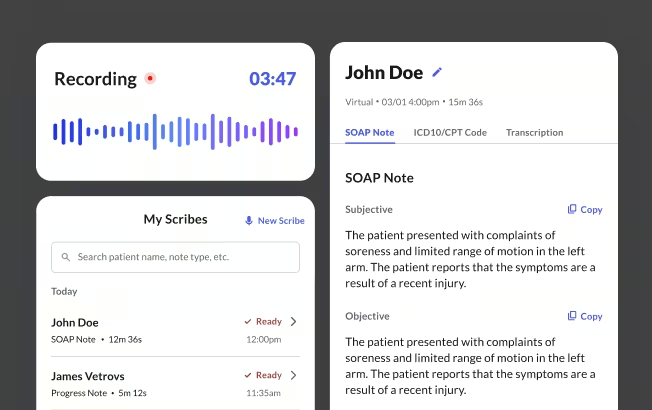
Right after End Recording, a structured SOAP note appears within seconds, with suggested ICD-10 and CPT codes generated. The note captures the second and third problems a family medicine visit piles on, and clinicians say the AI caught things they would have missed.
Pricing stays transparent. Solo and small practices (1–5 providers) get a 7-day unlimited trial with no credit card, then $89/mo, or $59/mo billed annually (visit the pricing page for the most up-to-date cost)-. Medium and large group practices get custom pricing with one-click EHR sync and live onboarding. The tool is EHR-agnostic, with 60+ EHR integrations, so a practice need not switch systems to adopt it.
A practice weighing the tools above can try Commure Scribe for family medicine inside the trial and score it the same way.
This article is for informational and educational purposes only, does not constitute legal, medical, or professional advice, and does not guarantee any documentation, billing, or quality-reporting outcome.
Frequently Asked Questions
Most ambient AI scribes for family medicine can separate problems, but quality varies. The best AI scribe for family medicine produces a distinct assessment and plan for each problem raised in the visit. Test this directly in a trial. Bring a three-problem visit and check whether the draft keeps each problem's plan separate and codable.
Indirectly. An AI scribe for family medicine captures preventive counseling and screening detail that feeds MIPS quality measures under the CMS Quality Payment Program³. It does not map notes to measure numerators or submit registry data. Your EHR or registry still handles submission. The scribe's job is making the source chart complete.
The best AI scribe for family medicine solo practice is the one you can test without a sales call. Commure Scribe, Freed, Heidi Health, and Nabla all offer self-serve access. Run two head-to-head on real clinic days. Pick the family medicine AI scribe that needs the fewest edits on your messiest multi-problem visits.
An AI scribe for family medicine runs from $0 (Heidi's free tier) to $119/mo (Freed Premier) at published self-serve pricing. Commure Scribe is $89/mo, or $59/mo billed annually. Enterprise tools rarely publish pricing. Third-party estimates place Abridge near $208/mo and DAX Copilot near $369/mo plus setup. Confirm current pricing with each vendor.
Match each family medicine AI scribe to your EHR before trialing. Epic shops can choose Abridge, Suki, Nabla, or Heidi. Athenahealth users have wide support across vendors. Commure Scribe lists 60+ EHR integrations. Solo tiers on several tools, including Commure Scribe and Freed, rely on copy/paste rather than API sync.
Sources
- UCLA Health, "UCLA study finds AI scribes may reduce documentation time," 2025. https://www.uclahealth.org/news/release/ucla-study-finds-ai-scribes-may-reduce-documentation-time
- American Medical Association, "Burnout on the way down, but 'pajama time' stands still," 2024. https://www.ama-assn.org/practice-management/physician-health/burnout-way-down-pajama-time-stands-still
- Centers for Medicare & Medicaid Services, Quality Payment Program. https://qpp.cms.gov
- Lukac et al., "Ambient AI Scribes in Clinical Practice: A Randomized Trial," NEJM AI, 2025. https://pmc.ncbi.nlm.nih.gov/articles/PMC12768499/
- Rotenstein, Holmgren, Thombley, et al., "Changes in Clinician Time Expenditure and Visit Quantity With Adoption of Artificial Intelligence–Powered Scribes: A Multisite Study," JAMA, 2026. https://jamanetwork.com/journals/jama/article-abstract/2847319
- Freed, pricing page, 2026. https://www.getfreed.ai/pricing
- Heidi Health, pricing page, 2026. https://www.heidihealth.com/en-us/pricing
- Nabla, EHR integrations page, 2026. https://www.nabla.com/ehr
- Nuance (Microsoft), DAX Copilot, 2026. https://www.nuance.com/healthcare/dragon-ai-clinical-solutions/dax-copilot.html
- Suki AI, Suki Assistant, 2026. https://www.suki.ai
- Abridge, 2026. https://www.abridge.com
- The Permanente Medical Group, "Analysis: AI scribes save physicians time, improve patient interactions and work satisfaction," 2025. https://permanente.org/analysis-ai-scribes-save-physicians-time-improve-patient-interactions-and-work-satisfaction/
- Topaz et al., "Beyond human ears: navigating the uncharted risks of AI scribes in clinical practice," npj Digital Medicine, 2025. https://www.nature.com/articles/s41746-025-01895-6
- npj Digital Medicine, "Policy brief: ambient AI scribes and the coding arms race," 2025. https://www.nature.com/articles/s41746-025-02272-z
- American Medical Association, "AI scribes save 15,000 hours—and restore the human side of medicine," 2025. https://www.ama-assn.org/practice-management/digital-health/ai-scribes-save-15000-hours-and-restore-human-side-medicine
- Freed, "How Freed Protects Patient Data and Ensures Compliance," 2026. https://www.getfreed.ai/blog/how-freed-handles-data-privacy-compliance
- Heidi Health, "Data & Security at Heidi Health," 2026. https://www.heidihealth.com/support/en/articles/8885107-data-security-at-heidi-health
- Suki AI, Security & Compliance FAQ, 2026. https://developer.suki.ai/documentation/faqs/security
- Abridge, Privacy Policy, 2026. https://www.abridge.com/privacy
.jpeg)
.jpeg)
.jpeg)


.jpeg)
.jpeg)
.jpeg)