


Urgent Care Doctor's Note: A Clinician's Guide to Faster, Defensible Work Notes
Six required elements, diagnosis-specific wording examples, and a repeatable workflow for writing defensible urgent care work notes in under 60 seconds.

Medically Reviewed by Dr. Jean-Luc "JL" Neptune, Clinical Commercial Leader
Written by the Commure Scribe Team
Published: May 8, 2026
•
8 min read
Updated May 8, 2026
What You Need to Know About Urgent Care Doctor's Notes
- An urgent care doctor's note for work or school must include six elements: provider identity, patient identity with date of birth, visit date, reason for visit, impact on work capacity, and a specific return date.
- Missing any one element creates employer callbacks, HR rejections, or medico-legal exposure.
- Standardizing note language by diagnosis type and asking about work-note needs at intake reduces documentation time per encounter.
- Recording the clinical encounter and generating a structured note from it lets the work excuse letter be drafted from the same encounter content the clinician already reviewed and finalized.
What Is an Urgent Care Doctor's Note and What Are Clinicians Actually Responsible For?
An urgent care doctor's note is official medical documentation confirming that a patient was seen, the reason for the visit, and any impact on their ability to work or attend school. For frontline clinicians in independent US outpatient urgent care practices, it is a document that can be audited or disputed by employers. It can also appear in legal proceedings.¹
Work notes feel like a two-minute add-on to a visit. When you are managing a full schedule without dedicated support staff, the cumulative drag adds up. Every incomplete doctor's note generates a callback, and each callback consumes time your clinic does not have.
This is a peer-level walkthrough for MD, DO, NP, and PA clinicians. The goal: faster, more defensible urgent care doctor's note workflows without adding steps to an already tight visit cadence.
What Should an Urgent Care Doctor's Note Include?
A work-ready urgent care doctor's note requires six elements to hold up with employers. Missing any one creates downstream friction: employer rejections, HR callbacks, or medico-legal exposure.²
- Provider identity and contact information. Full name, credentials, clinic name, clinic address, and a phone number or fax where employers can verify. Notes without contact information are often rejected by HR departments.
- Patient name and date of birth. Employers and schools need to confirm identity. Names alone do not meet verification standards.
- Date of visit. The date the patient was seen, not the date the note was generated if those differ.
- Diagnosis or reason for visit, appropriately worded. This is where clinicians most often under-document or over-disclose. See the section on diagnosis-specific wording below.
- Impact on work or school capacity. Specific dates of excused absence and any activity restrictions that affect the return (e.g., no lifting, no standing for extended periods, no patient contact).
- Return-to-work or return-to-school date. A specific date whenever clinically possible. "Patient may return when symptoms resolve" creates ambiguity that employers contest.
Unsigned notes or ones missing provider credentials are rejected as unverifiable by employers with formal HR systems. The signature and credentials are required, not optional.
What About Diagnosis Disclosure?
HIPAA does not require you to disclose the full diagnosis on an urgent care doctor's note. You can document "patient was seen for an acute medical condition" rather than specifying the diagnosis when the patient requests privacy. The same applies when the clinical context warrants discretion. Some employers need a diagnostic code or description to process leave. Discuss disclosure preferences with the patient before the note is finalized.²
The safest language in gray-zone situations is functional: "Patient was seen and evaluated. Due to the nature of the illness, patient is excused from work from [date] to [date] and may return without restriction on [date]."
Download: Free Urgent Care Work Note Template (PDF)
A ready-to-use urgent care doctor's note template is available as a free PDF download. It includes all six required fields in the correct structure, six diagnosis-specific wording examples for the most common urgent care presentations, and a signature block, formatted for print or EHR copy/paste.
The template covers provider and clinic identity, patient name and date of birth, visit date, reason for visit with disclosure guidance, excused absence dates, activity restrictions, return-to-work date, and provider signature. All six diagnosis wording examples from this guide are included on the same page.
What Situations Require an Urgent Care Doctor's Note?
Urgent care work notes cover a defined set of clinical situations. Not every visit generates a documentation obligation, but several common presentations consistently produce a note request from the patient, employer, or school.
The most common presentations that generate an urgent care doctor's note request include:
- Acute respiratory illness (influenza, COVID-19, strep, URI)
- Gastrointestinal illness (gastroenteritis, food poisoning)
- Musculoskeletal injuries (sprains, strains, minor fractures)
- Migraine or severe headache requiring evaluation
- Acute injury or laceration requiring treatment
- Fever of uncertain origin requiring evaluation and rest
- Medical appointments when the patient's PCP is unavailable
Urgent care is also a common option when a patient's primary care practice cannot provide same-day access. In this scenario, the urgent care clinician is the attending of record. Under federal FMLA regulations, nurse practitioners and physician assistants authorized to practice under state law are eligible health care providers for medical certification purposes.³ The doctor's note carries the same standing as documentation from a PCP.
Diagnosis-Specific Note Wording: Six Common Presentations
Standardizing note language across common diagnoses reduces variation, protects your clinic, and cuts employer callbacks.² Below are clinician-level phrasing examples for six frequent urgent care presentations that generate work-note requests.
Influenza and Acute Respiratory Illness
Recommended wording: "Patient presented with acute respiratory illness. Patient is excused from work [start date] through [end date] and should not return until fever-free for 24 hours without the use of fever-reducing medication. Patient may return to work without restriction on [return date]."
Why this works: It documents the clinical basis without specifying the pathogen when the patient prefers privacy. The fever-free language aligns with CDC guidance and gives the employer a clinical rationale, not just a date.
COVID-19
Recommended wording: "Patient was evaluated and diagnosed with COVID-19. Per current public health guidance, patient is advised to isolate from [date] through [date]. Patient may return to work on [return date] contingent upon resolution of symptoms."
Why this works: COVID-19 documentation has become standardized. Employers and schools have established policies, and clear diagnostic language reduces disputes. Verify isolation timelines against current CDC guidance before use.
Sprain or Strain
Recommended wording: "Patient was evaluated for [ankle/wrist/knee] injury. Diagnosis: [sprain/strain], [grade if documented]. Patient is excused from work [start date] through [end date]. Patient should avoid [activity restriction, e.g., prolonged standing, heavy lifting, repetitive use of affected extremity] during this period. Return to work on [date] with or without restrictions noted."
Why this works: Activity-specific restrictions are what employers and occupational health departments need. Vague language such as "patient should rest" does not satisfy HR requirements in physically demanding jobs.
Migraine
Recommended wording: "Patient was evaluated for severe migraine headache requiring medical attention. Patient is unable to work on [date] due to the nature of the condition. Patient may return to work on [date] without restriction."
Why this works: Migraine documentation is frequently contested by employers because the condition is not visible. Explicit language confirming that the condition needed medical attention and documenting a specific absence date reduces pushback.
Gastroenteritis
Recommended wording: "Patient presented with acute gastrointestinal illness. Due to the nature of the illness and infection control considerations, patient is excused from work [start date] through [end date] and should not handle food or work in direct patient care during this period. Patient may return to full duties on [return date]."
Why this works: Food handler and patient-facing workers need explicit infection control language. Generic excuses are rejected by employers in healthcare, food service, and childcare settings.
Minor Laceration or Injury
Recommended wording: "Patient was treated for a minor laceration/injury at this facility on [date]. Due to the nature of the injury, patient is advised to avoid [specific activity] from [start date] through [end date]. Patient may return to work with or without restriction on [date]."
Why this works: Physical injury notes need specific activity restrictions to be actionable. Without them, patients and employers call back for clarification.
How to Build an Urgent Care Doctor's Note Into Your Visit Flow in Under 60 Seconds
The bottleneck in urgent care is not the work note itself; it is the lack of a repeatable system. In clinics without dedicated scribe staff, doctor's notes are drafted from scratch in the EHR, dictated ad hoc, or handed off to front desk staff without a template.
Step 1: Confirm the need at intake
Ask during the chief complaint intake: "Will you need documentation for work or school today?" This takes four seconds and removes the scramble at checkout when the patient asks as they are leaving.
Step 2: Capture work note content inside your SOAP note
Tie work-note content to your assessment and plan. If your A/P section includes diagnosis, treatment plan, and activity restrictions, most of the note fields are already captured. You should not need to re-enter data you have already documented.
Step 3: Use a template or smart phrase
Nearly all EHRs used in urgent care support some form of templating or macros. Whether you use Epic's SmartPhrases, Athenahealth's text macros, or a copy-paste library, a pre-built template cuts drafting time to under 30 seconds. Fill in fields for date, diagnosis language, and return-to-work date before signing.
A basic smart phrase structure:
- [CLINIC NAME] Work/School Excuse Note
- Patient Name: [PATIENT NAME]
- DOB: [DOB]
- Date of Visit: [DATE]
- This patient was evaluated at our clinic on [DATE] for [REASON: adjust for privacy as needed]. Patient is excused from [work/school] from [START DATE] through [END DATE].
- Activity restrictions: [RESTRICTIONS / NONE]. Patient may return without restriction on [RETURN DATE].
- [PROVIDER NAME, CREDENTIALS] [CLINIC NAME] [PHONE]
Fill five fields, sign, and the urgent care doctor's note is complete.
Step 4: Sign before the patient leaves
Unsigned notes that go home with the patient create problems later. Sign the note before the patient checks out whenever your workflow allows. If your EHR needs a separate step, assign the task to a designated staff member to complete within the visit window.
How to Handle Common Urgent Care Doctor's Note Pressure Scenarios
Patients often arrive knowing exactly what they want the note to say. Employers send fax requests for notes that were never issued. Independent and small group practices do not have a compliance team to route these requests through, so the clinician handles them directly. Clear, consistent language in each scenario protects your clinic.²
"My employer requires a specific form." You can complete an employer's form, but you are not required to. Completing a proprietary form is a clinical and administrative decision, not a legal obligation. If the form asks you to certify something beyond what you can verify, document what you observed. Decline to sign any sections that exceed your clinical scope.
"Can you extend the note for a few more days?" You can update documentation to reflect your clinical judgment. Extending a work note beyond what the clinical picture supports creates liability. If the patient has not been re-evaluated, document that the extension was requested. Note that a follow-up visit would be needed to assess current functional status.
"I need a note backdated to [earlier date]." Do not backdate. Document the date the patient was seen. If the patient requests documentation for a period before the visit, note that the patient reported symptom onset on an earlier date. Do not document that the patient was evaluated on a date they were not seen at your clinic.
How Ambient Documentation Supports Urgent Care Doctor's Note Generation
Treating the work note as a separate task from the clinical note creates duplicate entry. When a clinician records the encounter, the plan section of the generated note often already contains the raw material for the note: diagnosis, visit date, treatment plan, and return-to-work guidance.
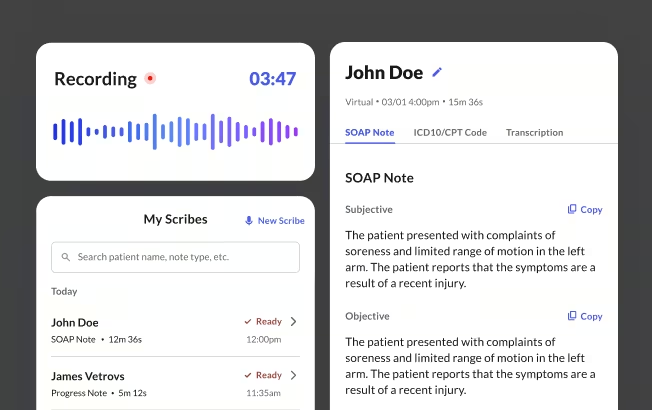
Ambient documentation tools record the clinical encounter and generate a structured note from it. The clinician reviews and edits the draft. The urgent care doctor's note work excuse letter can then be drafted from that same encounter content rather than rebuilt from scratch.
The clinician reviews, edits, and signs before anything goes to the patient. Ambient documentation accelerates the draft; clinical judgment is what finalizes it.
How Commure Scribe Handles Urgent Care Work Note Documentation
Commure Scribe is an AI medical scribe built for urgent care and 25 other specialties. For urgent care doctor's note generation, the value is accuracy: the note reflects what was actually said and documented in the room. Commure Scribe posts 99.4% transcription accuracy across 90 languages with automatic detection.
AI Copilot drafts documentation beyond the clinical note, including work excuse letters and other doctor’s notes, directly from the encounter content. The clinician edits a pre-drafted letter that already reflects the diagnosis, dates, and restrictions from the visit.
The first value moment: End Recording. The structured SOAP note appears in seconds. Suggested ICD-10 and CPT codes are generated in a separate tab. The clinician reviews, edits, and finalizes. An accurate, complete note means the work excuse letter built from it starts from the same verified encounter.
Urgent Care Doctor's Note Template Download
Download a copy of this template
Thanks! Your template is ready.
Click below to download

Frequently Asked Questions
Yes. Urgent care clinicians, including MD, DO, NP, and PA providers, are authorized to issue work excuse documentation. An urgent care doctor's note carries the same validity as documentation from a primary care provider. Employers are not required by federal law to accept it, but most employer and school attendance policies recognize urgent care documentation.³
A complete urgent care doctor's note includes provider name and credentials, clinic contact information, patient name and date of birth, and visit date. It also includes reason for visit or diagnosis, specific dates of excused absence, any activity restrictions, and a return date. Disclosure level should match what is clinically appropriate. Missing any element increases the likelihood of an employer callback or rejection.²
There is no federal law requiring employers to accept medical documentation. Most employer attendance policies accept an urgent care doctor's note, but some need documentation from specialists or PCPs for extended leave. FMLA-covered leave requires specific certifying forms from providers. Clinicians are not obligated to advise patients on their employer's internal policies.²
The excused absence period reflects the clinical picture, not a fixed rule. Many acute illnesses commonly need on the order of one to five days of absence, depending on severity and job type. Activity-limiting injuries may need longer. Document a specific return date whenever clinically possible. Vague language such as "patient may return when symptoms resolve" leads to employer disputes.
Sources
- Hayman, K., McLaren, J., Ahuja, D., Jimenez Vanegas, C., & Sheikh, H. (2021). Emergency physician attitudes towards illness verification (sick notes). Journal of Occupational Health, 63, e12195. https://doi.org/10.1002/1348-9585.12195
- Story, J., & Ash, E. (2021). Be careful what you write: Employment, disability, and healthcare law considerations for doctor's notes. Missouri Medicine, 118(4), 318–321. https://pmc.ncbi.nlm.nih.gov/articles/PMC8343629/
- U.S. Department of Labor, Wage and Hour Division. (n.d.). elaws — Family and Medical Leave Act Advisor: Health care provider definition. https://webapps.dol.gov/elaws/whd/fmla/3.aspx?Glossary_Word=PROVIDER
- Soklaridis, S., Tang, G., Cartmill, C., Cassidy, J. D., & Andersen, J. (2011). "Can you go back to work?": Family physicians' experiences with assessing patients' functional ability to return to work. Canadian Family Physician, 57(2), 202–209. https://pmc.ncbi.nlm.nih.gov/articles/PMC3038819/