



After Visit Summary Template (Free Printable)
A CMS-aligned after visit summary template and workflow guide for independent and group practices.
Written by the Commure Scribe Team
Published: May 28, 2026
•
7 min read
Updated May 28, 2026
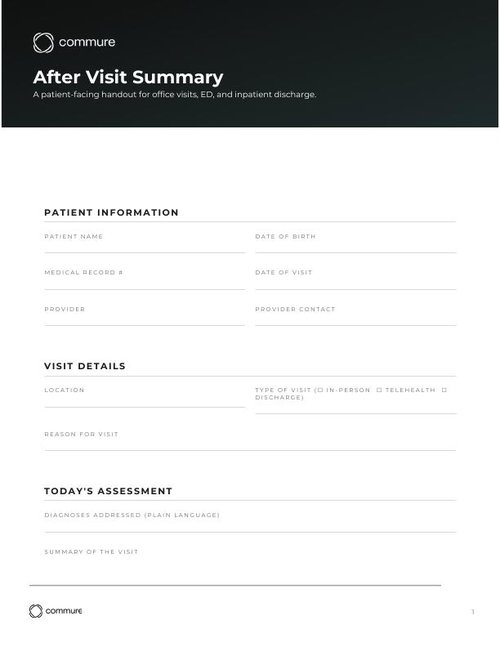
This after visit summary template is a fillable Word document that fits on one patient-readable page. Its eight sections open with the header, visit details and today's assessment. Medications, vitals, and tests and procedures come next, and the page closes with instructions and follow-up. The layout follows the clinical summary elements Centers for Medicare & Medicaid Services (CMS) defines under Promoting Interoperability. Independent and group practices can use it to give patients a plain-language summary after an office visit. Each practice can add its own letterhead, callback number and phrasing.
What You Need to Know About After Visit Summaries
- An after visit summary is the patient-facing handout covering the visit, medications, and next steps¹.
- Core content covers patient info, visit details, medications, vitals, reason for visit, procedures, instructions, and follow-up⁴.
- If you report Promoting Interoperability (PI), you owe patients a clinical summary for most office visits within three business days; inpatient programs have separate discharge charting rules⁴.
- A plain-language, single-page layout with clearly separated sections cuts patient confusion and call-back volume⁶,⁸.
Download the after visit summary template. A fillable Word version of the template described in this article is free. It covers all eight sections below. It aligns with CMS clinical summary rules.
What exactly is an after visit summary?
An after visit summary is the handout a clinician sends home after an office visit. Inpatient teams call the equivalent a discharge summary or discharge instructions. The AHRQ defines the after visit summary as a post-appointment handout for patients¹. It tells them about their health, the services they got, and how to care for themselves.
CMS spells out what has to be on it under Meaningful Use⁴. Meaningful Use has since been folded into Promoting Interoperability. What CMS asks for:
- Patient name
- Provider contact
- Date and location of visit
- Updated medication list
- Updated vitals
- Reasons for visit
- Procedures and other instructions
CMS also flags problem list updates, immunizations or meds given, next visits, decision aids, and tests and results⁴. The list above is a subset. Check the full CMS definition for whichever program year you're reporting under.
For clinicians in both outpatient and inpatient teams, three things matter most. Compliance, patient communication, and fit with your charting workflow.
What should be in after visit summary template?
What has to go in the after visit summary comes from CMS⁴. The rules started under Meaningful Use and now sit under Promoting Interoperability. CMS calls it a "clinical summary." Specific measures shift by year. The job stays the same: give patients clear, useful info and instructions.
The NCBI Bookshelf chapter on outpatient after visit summaries adds practical detail to that list⁵. Standard sections cover many elements. They include patient info, a Today's Visit block, problem list, tests, immunizations, medications, referrals, and learning content. These sections align with many health system after visit summary and discharge-instruction layouts in wide use.
One practical approach is to use eight sections on a single patient-readable page. It organizes the required elements. This is a design suggestion supported by usability research, not a regulatory rule.
- Header: Patient name, date of birth, provider name, provider contact
- Visit details: Date, location, type of visit, reason for visit
- Today's assessment: Diagnoses addressed, stated in plain language
- Medications: New, changed, continued, and stopped, with dose and instructions
- Vitals: Recorded at this visit
- Tests and procedures: What was done today, what was ordered, and when results are expected
- Instructions: What to do before the next visit, red-flag symptoms, and a callback number
- Follow-up: Next appointment or referral, including whom to contact
A fillable Word version of this eight-section template downloads free. Practices can tailor it with their letterhead, callback number, and custom phrasing.
Each section has a compliance reason and a plain-language one. A template that meets CMS rules but buries instructions often loses the patient⁶. Readability is an important factor to consider.
How does a well-built after visit summary template help patients and your practice?
In the research, improved understanding, recall, and adherence are the main benefits a well-designed after visit summary delivers. Patients who get a readable summary can better grasp the visit and what to do next.
AHRQ reports that a well-built after visit summary helps patients understand¹. It also supports shared decision-making, coordination of care, and adherence to preventive tasks².
Evidence on actual patient use shows that access and awareness matter as much as content. In a VA patient portal study, enrollment and awareness drove use⁷. The presence of the summary alone did not.
Primary care patients show wide variation in whether they review their AVS⁹.
For the practice, a well-built summary holds up instructions and can cut follow-up calls and messages⁸. That benefit has not been quantified at scale. Both patients and clinicians condition that value on accuracy between the summary and the actual visit. Its value erodes when the summary drifts from the visit or becomes unreadable for the patient.
Why do after visit summaries often create more work or confusion than they solve?
Three things usually go wrong with after visit summaries.
- Readability problems
- Mismatch with what was discussed
- Workflow burden on clinicians
Each is supported by peer-reviewed and agency evidence, and each compounds the others.
Readability is the first failure mode. The summary breaks down along three lines: length, dense formatting, and clinical language⁶. Each often makes it hard for patients to act on.
The design research names a real tension⁶. Regulators reward completeness. Patients need plain language. A thorough summary the patient cannot read fails them.
Mismatch is the second. AHRQ's PSNet case on after-visit confusion traced patient harm to a mismatch³. A 2017 qualitative study found the same pattern at scale⁸. Mismatches drive patient and clinician mistrust. They also send patients back through portal messages and calls. That follow-up wipes out the time the summary was meant to save.
Workflow burden is the third. Clinicians spend time matching the after visit summary to the note after the visit⁸. Most of that work is on patient-facing instructions and medication changes. That work spills into after-hours charting in both outpatient and inpatient teams. It is a focus of clinical documentation improvement work.
Where can an AI medical scribe fit into your after visit summary workflow?
Some AI medical scribe tools aim to generate both clinician notes and draft patient summaries. They pull from the same encounter data. That works whether the visit is an office appointment, an ED visit, or a hospital discharge. The workflow is still evolving, and features differ by vendor. Use it with careful clinician oversight.
Older AHRQ work studied EMR after visit summaries in outpatient settings¹,². In those settings, clinicians completed both the chart note and a separate after visit summary process. Inpatient discharge charting follows a parallel path. AI scribes are replacing manual medical transcription and copy-paste workflows.
Experts recommend three safeguards when making after visit summaries with AI assistance.
- A clinician review step before the note is signed
- Clear separation between the clinical note view and the after visit summary view
- Explicit accuracy verification against the visit itself
Source text errors carry over if not caught⁶. Keeping the clinical note and after visit summary views separate helps contain clinician shorthand. That keeps shorthand from reaching the patient.
Practical guardrails many outpatient and inpatient teams build into check-out include three steps.
- A short in-visit review of the ambient note
- Templated phrasing for common steps, to keep language plain
- A check at checkout that the after visit summary matches the plan
How Commure Scribe supports your after visit summary workflow
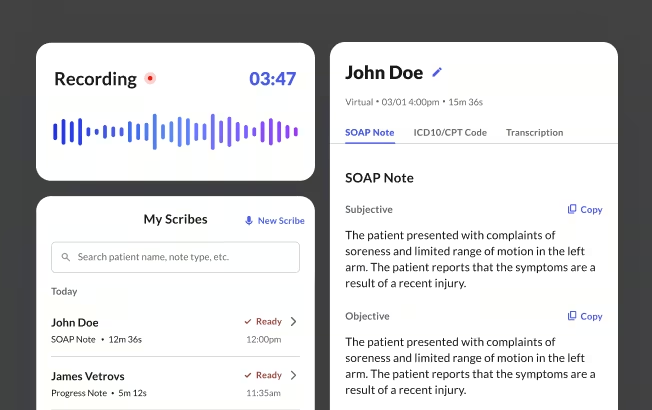
Commure Scribe records the visit via ambient listening and makes a structured Subjective, Objective, Assessment, Plan (SOAP) note the clinician reviews and signs. The workflow is Capture → Edit → Finalize. The clinician stays present in the room and reviews the SOAP note seconds after clicking End Recording. That note is the source of truth for the visit. It feeds the patient-facing after visit summary downstream.
For after visit summary drafting, Commure Scribe offers templates and customization. Outpatient, ED, and inpatient teams can tailor the output to their specialty, patient mix, and workflow. Its document generation drafts the summary from the same encounter note the clinician just finalized. It pulls through the diagnoses, medications, instructions, and follow-up already captured. The clinician reviews the draft before it goes to the patient.
Among Commure Scribe users, 90%+ of providers reduce clinical documentation time and digital fatigue. 91% of providers report feeling less fatigued.
Note: This is an educational piece for clinicians thinking about their summary workflow. It is not legal or compliance advice, and it does not guarantee you meet CMS PI rules. Run changes past your compliance team and check your payer contracts before rolling anything out.
After Visit Summary Template Download
Download a copy of this template
Thanks! Your after visit summary template is ready.
Click below to download.

Frequently Asked Questions
An after visit summary is the patient handout a clinician provides after an office visit¹. Inpatient teams give a similar document at discharge. Either version covers the reason for visit, medications, vitals, procedures, and follow-up instructions in plain language.
CMS defined clinical summary content under the Meaningful Use criterion and continues it under the PI program⁴. Core elements: patient name and provider contact, date and location of visit, updated medications and vitals, and reasons for visit. CMS also calls for procedures performed and other instructions, problem list updates, immunizations or meds given, next visits, decision aids, and tests and results. Check what applies to your program year.
If you report Promoting Interoperability (the program that replaced Meaningful Use), yes. Under the outpatient MU Stage 1 rules, clinicians had to give a clinical summary for most office visits⁴. The cutoff was more than half. They had three business days to do it. Hospitals under the hospital track have their own discharge charting rules. Current PI rules shift by year and by which measures you report, so check yours. State laws and payer contracts can layer on other charting rules.
The progress note is the clinician's record of the visit. It documents assessment and reasoning for the chart. The after visit summary is a patient-facing summary. It restates the plan, medications, and instructions in plain language for the patient. The two documents share source content but serve different audiences.
Some AI scribes draft the summary from the same structured note they produce during the visit¹. Commure Scribe, for example, offers template customization and document generation. These can draft the summary from the finalized note and the practice's workflow. Safe use means the clinician reviews the draft before it goes to the patient. The clinical note should stay separate from the patient-facing after visit summary.
Sources
- AHRQ. (2015). Development of an electronic medical record-integrated enhanced after visit summary. https://digital.ahrq.gov/ahrq-funded-projects/development-electronic-medical-record-integrated-enhanced-after-visit-summary
- AHRQ. (2022). Evaluation of computer generated after-visit summaries to support patient-centered care. https://digital.ahrq.gov/ahrq-funded-projects/evaluation-computer-generated-after-visit-summaries-support-patient-centered
- AHRQ Patient Safety Network. (2003). After-visit confusion. https://psnet.ahrq.gov/web-mm/after-visit-confusion
- CMS. (2014). Eligible professional meaningful use core measures, clinical summaries (Stage 1). https://www.cms.gov/regulations-and-guidance/legislation/ehrincentiveprograms/downloads/13_clinical_summaries.pdf
- NCBI. (2014). Outpatient after-visit summaries, facilitating patient understanding of care and treatment. In Finding what works in health care: Standards for systematic reviews. https://www.ncbi.nlm.nih.gov/books/NBK268658/
- Federman, A. D., Sanchez-Munoz, A., Derman, R., et al. (2018). Challenges optimizing the after visit summary. Patient Education and Counseling, 101(1), 126–132. https://pmc.ncbi.nlm.nih.gov/articles/PMC6326571/
- Nazi, K. M., Turvey, C. L., Klein, D. M., & Hogan, T. P. (2016). Awareness and use of the after-visit summary through a patient portal: A mixed methods study. Journal of Medical Internet Research, 18(4). https://pubmed.ncbi.nlm.nih.gov/27076485/
- Dykes, P. C., Samal, L., Donahue, M., et al. (2017). Patient and clinician perspectives on the outpatient after-visit summary: A qualitative study. Journal of the American Medical Informatics Association, 24(e1), e61–e68. https://academic.oup.com/jamia/article/24/e1/e61/2631493
- Wooldridge, A. N., Carayon, P., Hoonakker, P. L., et al. (2019). Patient-reported use of the after visit summary in a primary care setting. Applied Clinical Informatics, 10(5), 885–893. https://pmc.ncbi.nlm.nih.gov/articles/PMC7705830/