



Medical Release Form Template: Free Editable Download
Guide to medical release template, covering every field required under 45 CFR 164.508 and explains the substance use disorder records exception.
Written by the Commure Scribe Team
Published: June 13, 2026
•
4 min read
A medical release form is a signed document that lets a provider share specific health records. The records go to a named recipient for a stated reason, outside treatment, payment and operations. Under 45 CFR 164.508, the template includes nine elements. The first three name the records to share, who releases them and who receives them. The form then states the purpose and an expiration date or event. The rest cover the patient's signature and date, a right to revoke, a conditioning statement and a redisclosure warning.
What You Need to Know About Medical Release Form Templates
- A medical release form lets a patient authorize their provider to share specific health records with a named recipient.
- Under 45 CFR 164.508, a valid authorization needs nine required elements, and a single missing field makes the form legally defective.¹
- Download the free editable template below and review the HIPAA requirements before using it in your practice.
Download the Free Medical Release Form Template
Note: This template is for informational purposes only and does not constitute legal or medical advice. Have your compliance officer review it before clinical use.
- Download the Medical Release Form Template: editable DOCX, all nine HIPAA-required elements included
What Is a Medical Release Form?
A medical release form is a signed document in which a patient gives a provider written permission to disclose specific health records to a named person or organization for a stated reason. HIPAA lets providers share patient records for treatment, payment, and healthcare operations without patient authorization.¹ For releases outside those three categories, a completed medical release form template is required.
Common situations include sharing records with attorneys, employers, life insurers, and specialists at patient request. Substance use disorder records carry extra requirements under 42 CFR Part 2.² Department of Health and Human Services (HHS) updated Part 2 in 2024 to bring it closer to HIPAA. The form's nine required elements come from federal regulation. Getting each field right determines whether the release is lawful.
What Should a Medical Release Form Include?
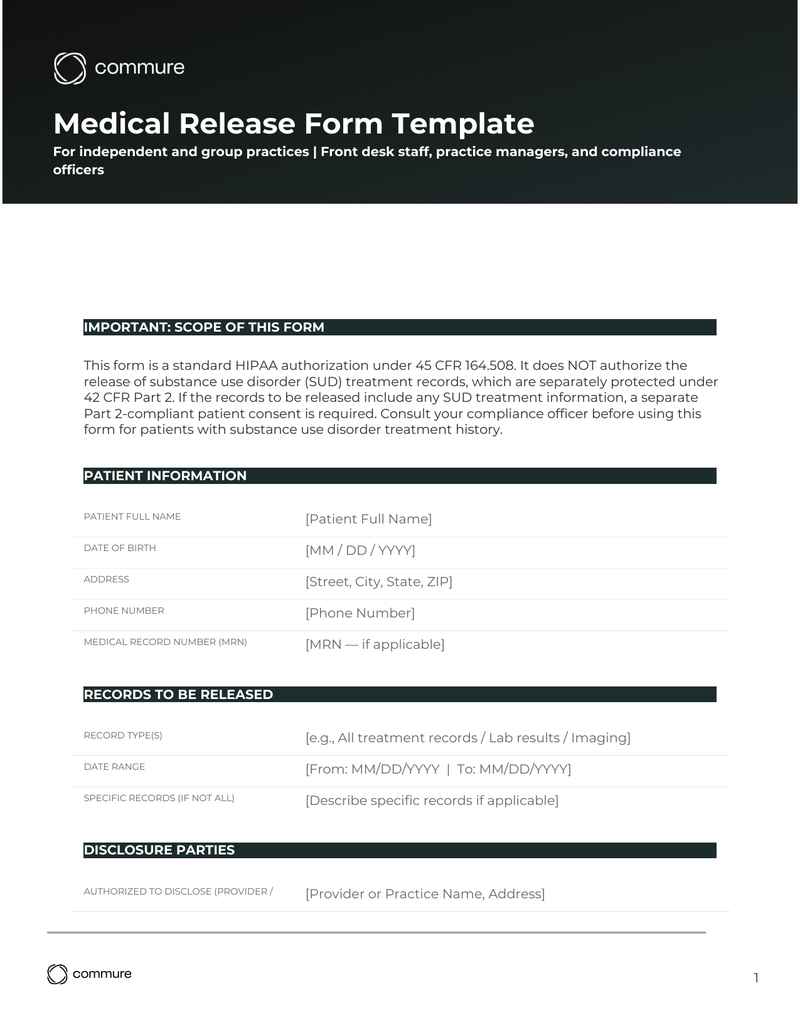
A valid medical release form template needs all nine elements below.¹ A missing field makes it defective. Here is what each one captures:
- What records will be shared. Name the specific records being released: date range, record type (lab results, imaging, or all records). A vague entry like "medical records" may not meet the specificity standard under 45 CFR 164.508(c)(1).¹
- Who can release the records. Name the provider or practice authorized to disclose.
- Who receives the records. Name the person, company, or organization getting the records.
- Why the records are being released. State the purpose clearly: "for legal proceedings," "for life insurance review," or "at the patient's request."
- When the authorization expires. Give a date or an event (such as "end of legal proceedings"). Leaving this blank makes the form defective.
- Patient signature and date. If a representative signs, include their authority to act for the patient (parent, legal guardian, or power of attorney).
- Right to revoke. Patients can withdraw authorization in writing at any time, except where the covered entity has already taken action based on the authorization. The form must say this, including the exception.
- Conditioning statement. Treatment cannot be withheld for refusing to sign, with limited exceptions. The form must say this.
- Redisclosure warning. Once released, records may no longer be protected under HIPAA. The form must tell the patient this.
A medical release form template missing any of these elements cannot be used to release records lawfully. Staff who receive incomplete forms should return them before pulling charts. Tracking these requirements alongside your other privacy safeguards is easier with a HIPAA compliance checklist.
How Do You Fill Out a Medical Release Form?
Fill in each field on this medical release form template as specifically as possible. Vague entries are the most common reason forms get returned.
- Records section. Write the exact type and date range: "All treatment records from January 1, 2024 to December 31, 2024" is stronger than "medical records." If only certain records are needed, name them: "cardiology notes and ECG results."
- Disclosing party. Enter the practice name, address, and provider name exactly as they appear on the patient's chart.
- Receiving party. Enter the full name and address of the person or organization receiving the records. For law firms, include the attorney's name.
- Purpose. Be direct: "legal proceedings," "continuing care," or "personal use." When a patient initiates the authorization themselves, "at the request of the individual" is explicitly sufficient under 45 CFR 164.508(c)(1)(iv).¹ For third-party requests (insurer, employer, attorney), state a specific purpose and avoid vague language.
- Expiration. Choose a specific future date or tie it to a defined event: "upon completion of litigation." HIPAA sets no minimum duration, but practices commonly use 90 to 180 days as a working standard. Never leave this blank.
- Signature. The patient or their authorized representative must sign and date the form. If a representative signs, note their authority.
Keep a signed copy of the completed medical release form template in the patient's file, alongside the patient's medical chart. Note what records were released and to whom at the time of release.
What Are the HIPAA Requirements for Medical Release Forms?
Three federal requirements govern this medical release form template under the HIPAA Privacy Rule.¹
The nine-element rule
Under 45 CFR 164.508, each authorization must name the records, the disclosing party, the receiving party, and the purpose.¹ It must also include an expiration date, a patient signature, and three disclosure statements. A form that is vague, expired, or unsigned is defective. Return it and ask the patient to complete a new one.
Substance use disorder records
A standard medical release form does not cover substance use disorder treatment records. Those records fall under 42 CFR Part 2. That rule needs a separate patient consent.² HHS's 2024 final rule required practices to update their consent processes by February 16, 2026.² If your practice treats patients with substance use disorders, review your authorization workflow with your compliance officer.
State requirements
Federal law sets the floor. Some states need separate consent for mental health records or impose stricter expiration rules. Requirements vary by state. Check your state's specific rules before using this medical release form template in clinical practice. For mental health records, a dedicated mental health release of information form pairs the release with a separate psychotherapy notes authorization.
How Commure Scribe Works With the Medical Release Form
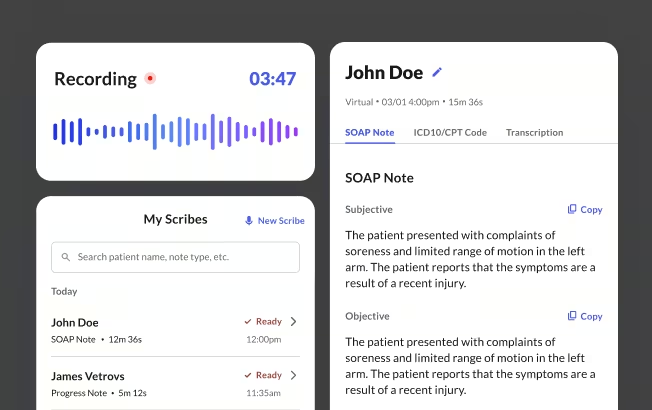
A completed medical release form names specific records (a date range and record type) that must then be located and pulled from the chart. The accuracy of that release depends on whether the underlying documentation is complete and well organized. Commure Scribe listens to clinical encounters and drafts structured clinical notes, often formatted as SOAP notes, which providers review and finalize before anything enters the chart.
Because the encounter content is captured cleanly the first time, the records a release authorization points to are easier to identify and assemble. When a request arrives for "all treatment records from January 1, 2024 to December 31, 2024," staff are working from documentation that is already structured and dated rather than reconstructing it after the fact. The AI Copilot can also draft the referral summaries and clinical letters that often accompany a records release, with the provider reviewing and editing before anything goes out.
More than 75,000 clinicians across 25 specialties use Commure Scribe, and 90%+ report reduced clinical documentation time.³ Documentation feeds into 60+ EHR integrations, including Athenahealth, eClinicalWorks, SimplePractice, and AdvancedMD, keeping the source records accurate and accessible.
This article is for general informational and educational purposes only. It does not constitute legal, medical, or professional advice and does not guarantee compliance. Requirements vary by state, payer, and clinical setting and can change over time. Verify current details with your own compliance officer, legal counsel, or the relevant authority before relying on this information.
Medical Release Form Template Download
Download a copy of this template
Thanks! Your medical release form template is ready.
Click below to download.

Frequently Asked Questions
The two terms refer to the same document. A medical release form template and a HIPAA authorization form template both describe a signed patient consent that lets a provider share protected health information (PHI) with a named recipient for a stated purpose. PHI is individually identifiable health information that relates to a person's health, health care, or payment for care, and is created or held by a HIPAA-covered entity or its business associates.
A form with a missing field is legally defective under 45 CFR 164.508.¹ You cannot use a defective form to release records. Ask the patient to complete a new form with all nine required fields filled in.
If the records include substance use disorder treatment, a standard form is not enough. You also need a separate consent under 42 CFR Part 2.² Check with your compliance officer if you treat patients for substance use disorders.
Keep a copy of each signed authorization in the patient's record. Your compliance officer can advise on the exact retention period for your state and practice type.
One authorization can cover all records if the form clearly states that. Substance use disorder records are the exception. They need a separate Part 2 consent even when a standard authorization covers the rest of the chart.²
Add your practice name, logo, and address to the header of this medical release form template. You can also add state-specific disclosures required by your state. Do not change the nine required elements or the three required statements. Modifying those fields risks making the form defective. Have your compliance officer review any changes before use.
Sources
- U.S. Department of Health and Human Services. 45 CFR 164.508: Uses and Disclosures for Which an Authorization Is Required. Electronic Code of Federal Regulations. https://www.ecfr.gov/current/title-45/subtitle-A/subchapter-C/part-164/subpart-E/section-164.508
- U.S. Department of Health and Human Services. Fact Sheet: 42 CFR Part 2 Final Rule. February 8, 2024 (updated January 30, 2026). https://www.hhs.gov/hipaa/for-professionals/regulatory-initiatives/fact-sheet-42-cfr-part-2-final-rule/index.html