



Format of Physical Examination: Free 9-System Template
A 9-system physical examination template for adult outpatient documentation, with structure compatible with 2021+ CMS office and outpatient E/M guidelines and PHI handling subject to HIPAA on completed forms.
Written by the Commure Scribe Team
Published: June 3, 2026
•
8 min read
Updated June 3, 2026
What You Need to Know About the Format of a Physical Examination
- The format of a physical examination is a structured set of body-system findings recorded in the Objective section of a SOAP note.
- US physicians report substantial after-hours documentation time, with peer-reviewed estimates in the range of one to two hours daily; templates alone do not fully resolve this load⁴.
- A structured multi-system exam format can support medically appropriate documentation under 2021 office and outpatient E/M rules, but does not by itself determine visit level.
Download the Physical Examination Format Template
Note: This template is for informational purposes only and does not constitute legal or medical advice. Have your compliance officer review it before clinical use.
- Download the Physical Examination Format template. Editable 9-system DOCX for reviewer or designer branding.
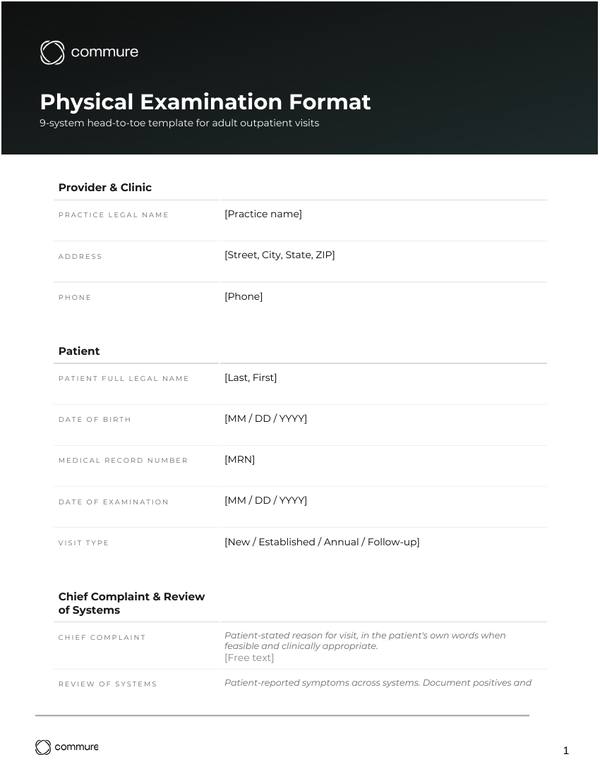
Customize the fields for your specialty and EHR before clinical use.
What Is the Standard Format of a Physical Examination?
The standard format of physical examination is a head-to-toe sequence of body-system findings, typically covering nine systems from general appearance through psychiatric. The clinician documents each system during an in-person exam, capturing pertinent positives and negatives tied to the chief complaint.
EHRs, billing auditors, and care teams generally prefer a consistent order across notes¹. A shared sequence cuts cognitive load for the clinician writing the note. It also helps any later reader of the note.
Two recent shifts have reshaped how clinicians treat the format of physical examination. The 2021 CPT revisions stopped scoring office and outpatient E/M codes by counting exam bullets, and 2023 CPT revisions extended the same medical-decision-making-or-total-time framework to most other E/M categories². Templates and ambient tools have also become a routine part of exam documentation. Smartphrases and dot phrases are commonly available in major EHRs³.
This template uses nine body systems commonly included in a general adult exam. Each finding ties back to the chief complaint and the plan. Independent and small group practices gain time when their exam template fits their visit mix rather than a generic head-to-toe checklist. The structure of the downloadable Physical Examination Format below is compatible with 2021+ Centers for Medicare & Medicaid Services (CMS) office and outpatient E/M documentation guidance, and any completed copies containing patient identifiers become PHI subject to HIPAA. Final compliance depends on your implementation.
Why Do Clinicians Need a Physical Examination Template?
A standard exam template solves three problems clinicians face every visit:
- Speeds chart entry by giving the clinician a known structure to fill in.
- Matches the documented exam level to the billed service level.
- Helps the next reader find the data fast. The next reader could be a coder, a partner, or an auditor.
The time pressure is real. Peer-reviewed studies of US physician documentation place after-hours charting in the range of one to two hours per day, with EHR-using clinicians at the higher end of that range⁴. A well-built template for the format of physical examination cuts data entry. A substantial portion of the documentation load is linked to billing, regulatory requirements, and EHR-related tasks³. The broader documentation burden sits on every clinician's desk. Beyond the exam, a guide to writing clinical notes covers the core fields and documentation practices for the rest of the record.
A template also reduces variation. Every clinician in the practice fills in the same nine-system format of physical examination. Downstream readers can scan those notes in seconds. That consistency matters most for cross-coverage, prior authorization review, and audit prep. For independent and small group practices, a shared format cuts onboarding time for new hires. It keeps the standard the same across providers.
What Sections Should a Physical Examination Format Include?
A complete format of physical examination includes administrative fields and clinical sections¹. The administrative fields tie the note to the patient and the visit. The clinical sections record the body-system findings.
Required administrative fields:
- Patient identifier fields: [Patient Name], [Date of Birth], [MRN]. Tie the note to the right chart and support HIPAA PHI handling.
- Date of examination: drives billing, audit timelines, and clinical follow-up.
- Chief complaint: the patient's stated reason for the visit, ideally in their own words.
- Review of systems: a brief patient-reported account of symptoms across systems.
The nine body systems. Many general adult exam templates include nine systems in head-to-toe order, such as:
- General appearance: well-developed, well-nourished, in no acute distress (NAD)⁵.
- HEENT (head, eyes, ears, nose, throat): pupil response, oropharynx, neck range of motion, lymph nodes.
- Cardiovascular: rate, rhythm, murmurs, peripheral pulses, edema. Standard normal: regular rate and rhythm (RRR), no murmurs⁶.
- Respiratory: breath sounds, respiratory effort. Standard normal: lungs clear to auscultation bilaterally.
- Abdominal: bowel sounds, palpation, organ size. Standard normal: soft, non-tender, non-distended (ND/NT).
- Musculoskeletal: range of motion, strength, deformity, joint findings.
- Neurological: cranial nerves, motor, sensory, reflexes, mental status.
- Skin: rashes, lesions, moles, pressure injuries.
- Psychiatric: mood, affect, thought process, insight.
Required closing fields:
- Clinical impression: the clinician's interpretation tied to the chief complaint.
- Plan: testing, referrals, medications, and follow-up timing.
- Provider signature, credentials, and date of signing¹.
Body system findings tie directly to the assessment and plan. Under current CPT E/M rules (2021 for office and outpatient visits; 2023 revisions extended the same framework to most other E/M categories), visit level is determined by either medical decision-making or total time, not by exam bullet counts².
How Do You Fill Out a Physical Examination Template?
A clinician fills out the format of physical examination from the top of the page down. The order matches the order of work during the visit. The header captures the encounter context. The body holds the exam findings. The closer records the assessment, plan, and signature. The exam follows the patient history, and a worked history of present illness example shows how to document that earlier part of the history and physical.
Step 1. Fill in the header.
- Enter [Patient Name], [Date of Birth], and [MRN]. Use the chart, not memory.
- Record the date of examination. The date drives billing and audit timelines.
- Type the chief complaint in the patient's own words when possible.
Step 2. Document each body system in head-to-toe order.
- Use a smartphrase or dot phrase for the normal baseline (e.g., "RRR, no murmurs" for cardiovascular).
- Edit the baseline to match the actual observation. Documentation should reflect the exam performed at this encounter; OIG and CMS compliance guidance flag indiscriminate copy-forward as a documentation accuracy and audit risk³.
- Capture pertinent positives and negatives tied to the chief complaint¹.
Step 3. Close the note.
- Write the assessment as the clinician's interpretation. Tie it to the chief complaint.
- Record the plan in concrete steps. Include orders, referrals, medications, and follow-up timing.
- Sign and date the note. Add credentials.
Practical tips by field:
- In the chief complaint field, use the patient's own words rather than a diagnostic term. A common error is rewriting "headache for three days" as "tension headache, working diagnosis."
- A commonly taught approach is to palpate gently before percussion in patients with abdominal tenderness. Follow your institution's exam standards.
- Avoid copy-forward of the format of physical examination without re-examination. OIG and CMS compliance guidance flag indiscriminate copy-forward as a documentation accuracy and audit risk³.
What Compliance Requirements Apply to Physical Exam Documentation?
Three rule sets affect physical exam documentation in different ways: HIPAA governs how PHI on completed forms is used and disclosed, CMS E/M guidelines affect office and outpatient visit-level coding, and state medical board standards govern record-keeping. Payer-specific and accreditor requirements may also apply. Templates can support these rules. They do not by themselves make a practice compliant.
HIPAA Privacy and Security Rules. The HIPAA Privacy Rule (45 CFR Part 164, Subpart E) sets standards for how PHI (protected health information, meaning individually identifiable health information held by a covered entity) is used and disclosed⁷. A completed exam form containing patient identifiers is PHI.
- Apply the minimum necessary standard when collecting and disclosing PHI (45 CFR 164.502(b)).
- Implement appropriate technical safeguards for ePHI. Encryption in transit and at rest is widely used to satisfy the addressable encryption specification under 45 CFR 164.312(a)(2)(iv) and (e)(2)(ii).
- Provide patients a Notice of Privacy Practices at first service delivery and on request (45 CFR 164.520).
- Consult your compliance officer before a template enters live use.
CPT E/M guidelines (2021 and 2023 revisions). The 2021 CPT revisions stopped scoring office and outpatient visits by counting exam bullets, and 2023 CPT revisions extended the same framework to most other E/M categories². Visit level rests on medical decision-making (MDM) or total time spent on the date of service².
- Document the exam findings tied to the chief complaint and assessment. Skip the fixed bullet count.
- Match the level of detail in the exam to the complexity of the visit.
- For visits billed by time, document total time spent on the date of service, including face-to-face and non-face-to-face activities personally performed by the rendering provider².
- ICD-10 and CPT code sets update on a regular schedule, typically at least annually with additional in-year updates. Confirm you are using the most current official code sets and payer guidance before billing.
State and CMS facility standards. Facility-based readers in Medicare-participating hospitals should note CMS Conditions of Participation for medical records (42 CFR 482.24); other facility types have their own CoPs in 42 CFR Parts 482–485. State medical board rules add custom signature, retention, and amendment rules. Requirements vary by state. Check your state's specific rules.
The phrase "fully compliant template" does not exist in regulation. The format of physical examination can be designed with HIPAA and CMS rules in mind. Final compliance rests on workflow, training, and review by counsel.
How Do You Customize a Physical Exam Template for Your Practice?
A generic head-to-toe format of physical examination captures the basics. Most clinicians cut or expand sections to match their visit mix. Three changes deliver the largest gains.
Build a focused exam variant for routine visits. Build a second template for routine encounters with preset normal blocks for heart, lungs, and neck. Add a one-click expansion to the full nine-system exam when the chief complaint warrants. The American Academy of Family Physicians (AAFP) recommends template variants tied to common visit types as a documentation-burden reduction technique³.
Adapt to specialty practice. Different specialties expand different sections:
- Orthopedics expands the musculoskeletal section. The HEENT and abdominal sections shrink.
- Psychiatry expands the psychiatric section. Mood, affect, thought process, insight, and risk assessment all sit there.
- Pediatrics adds growth, developmental, and immunization fields.
- Telehealth visits drop hands-on findings. Add a note that the exam was virtual when relevant.
Connect the format to your EHR and workflow. Many major EHRs support smartphrases or dot phrases. Build a phrase for the practice baseline rather than the EHR vendor default. Standard variants to set up:
- A core 3-system normal block for routine visits.
- A full 9-system normal block for new patients and annuals.
- A pediatric variant.
- A telehealth disclosure block.
Ambient AI tools change this picture. A smartphrase fills the page with normal text. The clinician then edits the text. Ambient capture builds the exam draft from the clinician's spoken words and visit observations. The result is a starting draft tied to the encounter, not a generic block to edit.
How Commure Scribe Captures the Physical Exam
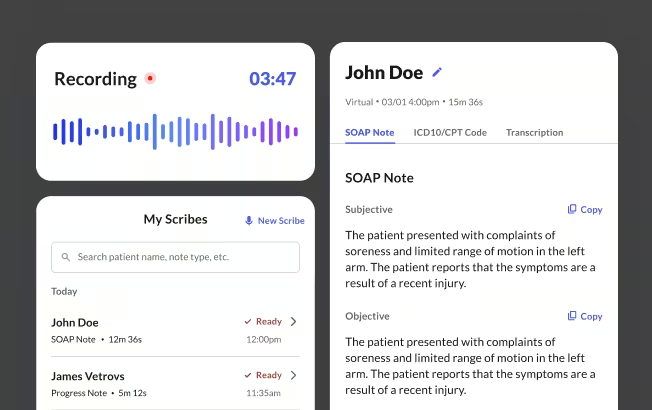
Commure Scribe listens during the visit and drafts the Subjective, Objective, and Assessment sections of the Subjective, Objective, Assessment, Plan (SOAP) note. The format of physical examination appears in the Objective section, organized by body system. The clinician reviews, edits, and finalizes before anything posts.
Within seconds of End Recording, a structured note appears. Suggested ICD-10 and CPT codes generate alongside the note. Clinicians say "the AI caught things I would have missed." The note captures the full clinical context of the encounter. It includes pertinent positives and negatives tied to the chief complaint.
Specialty templates and a custom template builder. Specialty templates and a builder let clinicians shape the format of physical examination to match their practice. The AI learns the clinician's phrasing over time. The exam draft sounds like the clinician, not the vendor default.
EHR fit by practice size. Solo and small practices (1–5 providers) use copy/paste to move the note into the chart. Medium and large group practices can use one-click sync with the EHR. Commure Scribe supports 60+ EHR integrations.
90%+ of providers reduce clinical documentation time and digital fatigue. 91% of providers report feeling less fatigued. Commure Scribe processes 25M+ patient encounters annually with 99.4% transcription accuracy. The platform is HIPAA compliant with System and Organization Controls 2 (SOC 2) certification and onshore data storage. Audio recordings are encrypted in transit and at rest. Audio is never used for AI training.
This article is for informational and educational purposes only, does not constitute legal, medical, or professional advice, and does not guarantee compliance with HIPAA, CMS, or state regulations.
Format of Physical Examination Template Download
Download a copy of this template
Thanks! Your Format of Physical Examination template is ready.
Click below to download.

Frequently Asked Questions
The standard format of a physical examination records exam findings in the Objective section of a SOAP note. It covers nine body systems in head-to-toe order: general appearance, HEENT, cardiovascular, respiratory, abdominal, musculoskeletal, neurological, skin, and psychiatric. Each system links back to the chief complaint and assessment.
The format of physical examination appears in the Objective section, alongside vital signs and lab results. List findings by body system in head-to-toe order. Use standardized normal language (e.g., "lungs clear to auscultation") for unremarkable findings. Use full descriptions for any abnormal exam result.
A comprehensive format of physical examination covers all nine body systems in detail. It is used for new-patient visits and annual physicals. A focused exam covers only the systems relevant to the chief complaint. Under current CPT E/M rules, visit level is set by medical decision-making or total time rather than exam scope.² The office and outpatient change took effect in 2021, and 2023 revisions extended it to most other E/M categories.
Completed forms for the format of physical examination contain PHI under HIPAA (45 CFR Part 164, Subpart E).⁷ Practices must apply the minimum necessary standard and limit access to authorized staff (45 CFR 164.502(b)). Implement technical safeguards under 45 CFR 164.312. Many practices meet the addressable encryption specification by encrypting data in transit and at rest. Provide patients a Notice of Privacy Practices at first service delivery and on request (45 CFR 164.520).
Yes. Practices can adapt this physical examination format to specialty needs. Orthopedics expands musculoskeletal sections. Psychiatry expands the psychiatric section with risk assessment. Pediatrics adds growth and developmental fields. Have the customized version reviewed by your compliance officer before use.
Sources
- University of North Carolina School of Medicine. (2018). Sample Written History and Physical Examination. https://www.med.unc.edu/medclerk/wp-content/uploads/sites/877/2018/10/UMNwriteup.pdf
- American Medical Association. (2026). Are physicians required to document the time spent on each specific element of the patient encounter (e.g., history, exam, MDM)? https://www.ama-assn.org/health-care-advocacy/administrative-burdens/are-physicians-required-document-time-spent-each
- American Academy of Family Physicians. (2023). Techniques to Alleviate Documentation Burden. https://www.aafp.org/family-physician/practice-and-career/administrative-simplification/doc-burden/techniques-doc-burden.html
- Wang, Z., et al. (2024). Measuring Documentation Burden in Healthcare. Journal of General Internal Medicine, 39(14), 2837. https://pmc.ncbi.nlm.nih.gov/articles/PMC11534919/
- Cleveland Clinic. (2023). Physical Examination: What Is a Physical Exam? https://my.clevelandclinic.org/health/diagnostics/17366-physical-examination
- Florida State University College of Medicine. SOAP Notes Format in EMR. https://med.fsu.edu/sites/default/files/userFiles/file/MedInfo_SOAPnote_Jobaid.pdf
- U.S. Department of Health and Human Services. HIPAA Privacy Rule (45 CFR Part 164, Subpart E). https://www.hhs.gov/hipaa/for-professionals/privacy/index.html