



SIRP Notes Template: Free Download and Step-by-Step Guide
Everything behavioral health clinicians need to understand the SIRP format, write compliant notes, and start using a ready-made template.
Written by the Commure Scribe Team
Published: June 13, 2026
•
6 min read
A Situation, Intervention, Response, Plan (SIRP) note template is a progress note form for one therapy session. Beyond those four sections, it carries admin IDs plus safety and compliance fields. These cover risk assessment, diagnostic impression, treatment goals, consent and a psychotherapy notes designation. Therapists, social workers, psychologists and counselors use it. Settings include outpatient mental health, behavioral health and substance use treatment, for individual, group and family sessions.
What You Need to Know About SIRP Notes
- What it is: SIRP notes are a four-part clinical note used in behavioral health to document therapy sessions.
- Key finding: The Intervention and Response sections give payers the billing detail they need. This helps support medical necessity for each claim.
- Practical takeaway: A compliant template must include risk assessment, diagnosis codes, and a psychotherapy notes notice alongside the four clinical sections.
Download the Free SIRP Note Template
Note: This template is for informational purposes only and does not constitute legal or medical advice. Have your compliance officer review it before clinical use.
- Download the SIRP Note Template: editable DOCX, all four clinical sections plus required safety and compliance fields included
What Is a SIRP Note?
SIRP notes are one of several therapy progress notes used in outpatient mental health, behavioral health, and substance use treatment settings. Therapists, social workers, psychologists, and counselors use them to document individual sessions. Group practices also use the format for group and family therapy encounters.
The format works across therapy styles. CBT, motivational interviewing, and psychodynamic therapy all fit within the SIRP structure. The Situation section captures what the client reports and what the clinician observes. This means the format does not need a strict split between subjective and objective data. SIRP is a practical fit for mental health work. The client's inner experience and the clinician's assessment often describe the same moment.
SIRP notes build a record of each intervention used and how the client responded. Over time, that record helps with clinical documentation, payer audits, and licensing board requests. A compliant SIRP note spans two types of fields: clinical content and admin identifiers.
Why Do Behavioral Health Providers Use SIRP Notes?
Behavioral health providers choose SIRP notes for one main reason. The format separates what the client experienced from what the clinician did. That separation matters for clinical review and for billing.
SOAP notes include an Objective section and an Assessment section. Both work well in a medical setting. In talk therapy, the distinction is less clear. A client's words are often both the reported complaint and the clinical data. SIRP avoids this problem. All client information goes into the Situation section. The clinician's actions go into the Intervention section alone.
BIRP notes follow a similar pattern. They lead with the client's Behavior rather than the full Situation. SIRP gives more room to describe context before naming the intervention. DAP notes use three sections: Data, Assessment, and Plan. The Data section holds client information. The Assessment section holds clinical judgment. SIRP separates client information and clinician actions with different section names. Goal-focused formats like GIRP notes organize the note around measurable treatment objectives instead.
The Intervention and Response sections are also useful for billing. The Intervention section names the specific techniques used. The Response section shows the client's reaction to those techniques. Together, they help document medical necessity for each session. Payers reviewing behavioral health claims often look for exactly this kind of specificity.
SIRP notes are also common in community mental health, hospital social work, and crisis services. These settings have strict timelines and payer rules. The four-section structure makes it easy to write a complete note quickly. No required detail gets left out.
What Should a SIRP Note Template Include?
Compliant SIRP notes need two types of fields: admin identifiers and clinical content. Both are required for a compliant behavioral health record.
Administrative fields
- Patient identifiers: full name, date of birth, and medical record number or session number
- Date of service: including session start and end time and total session duration
- Service type: individual therapy, group therapy, or family therapy
- Provider information: name, license type, license number, and signature
Clinical content fields
- Situation: a description of the client's presenting concerns, mood, affect, and any events or stressors reported since the last session
- Intervention: the specific clinical techniques used during the session, such as cognitive restructuring, motivational interviewing, or psychoeducation
- Response: the client's visible reaction to each intervention, including engagement level and any behavior or mood shifts
- Plan: the clinical plan for the next session, including homework, referrals, and any changes to the treatment approach
Required safety and compliance fields
- Risk assessment: documentation of suicidal ideation, homicidal ideation, and self-harm risk, including current status and any changes from the prior session
- Safety plan reference: a note confirming the safety plan is in place or was reviewed, if applicable
- Treatment goals reference: a link to the client's active treatment plan and measurable objectives
- Diagnostic impression: current Diagnostic and Statistical Manual of Mental Disorders, Fifth Edition (DSM-5) or ICD-10 diagnosis codes
- Consent for treatment reference: confirmation that consent is on file
- Psychotherapy notes notice: a statement indicating whether this note qualifies as a psychotherapy note under HIPAA and is stored separately from the general medical record
A SIRP notes template with all of these fields supports compliant records. Payers, licensing boards, and supervisors rely on complete notes.
How to Fill Out a SIRP Note (Step by Step)
When completing SIRP notes, start with the admin fields. Enter the client's name, date of birth, and session number before writing any clinical content. Include the session date, start time, end time, and the service type. This information anchors the record and is required for billing.
Step 1: Write the Situation
Describe the client's presenting state at the start of the session. Include mood, affect, and any events the client reported. Keep this section objective and specific.
Example: "Client presented with a depressed mood and flat affect. Client reported ongoing conflict with a family member and difficulty sleeping for the past five days. No acute safety concerns reported at session start."
Tip: Write the Situation before reviewing prior notes. This keeps the description grounded in the current session.
Step 2: Document the Intervention
Name each clinical technique you used. Reference the therapy style where relevant.
Example: "Clinician used cognitive restructuring to identify automatic thoughts related to the family conflict. Clinician introduced a thought record worksheet and reviewed completion instructions with the client."
Tip: Use specific technique names rather than general terms like "counseling" or "therapy." Payers may reject claims that lack clinical specificity.
Step 3: Record the Response
Describe how the client responded to each intervention. Include what you observed.
Example: "Client engaged actively with the thought record exercise. Client identified three automatic thoughts and generated two alternative perspectives. Client reported mild reduction in distress by session end."
Step 4: Write the Plan
State the clinical plan for the next session. Include any between-session assignments.
Example: "Client will complete the thought record worksheet twice before the next session. Follow-up on sleep concerns. Next session scheduled in one week."
Step 5: Complete the safety and compliance fields
Document risk findings and confirm the safety plan status. Note current diagnosis codes and verify that consent is on file. Complete the psychotherapy notes notice if applicable.
Sample SIRP Note (Completed Example)
The following is a fictional example showing what a complete SIRP note looks like when all fields are filled in. Names and details are illustrative only.
Client: Alex M. DOB: 03/14/1989 MRN: 00847
Date of Service: [Date] Start: 2:00 PM End: 2:53 PM Duration: 53 min
Service Type: Individual therapy Session #: 14
Provider: Jordan T. Lee, LCSW License #: SW-29341
Situation
Client presented with depressed mood and flat affect. Client reported an escalating conflict with a sibling over a shared living situation and stated, "I can't stop thinking about it. It's all I thought about this week." Client also reported five nights of disrupted sleep, averaging four to five hours. No acute safety concerns at session start. Client denied suicidal ideation, homicidal ideation, and self-harm urges. Current Patient Health Questionnaire-9 (PHQ-9) score: 14 (moderate depression, unchanged from prior session).
Intervention
Clinician used cognitive restructuring (CBT) to help client identify automatic thoughts linked to the sibling conflict. Clinician prompted client to articulate the core belief underlying the conflict ("If I speak up, I'll damage the relationship permanently"). Clinician introduced a thought record worksheet and modeled completion with the client using the session example. Psychoeducation provided on the relationship between sleep disruption and depressive symptom severity. Clinician and client collaboratively reviewed current safety plan; no updates required.
Response
Client engaged actively throughout the session. Client identified three automatic thoughts and, with clinician support, generated two alternative perspectives for each. Client stated, "I didn't realize I was assuming the worst without any evidence." Client reported mild reduction in distress (self-rated 7/10 → 5/10) by session end. Client demonstrated understanding of sleep hygiene recommendations and agreed to attempt a consistent wake time for the coming week.
Plan
Client will complete the thought record worksheet independently at least twice before the next session, using a new situation if the sibling conflict resolves. Clinician will follow up on sleep at session start. Referral to PCP for sleep evaluation discussed; client will consider and report back. Next session scheduled in one week. Treatment goals reviewed. Goal 2 (reduce PHQ-9 to ≤9) remains active.
Risk Assessment
Suicidal ideation: Denied
Homicidal ideation: Denied
Self-harm: Denied
Safety plan: On file, reviewed this session, no updates needed
Diagnosis (DSM-5 / ICD-10)
F32.1: Major depressive disorder, single episode, moderate
Consent for Treatment
Signed consent on file. Date obtained: [initial session date].
Psychotherapy Notes Designation
☐ This note IS designated as a psychotherapy note under HIPAA (stored separately from the general medical record).
☑ This note is NOT designated as a psychotherapy note under HIPAA (stored as part of the general medical record).
Clinician Signature: _________________________ Date: _____________
Compliance Requirements for Behavioral Health SIRP Notes
Behavioral health records are subject to HIPAA. A HIPAA compliance checklist can help practices verify their documentation meets federal standards. The Privacy Rule sets a minimum standard for sharing client data (45 CFR 164.502–514).¹ Treatment disclosures are exempt from this standard (45 CFR 164.502(b)(2)).¹ SIRP notes stored in an electronic health record fall under these rules.
Psychotherapy notes have extra rules. Under HIPAA, psychotherapy notes are a clinician's own session notes, kept apart from the rest of the medical record (45 CFR 164.501).¹ Clients must give written authorization to disclose psychotherapy notes (45 CFR 164.508(a)(2)).¹ This is a stricter standard than the authorization required for other records. The HIPAA definition excludes notes that summarize treatment plans, progress, or next steps (45 CFR 164.501).¹ A SIRP note's Plan section commonly contains this content. Providers should consult counsel before designating SIRP notes as psychotherapy notes.
Substance use disorder records have their own federal rules. Records that show a person is in SUD treatment are protected under 42 CFR Part 2.² Those rules are stricter than HIPAA. They block sharing even for care coordination in some cases. Practices that treat mental health and SUD clients should also review 42 CFR Part 2.
State laws may add rules beyond the federal floor. Some states have privacy rules for mental health records that go beyond HIPAA. Providers should check state rules for their location.
Clinical records must also support the level of service billed. The CPT code on each claim should match the service type documented in the note.
How to Customize Your SIRP Note Template
SIRP notes can be adapted for specialty settings without removing any required fields. The template in this article covers the required fields for most behavioral health settings. Practices that need a lighter format can also start with a case notes template and add SIRP structure incrementally.
Common customizations by setting:
- Substance use disorder: Add a field for substance use status, last use date, and motivation stage
- Crisis services: Add a field for crisis intervention type and disposition
- Group therapy: Add a field for group session topic, attendance, and member participation notes
- Family therapy: Add a field for family dynamics and presenting relational concerns
EHR integration
Some EHRs support custom note templates. When they do, map each SIRP field to a structured field rather than a free-text block. This supports reporting and audit readiness. Practices evaluating platforms can review options in our guide to the best EHR for mental health.
AI-assisted documentation
Some practices use AI scribes to generate SIRP note drafts from session audio. For behavioral health specifically, see how AI therapy notes work across common note formats. AI-generated drafts still need clinician review and signature before they become part of the clinical record.
How Commure Scribe Works With SIRP Notes
Behavioral health providers spend a lot of time turning session content into SIRP notes and other clinical records. Commure Scribe is an AI medical scribe built for this workflow.
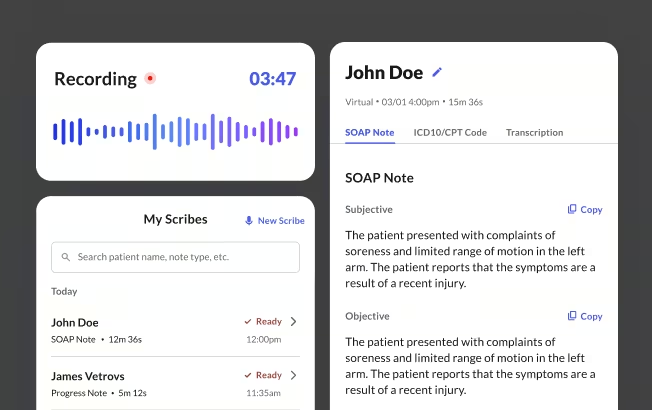
When a clinician ends a session recording, a structured draft appears within seconds. Commure Scribe listens to the session and drafts each section based on what was said. The Situation section covers what the client reported. The Intervention section captures the techniques the clinician used. The Response section documents visible reactions. The Plan section covers next steps and homework.
The clinician reviews each section, edits where needed, and finalizes the note before it enters the chart. The Capture → Edit → Finalize workflow gives the clinician full control over the record.
Commure Scribe is HIPAA compliant and System and Organization Controls 2 (SOC 2) certified. It works for in-person and telehealth visits on any device. 90%+ of providers report reducing clinical documentation time and digital fatigue after using Commure Scribe. The tool has been used across specialties including Psychiatry and Behavioral Health.
Clinicians report that AI-generated drafts capture clinical context they might otherwise miss. This is especially common in longer or complex behavioral health sessions.
This article is for general informational and educational purposes only. It does not constitute legal, medical, or professional advice and does not guarantee compliance. Requirements vary by state, payer, and clinical setting and can change over time. Verify current details with your own compliance officer, legal counsel, or the relevant authority before relying on this information.
SIRP Notes Template Download
Download a copy of this template
Thanks! Your SIRP notes template is ready.
Click below to download.

Frequently Asked Questions
SIRP stands for Situation, Intervention, Response, and Plan. In behavioral health settings, clinicians use SIRP notes to document sessions. The four sections cover what the client presented and what the clinician did. They also show how the client responded and the plan for the next session.
SOAP notes divide into four sections: Subjective, Objective, Assessment, and Plan. In a medical setting, these sections map to patient symptoms and clinician findings. In talk therapy, that split is harder to maintain. A client's words often serve as both the complaint and the clinical data. SIRP notes address this. All client information goes in the Situation section. All clinician actions go in the Intervention section.
Yes, when completed and stored correctly. HIPAA applies to all health records, including those for behavioral health. Some practices designate SIRP notes as psychotherapy notes under HIPAA. Those notes then require a separate written authorization for disclosure. They must also be stored apart from the general medical record. Providers treating substance use disorders should also review 42 CFR Part 2, which applies stricter rules than HIPAA.
Yes. The required fields in this template apply across behavioral health settings. Practices can add specialty fields (such as substance use status, crisis disposition, or group attendance notes) without removing any required elements.
SIRP notes do not have a required length. A complete note covers all four clinical sections and all required admin and compliance fields. Most outpatient therapy notes run between 150 and 400 words depending on session complexity.
Some AI scribes can generate SIRP note drafts from session audio. The clinician must review and edit any AI-generated draft. They must sign it before it enters the clinical record. Practices should verify that the tool handles patient data in line with HIPAA and state law.
Sources
¹ U.S. Department of Health and Human Services. HIPAA Privacy Rule. https://www.hhs.gov/hipaa/for-professionals/privacy/index.html
² Substance Abuse and Mental Health Services Administration. Confidentiality of Substance Use Disorder Patient Records (42 CFR Part 2). https://www.samhsa.gov/about-us/who-we-are/laws-regulations/confidentiality-regulations-faqs