



GIRP Note Template: Free Download for Therapists
Covers the four GIRP sections, required compliance fields, and customization tips for behavioral health practices of any size.
Written by the Commure Scribe Team
Published: June 19, 2026
•
7 min read
Updated June 19, 2026
A Goal, Intervention, Response, Plan (GIRP) note template is a behavioral health progress note with four clinical sections. They are Goals, Intervention, Response and Plan. This page's template adds patient and provider identifiers, service details and a risk assessment. It also carries a safety plan reference, a diagnostic impression, a consent reference and an amendment line. Therapists can use it when a client has defined treatment goals to track across sessions. Settings include outpatient therapy, community mental health and substance use disorder (SUD) treatment.
What You Need to Know About GIRP Notes
- A GIRP note is a therapy progress note structured around Goals, Intervention, Response, and Plan.
- Incomplete progress notes are among the most common reasons Centers for Medicare & Medicaid Services (CMS) identifies for improper Medicare payment.²
- Download the free GIRP note template below and add your practice's fields before using it clinically.
Download the Free GIRP Note Template
Note: This template is for informational purposes only and does not constitute legal or medical advice. Have your compliance officer review it before clinical use.
- Download the GIRP Note Template: editable DOCX, all four clinical sections plus required compliance fields included
What Is a GIRP Note and When Do Therapists Use It?
A GIRP note is a four-section behavioral health progress note built around Goals, Intervention, Response, and Plan, and therapists reach for it when a client has clearly defined treatment goals to track from session to session. In practice, GIRP notes show up in outpatient therapy, community mental health, and substance use disorder (SUD) treatment. Most clinicians who use a GIRP note work with clients who have clearly defined treatment goals: anxiety reduction, improved coping, and mood stabilization. The format covers four areas: what the client is working toward, what the therapist did in session, how the client responded, and what comes next.
Formats like SOAP and DAP remain common in medical settings, but a GIRP note fits goal-oriented behavioral health work. As of January 2024, marriage and family therapists and mental health counselors became covered under Medicare¹, making compliant note structure more important than before. Compliance also depends on keeping therapy progress notes in the medical record, apart from the psychotherapy notes HIPAA protects separately.
What Does a GIRP Note Template Include?
A GIRP note template includes the four clinical sections plus the administrative and compliance fields that let it survive a payer audit: patient and provider identifiers, service details, a risk assessment section, a safety plan reference, a diagnostic impression, a consent reference, and an amendment line. In other words, a complete GIRP note has more than four clinical sections. It also needs identifying fields, a risk assessment section, and a provider signature to hold up under a payer audit.² Missing any required field is one of the most common reasons mental health claims are denied.
The four clinical sections:
- Goals. The client's short-term and long-term objectives. Write these in the client's own words. Include a measurable target ("reduce panic attacks from five per week to two").
- Intervention. What the therapist did during the session. Name the modality: cognitive behavioral therapy (CBT), DBT, motivational interviewing, EMDR. Use action words ("guided," "introduced," "reviewed").
- Response. How the client reacted. Note engagement level, affect, and any direct quotes. Be specific: "client appeared withdrawn" is more useful than "session went well."
- Plan. The next steps. List homework, referrals, the next appointment date, and topics for the following session.
Required administrative and compliance fields:
- Patient name, date of birth, and medical record number (MRN) or account number
- Date of service, session length, and session type (individual, group, or family)
- Provider name, license type and number, and signature line
- Risk assessment section (suicidal ideation, homicidal ideation, self-harm)
- Safety plan reference or section
- Diagnostic impression (DSM-5 or ICD-10 codes)
- Consent for treatment reference
- Amendment or addendum line for late entries
The risk assessment section is required for mental health progress notes. Most payers and state licensing boards look for it in the note file, even when no crisis is present.
How to Fill Out a GIRP Note Step by Step
Start at the top of the template and work down. Filling out a GIRP note out of order often leads to gaps in required fields.
Goals
Use the client's words, not a clinical paraphrase. A goal like "client wants to feel less anxious at work" is more useful than "client presents with occupational anxiety." Link every goal to the treatment plan. Sometimes a session covers a goal not yet in the treatment plan. Note why when that happens.
Intervention
Name the modality and describe what you did. "Provided CBT psychoeducation on thought records" is clear for billing purposes. "Talked about coping" is not. Use action verbs: guided, reviewed, introduced, practiced, modeled.
Response
Write what you saw and heard. Include the client's affect, engagement level, and direct quotes when they're clinically useful. Avoid vague phrases like "client did well." If an intervention did not work, say so. Adjustments documented here support the next session's plan.
Plan
Be concrete. List:
- Homework assigned (with the specific task, not just "practice skills")
- Topics for the next session
- Any referrals or outside contacts
- Date and time of the next appointment
Patient and provider fields
Fill in the identifying fields before the session starts, not after. Late entries must be labeled as amendments with the date they were added.² Use the provider's full license number, not just credentials after the name.
Risk assessment
Complete this section even when there is no crisis. Note the presence or absence of suicidal ideation, homicidal ideation, and self-harm. If any risk is present, document the safety plan and any actions taken.
HIPAA and Documentation Compliance Requirements for GIRP Notes
GIRP notes in mental health settings touch three separate sets of rules. Which rules apply depends on the client and the setting.
HIPAA and psychotherapy notes
HIPAA gives mental health notes extra protection. Notes that document the content of a counseling session are called psychotherapy notes under HIPAA (defined at 45 CFR 164.501). They are stored separately from the rest of the medical record. They need their own authorization before they can be shared, a requirement set out at 45 CFR 164.508(a)(2). A GIRP note that stays in the main chart is treated as a regular medical record, not a psychotherapy note. Keep session-content notes in a separate file if you want the added HIPAA protection.
42 CFR Part 2 and substance use disorder clients
If you treat clients for substance use disorder (SUD), a separate federal rule applies. The 2024 final rule updating 42 CFR Part 2 created a new category called SUD counseling notes.³ These are notes a clinician voluntarily chooses to maintain separately from the general medical record. They get the same extra protection as HIPAA psychotherapy notes. You need a separate, dedicated consent to share them. They cannot be used or disclosed under a broad treatment, payment, or operations (TPO) consent. The updated rule took effect in April 2024, with enforcement starting in February 2026.³
CMS documentation standards
Medicare and Medicaid require that every progress note supports the service billed.² If a reviewer finds the note lacks sufficient detail to confirm medical necessity, the payment can be recovered. CMS calls this an overpayment. A note that shows what you did, why it was necessary, and how the client responded is your strongest protection against recoupment.
State laws may add more requirements on top of these federal rules. Requirements vary by state.
Tips for Customizing Your GIRP Note Template
The required fields do not change across specialties. What changes is the clinical language inside them.
By modality
CBT-focused therapists can add a dedicated field for automatic thoughts and cognitive distortions under the Intervention section. Eye movement desensitization and reprocessing (EMDR) practitioners often add the bilateral stimulation phase and the client's SUDS rating (Subjective Units of Distress Scale, typically 0–100; some protocols use a simplified 0–10 version) to the Response section. Trauma-informed therapists may expand the Safety section to include a window of tolerance check. This marks the arousal range where a client can process material without becoming dysregulated. These additions do not replace required fields. They sit alongside them.
By population
For adolescent clients, add a guardian notification field and a note on age-of-consent rules in your state. These rules vary by state. For group therapy, change the session type field to capture the group name, group size, and each member's individual response on a separate note.
By practice size
A GIRP note template works for practices of every size, from independent solo and small practices to large group practices (1–100+ providers). Smaller practices can keep a single template. Group practices may want a shared version with a supervisor review and co-signature line. This helps with trainee oversight and payer documentation requirements. Some insurers require a supervising clinician's signature when an associate-level therapist provides the service.
Most EHRs let you build custom GIRP note templates. Map each GIRP field to a matching EHR field. If your EHR uses Subjective, Objective, Assessment, Plan (SOAP) format by default, add a Goals field before the Subjective section and rename the sections to match GIRP. Keep the risk assessment field visible, not buried in a dropdown.
One thing to keep fixed
Do not remove the risk assessment, diagnostic impression, or provider signature fields to save space. These are required for compliance. Any GIRP note template you share across your practice should have them locked in.
How Commure Scribe Works With the GIRP Note Template
The GIRP note template gives you the four-section structure: Goals, Intervention, Response, and Plan. Commure Scribe fills that structure from the session itself. It is an AI medical scribe built for clinical settings, including behavioral health, that supports clinical documentation directly from session capture.
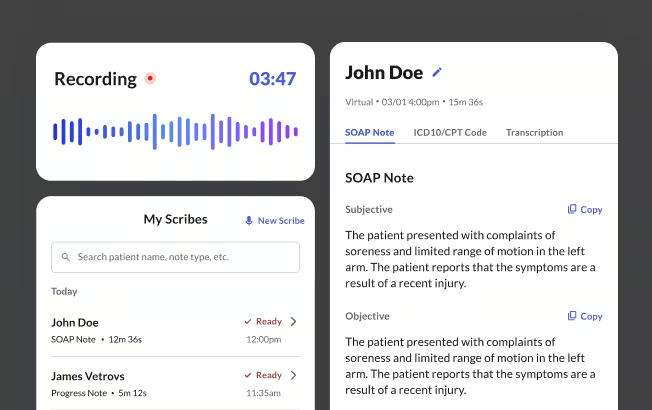
During an encounter, the tool records what happens in the room. Within seconds of clicking End Recording, a structured GIRP note appears with each section populated. The Intervention section names the modality you used, the Response section reflects how the client engaged, and the Plan section captures the next steps discussed in the room. The clinician reviews and adjusts the Goals, risk assessment, and provider fields, then finalizes before the note enters the chart. 90%+ of providers reduce clinical documentation time and digital fatigue.
Commure Scribe is HIPAA compliant and System and Organization Controls 2 (SOC 2) certified across 25+ specialties. Audio is encrypted in transit and at rest and is never used for AI training or any purpose other than generating the clinical note. The tool integrates with SimplePractice and 60+ EHRs, so smaller practices can sync notes via copy/paste while larger groups access one-click EHR sync.
This article is for general informational and educational purposes only. It does not constitute legal, medical, or professional advice and does not guarantee compliance. Requirements vary by state, payer, and clinical setting and can change over time. Verify current details with your own compliance officer, legal counsel, or the relevant authority before relying on this information.
GIRP Note Template Download
Download a copy of this template
Thanks! Your GIRP note template is ready.
Click below to download.

Frequently Asked Questions
GIRP stands for Goals, Intervention, Response, and Plan. Each letter represents one section of a structured therapy progress note. The GIRP note format is used in mental health and behavioral health settings. It documents what the client is working toward, what the therapist did in session, how the client responded, and what comes next.
A GIRP note starts with the client's goals, making it well-suited for goal-oriented therapy. SOAP notes start with the client's subjective report and the clinician's objective observations, and are more common in medical settings. BIRP notes start with behavior rather than goals. All three formats end with a plan section. The best format depends on your clinical approach and documentation context.
Yes. Most payers and state licensing boards require a risk assessment section in mental health progress notes. For a GIRP note, this means documenting the presence or absence of suicidal ideation, homicidal ideation, and self-harm. It applies to every session note, not only crisis visits. Requirements vary by state; confirm expectations with your compliance officer or licensing board.
GIRP notes can be HIPAA compliant when properly structured and stored. Notes that document counseling session content may qualify as psychotherapy notes under HIPAA (defined at 45 CFR 164.501). These receive extra protection and require a separate authorization for disclosure under 45 CFR 164.508(a)(2). Consult your compliance officer to determine how your practice should store and label GIRP notes.
Yes, but additional rules apply to GIRP notes in SUD contexts. The 2024 update to 42 CFR Part 2 created a new category of SUD counseling notes with protections similar to HIPAA psychotherapy notes. These notes require their own separate consent and cannot be used or disclosed under a general treatment, payment, or operations (TPO) consent. Check with your compliance officer before sharing SUD counseling notes with other providers.
Sources
- Centers for Medicare & Medicaid Services. "Calendar Year (CY) 2024 Medicare Physician Fee Schedule Final Rule." CMS.gov. November 2023. https://www.cms.gov/newsroom/fact-sheets/calendar-year-cy-2024-medicare-physician-fee-schedule-final-rule
- Centers for Medicare & Medicaid Services. "Complying with Medical Record Documentation Requirements." MLN Fact Sheet MLN909160. December 2024. https://www.cms.gov/files/mln909160-complying-with-medical-record-documentation-requirements.pdf
- SAMHSA/HHS. "Confidentiality of Substance Use Disorder Patient Records: 42 CFR Part 2 Final Rule." Effective April 16, 2024; enforcement effective February 16, 2026. https://www.samhsa.gov/about-us/who-we-are/laws-regulations/confidentiality-regulations-faqs