



Best Internal Medicine EMR in 2026: 7 Options for IM Providers
A practical comparison of seven internal medicine EMR platforms, from Epic to Elation, with coverage of the 2021 CMS E/M documentation reform.
Written by the Commure Scribe Team
Published: July 7, 2026
•
10 min read
Updated July 7, 2026
The best internal medicine electronic medical record (EMR) depends on group size. Epic fits large health systems and academic medical centers with full IT support. athenahealth suits small to mid-size groups focused on billing. eClinicalWorks suits independent practices that want a lower-cost, feature-rich platform. For solo internists, Elation Health and Practice Fusion fit well. CureMD offers low-cost built-in billing, and Praxis EMR offers concept-based charting.
What You Need to Know About Internal Medicine EMRs
- An internal medicine EMR is clinical software that manages patient records, charting, billing, and care workflows for internal medicine providers.
- Physicians spend 49.2% of their workday on EHR and desk work, more time than they spend on direct patient care.¹
- Choosing the right internal medicine EHR starts with Office of the National Coordinator for Health Information Technology (ONC) certification, specialty templates for chronic disease care, and billing sync.
Finding the best internal medicine EMR means matching platform depth to practice size and workflow complexity. Internal medicine providers manage more active chronic conditions per patient than nearly any other specialty, so the best internal medicine EMR for a large health system may not be the right fit for a solo group. This guide covers the top seven contenders, including what makes each one a candidate for the best internal medicine EMR title, followed by evaluation criteria and context on why documentation burden in this specialty runs so high.
How We Selected These EMRs
Selecting the best internal medicine EMR for this list required evaluating platforms on internal medicine workflow fit, availability of specialty templates for chronic disease management, support for MIPS/MACRA quality reporting, e-prescribing capabilities, billing support for E/M codes, ONC certification status, and range of compatible practice sizes. We reviewed vendor documentation, independent user reviews, and publicly available certification records. No vendor paid for placement. The list spans solo practices through large health systems. Platforms were excluded if they lacked ONC certification or lacked documented internal medicine templates. The goal was to identify the best internal medicine EMR and best internal medicine EHR options across all practice sizes, not just enterprise deployments.
The Best EMRs for Internal Medicine
The platforms below represent the top seven internal medicine EMRs across practice sizes.
1. Epic: Best for Large Health Systems
Epic is the most widely used internal medicine EMR in large health systems and academic centers. When evaluating the best internal medicine EMR for a large multi-specialty group or academic center, Epic is the standard benchmark. Its internal medicine module includes strong problem list tracking, chronic disease tools, and panel health features. Epic's quality reporting supports MIPS/MACRA workflows and its clinical alerts are among the best on the market.
- Best for: Large health systems, academic medical centers, and multi-specialty groups with full IT support
- Internal medicine features: Chronic disease management, care gap alerts, preventive care reminders, multi-problem visit support, population health dashboards
- E-prescribing: Included
- Billing: Strong E/M code support, MIPS/MACRA quality reporting built in, clinical decision support for coding
- AI scribe integration: One-click EHR sync available on Enterprise plans; copy-paste available on any plan
2. athenahealth: Best for Billing-Focused Groups
athenahealth is a cloud-based internal medicine EHR with built-in revenue cycle services. For groups that make billing performance the primary selection criterion, it ranks among the best internal medicine EMR options available. Its billing rules engine and claims denial management are a key advantage, and internal medicine templates cover chronic care, care reminders, and care gap workflows.
- Best for: Small to mid-size internal medicine groups that prioritize billing performance and want a cloud-based system
- Internal medicine features: Chronic care templates, care gap workflows, preventive care reminders, panel health tools
- E-prescribing: Included
- Billing: Integrated revenue cycle management (RCM) with claims denial management, E/M code support, MIPS/MACRA reporting included
- AI scribe integration: Direct EHR sync supported; copy-paste also available
3. eClinicalWorks: Best for Independent Practices
eClinicalWorks is one of the most widely used EMR systems in independent medicine and a strong contender for the best internal medicine EMR for groups that need a lower-cost, feature-rich platform. It has a large internal medicine user base and offers chronic disease workflows, health panel tools, and e-prescribing. Teams pairing eClinicalWorks with an AI scribe can find a full connection guide.
- Best for: Independent internal medicine groups and mid-size practices looking for a lower-cost, feature-rich EMR
- Internal medicine features: Chronic disease workflows, health panel tools, preventive care reminders, multi-problem visit support
- E-prescribing: Included
- Billing: Built-in E/M support, Merit-based Incentive Payment System (MIPS) reporting, telehealth and remote patient monitoring as add-ons
- AI scribe integration: Direct EHR sync supported; copy-paste also available
4. Elation Health: Best for Solo Internists
Elation Health is built for solo and small-group primary care and internal medicine providers, and it regularly ranks as the best internal medicine EMR option for practices that prioritize charting simplicity over population health depth. Its design puts clinical simplicity first. Elation uses a longitudinal patient record view that keeps problem lists, medications, and history in one place. See our guide to the best EMR for small practices for a broader comparison.
- Best for: Solo internists and small internal medicine groups that want a clean, fast charting experience
- Internal medicine features: Longitudinal patient record, problem list tracking, chronic disease management, e-prescribing
- E-prescribing: Included
- Billing: Standard billing included; MIPS/MACRA support is limited compared to larger platforms
- AI scribe integration: Copy-paste sync available
5. CureMD: Best for Affordable All-in-One Billing
CureMD is a cloud-based internal medicine EMR with its own internal medicine module and a setup timeline shorter than larger platforms. For groups evaluating the best internal medicine EMR under a tighter budget, CureMD is worth a close look. It includes chronic care templates, care checklists, and built-in billing for small and mid-size practices.
- Best for: Small to mid-size internal medicine groups seeking an affordable cloud-based EMR with built-in billing
- Internal medicine features: Chronic care templates, care checklists, preventive care reminders, patient portal
- E-prescribing: Included
- Billing: Built-in billing with MIPS reporting support, E/M code tools included
- AI scribe integration: Copy-paste sync available
6. Practice Fusion: Best for Low-Cost Solo Use
Practice Fusion is a cloud-based internal medicine EMR built for solo physicians. For solo internists comparing the best internal medicine EMR at the lowest price point, Practice Fusion offers internal medicine templates, e-prescribing, lab sync, and a patient portal. The interface is web-based and works from any browser.
- Best for: Solo internists and very small groups that want a straightforward, low-cost EMR
- Internal medicine features: Internal medicine templates, lab sync, preventive care reminders, patient portal
- E-prescribing: Included
- Billing: MIPS reporting supported; E/M code templates included; limited population health tools
- AI scribe integration: Copy-paste sync available; see best EMR software for additional options
7. Praxis EMR: Best for Concept-Based Charting
Praxis EMR uses a concept-based charting model rather than fixed templates. For providers who find template-based systems feel too rigid, Praxis is a legitimate candidate for the best internal medicine EMR in that specific use case. Instead of filling out set forms, clinicians build notes from their own clinical reasoning. Over time, the system learns each provider's charting style and surfaces relevant content.
- Best for: Experienced internal medicine providers who find template-based EMRs too rigid and want a charting system that adapts to their clinical voice
- Internal medicine features: Concept-based charting, adaptive learning from provider patterns, chronic disease documentation support
- E-prescribing: Included
- Billing: Standard billing included; more limited than athenahealth or eClinicalWorks for MIPS/MACRA reporting
- AI scribe integration: Copy-paste sync available
What to Look for in an Internal Medicine EMR
Evaluate any internal medicine EHR on these criteria when comparing candidates for the best internal medicine EMR for your group:
- ONC certification. Look for ONC-certified health IT. Certification confirms the system meets federal data standards. As of January 2026, ONC HTI-1 requires certified systems to support USCDI v3, the updated baseline for structured health data exchange.³
- Specialty templates. Internal medicine visits often cover many chronic conditions at once. Templates for diabetes, hypertension, CHF, and CKD check-ins save time per encounter. Pre-built order sets for common workups add more value.
- Billing connection and RCM. Look for built-in coding support, claims tracking, and denial review. A tight link between charting and billing cuts admin lag. Some systems offer revenue cycle services as an add-on.
- Interoperability. The 21st Century Cures Act set fines for information blocking. Health IT developers, certified health IT entities, and health information networks face civil monetary fines up to $1M per violation. For healthcare providers, violations result in MIPS Promoting Interoperability score cuts and potential loss of Medicare Shared Savings Program status.⁴ Choose a system with strong data sharing so labs, imaging, and specialist notes move without manual workarounds. Review EHR integrations to understand what connection options each platform supports.
- Setup support. A complex EMR with poor setup support leads to months of lost output. Ask vendors for specialty-specific setup timelines and named support contacts.
- Total cost. Factor in setup fees, training time, and ongoing support when comparing options. Monthly per-provider fees vary widely across vendors and group sizes.
What the 2021 CMS E/M Documentation Reform Means for Your EMR
On January 1, 2021, Centers for Medicare & Medicaid Services (CMS) changed how E/M visits are charted.⁵ The change applies to CPT codes 99202 to 99215.
The old rule required separate levels of history and physical exam to support a billing level. That rule is gone. Providers can now base the E/M level on medical decision-making (MDM) or total time spent on the encounter.
This change matters for the best internal medicine EMR selection. Many older internal medicine EMR templates were built around the pre-2021 structure: three-part history, multi-element physical exam, and a complexity score. Those templates add charting burden without adding clinical value. Before committing to any platform, verify that it supports updated E/M documentation standards.
What to verify in any internal medicine EMR:
- MDM-based templates. The system should support 2021-compliant templates that capture MDM level directly. The four MDM levels (Straightforward, Low, Moderate, High) map to E/M codes 99202/99212 through 99205/99215.
- Time-based charting. The system should let providers log total encounter time. This includes time reviewing results and coordinating care outside the visit.
- Automatic code suggestion. Some EMRs suggest the right E/M code based on documented MDM or time. This cuts undercoding and overcoding risk.
The ONC HTI-1 Final Rule took effect March 11, 2024. USCDI v3 becomes the data exchange baseline in January 2026.³ EMRs that keep ONC certification must meet these updated rules. Ask vendors for their current status before purchasing.
Why Internal Medicine Documentation Burden Is Uniquely High
Internal medicine has one of the heaviest charting loads in medicine. Providers often manage 8 to 12 active chronic conditions per patient. Diabetes, hypertension, heart failure, and chronic kidney disease often appear together. Each condition needs its own problem list entry, care gap check, and quality measure update. This is one reason that selecting the best internal medicine EMR is a more complex decision than choosing a general-purpose system.
A 2016 time-and-motion study found that physicians spent 49.2% of their workday on EHR and desk work. They spent just 27% on direct patient care.¹
After-hours charting adds to that burden. A study of family medicine physicians found they average 86 minutes of after-hours EHR time nightly.²
The best internal medicine EMR handles data storage and billing. It does not make complex encounters faster to chart. A single visit may cover five active problems, four medications, two lab orders, and three care gap flags. No EMR on its own eliminates this capture burden. That is why AI scribing has become a complementary tool for internal medicine providers.
How AI Scribing Reduces Internal Medicine Documentation Time
An internal medicine EMR stores, sorts, and bills for clinical data. It does not capture that data from the visit. The clinician still has to turn what happened in the room into chart text. That step is where most charting time goes.
An AI medical scribe fills this gap. It records the visit and builds a structured note for the provider to review and approve before anything enters the chart. Setup does not require switching the best internal medicine EMR already in use. For a broader look at how these tools are reshaping workflows, see AI in primary care.
How Commure Scribe Works with Internal Medicine EMRs
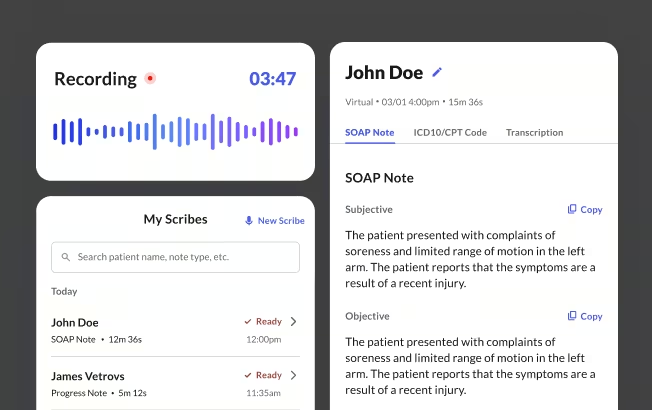
Commure Scribe records the internal medicine encounter. Within seconds of clicking End Recording, a structured note appears with suggested ICD-10 and CPT codes in a separate tab. The clinician reviews, edits, and approves before anything enters the chart. No EMR switch is required.
90%+ of providers reduce clinical charting time and digital fatigue. 91% report feeling less fatigued. Commure Scribe connects with athenahealth, eClinicalWorks, AdvancedMD, Practice Fusion, and 60+ other EHR systems. It is HIPAA compliant, System and Organization Controls 2 (SOC 2) certified, and audio is not used for AI training. Solo and small providers start with a 7-day free trial, no credit card required.
Frequently Asked Questions
The best internal medicine EMR depends on group size and workflow needs. Epic leads for large health systems with full IT support. athenahealth and eClinicalWorks are strong options for small to mid-size groups. Elation Health and Practice Fusion are good choices for solo internists and very small groups. CureMD and Praxis EMR serve specific needs: built-in billing and concept-based charting, respectively.
Prioritize ONC certification, specialty templates for chronic disease care, built-in billing and revenue cycle management (RCM), and data sharing. Check that the best internal medicine EMR you evaluate supports 2021-compliant E/M charting based on medical decision-making (MDM) or total time. Setup support quality and total cost are also key factors.
Many large health systems and academic medical centers run Epic for internal medicine. Its problem list tracking, chronic disease tools, and clinical alerts are strong. Its cost, complexity, and setup timelines make it impractical for many solo practices and small groups evaluating the best internal medicine EMR for independent use.
An EMR (electronic medical record) is a digital chart within one organization. An EHR (electronic health record) shares data across providers and systems. In common usage, the terms are used the same way. EHR often implies broader data sharing. Both refer to the same category of software when providers search for the best internal medicine EMR or best internal medicine EHR.
An AI scribe captures the clinical encounter and generates a structured note. The clinician reviews and approves the note before it enters the chart. The AI scribe connects with the best internal medicine EMR in use through direct sync or copy-paste. No system switch is required. AI scribes and EMRs handle different steps in the workflow and work well together.
Sources
- AHRQ PSNet. "Allocation of physician time in ambulatory practice: a time and motion study in four specialties." https://psnet.ahrq.gov/issue/allocation-physician-time-ambulatory-practice-time-and-motion-study-four-specialties
- AMA. "Family doctors spend 86 minutes of 'pajama time' with EHRs nightly." https://www.ama-assn.org/practice-management/digital-health/family-doctors-spend-86-minutes-pajama-time-ehrs-nightly
- Federal Register. "Health Data, Technology, and Interoperability: Certification Program Updates, Algorithm Transparency, and Information Sharing." January 9, 2024. https://www.federalregister.gov/documents/2024/01/09/2023-28857/health-data-technology-and-interoperability-certification-program-updates-algorithm-transparency-and
- Federal Register. "21st Century Cures Act: Establishment of Disincentives for Health Care Providers That Have Committed Information Blocking." July 1, 2024. https://www.federalregister.gov/documents/2024/07/01/2024-13793/21st-century-cures-act-establishment-of-disincentives-for-health-care-providers-that-have-committed
- CMS. "Physician Fee Schedule (PFS) Payment for Office/Outpatient Evaluation and Management (E/M) Visits," fact sheet, January 2021. https://www.cms.gov/files/document/physician-fee-schedule-pfs-payment-officeoutpatient-evaluation-and-management-em-visits-fact-sheet.pdf




.jpeg)

.jpeg)
.jpeg)

.jpeg)