



Mental State Assessment Example: Free Editable Template
A plain-language walkthrough of the ten domains, three filled examples, and the rules and customizations that matter.
Written by the Commure Scribe Team
Published: May 28, 2026
•
8 min read
Updated May 28, 2026
What you need to know about a mental state assessment
- A mental state assessment is a brief snapshot of how a patient looks, acts, sounds, and thinks during a clinical visit.
- Clinicians outside specialty mental health often feel less sure with the mental state assessment, and a checklist of domains keeps it consistent.¹
- Write what you saw and heard before what you think it means, and use a template so nothing gets dropped under time pressure.
What is a mental state assessment?
A mental state assessment is the section of a clinical note that captures how the patient looked, acted, sounded, and thought during the visit. It covers ten domains in a fixed order, from appearance and behavior through cognition and judgment, plus a separate risk assessment. In an outpatient setting it sits inside a broader progress note, often in the SOAP notes structure. The order is observation first, interpretation second: what you saw and heard before what you think it means. In a DAP note format (Data, Assessment, Plan), the mental state assessment findings typically sit in the Data section, with interpretation moving to Assessment.
The depth scales with the visit. You can run a focused mental state assessment in two minutes during a routine medication check, or take fifteen for a new patient evaluation. Therapists, psychiatrists, primary care doctors, nurses, and social workers all use the same backbone. The structure stays the same regardless of setting.
Setting itself matters less than people think. Speech, affect, and thought process come through on video as clearly as in person. Motor activity and gait need more attention by camera. The note still reads the same way at the next visit and during peer review.
Download the mental state assessment template
Note: This template is for informational purposes only and does not constitute legal or medical advice. Have your compliance officer review it before clinical use.
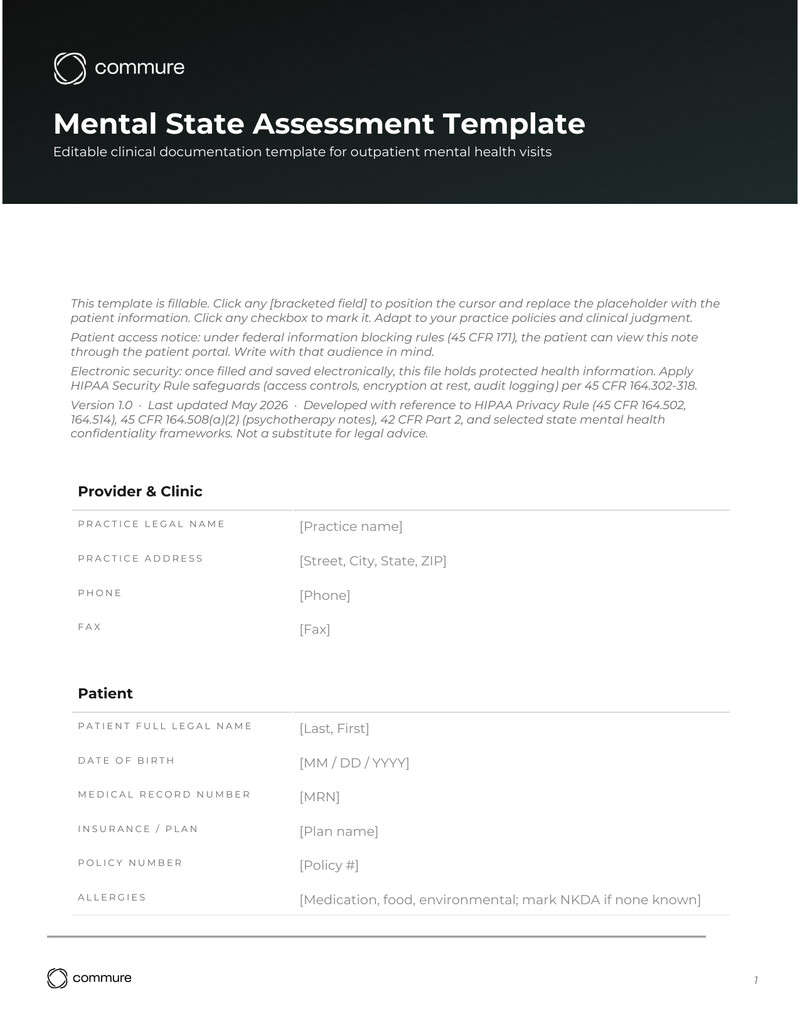
Customize it for your specialty and EHR before going live.
Why does the mental state assessment matter in outpatient practice?
The mental state assessment is what the chart leans on when the visit involved mood, behavior, or cognition. It's how a payer or auditor sees that the diagnosis matches the documentation, and it's a core piece of clinical documentation improvement work in behavioral health. It's also how the next clinician knows what was happening at the last visit. Skip it on a behavioral health visit and the medical record may not back up the diagnosis or the level of service billed.
Two things make a template more useful than memory alone:
- Many clinicians feel less sure about the mental state assessment outside dedicated mental health settings. A scoping review found knowledge gaps and lower confidence among clinicians in those settings.¹
- It's easy to blur what you saw with what you think it means. Educational work on teaching the mental state assessment shows the hardest part to pick up is keeping observation separate from interpretation while running a natural interview.⁴
A template handles both at once. The fields are in order, so nothing gets dropped when the schedule is tight. The structure puts what you observed in one place and what you think it means in another. That split is the framing taught in the Johns Hopkins Perspectives approach.⁵
Audit defense is the second case. Risk assessment is the line auditors look for, especially after a safety event. A mental state assessment that documents suicidal ideation with observation and a plan reads cleaner during peer review. A free-text paragraph that buries the same content does not. The template makes sure that line is in the chart every time.
What domains does a mental state assessment cover?
A complete mental state assessment covers ten domains. This template adds a separate risk assessment section. Each domain has its own cues to watch for and language to use.⁶ ⁷
- Appearance. Grooming, hygiene, dress, and how attentive the patient looks. Note what stands out, not what is normal.⁶
- Behavior. Attitude toward the interviewer (cooperative, guarded, irritable), eye contact, and motor activity. Skip value judgments.⁶
- Speech. Rate, rhythm, volume, and fluency. Note pressured speech, latency, or trouble finding words.⁶
- Mood. What the patient says they're feeling, in their own words. Quote them directly.⁷
- Affect. What you see on their face and in their tone. Describe range, congruence with mood, and stability.⁷
- Thought process. How thoughts are organized: linear, tangential, circumstantial, loose, or blocking.⁶
- Thought content. What the patient is thinking about: preoccupations, delusions, obsessions, suicidal or homicidal ideation.⁶
- Perception. Hallucinations, illusions, depersonalization, derealization. Note the type (auditory, visual, tactile).⁷
- Cognition. Orientation, attention, memory, language. Note any structured tool used, such as the SLU Mental Status Exam for older adults.⁸
- Insight and judgment. Whether the patient understands their condition and can make reasonable decisions about it.⁶
In our mental health templates, risk assessment sits as a separate section. Document suicidal ideation, homicidal ideation, and self-harm explicitly. Note any plan, intent, means, or recent attempts. If any answer is yes, our template activates the safety plan section.
What does a complete mental state assessment example look like?
Three short examples show how the same structure adapts across outpatient settings. Each writeup leads with observation and ends with interpretation. They are illustrative composites with no real patient information.
Example 1: Outpatient psychiatry medication follow-up. [Adult patient] returning for a two-week follow-up on sertraline.
Appearance: well-groomed, dressed for the season. Behavior: cooperative, eye contact maintained, no psychomotor agitation. Speech: regular rate, rhythm, and volume.
Mood: "a little better, still tired." Affect: full range, congruent with mood. Thought process: linear and goal-directed. Thought content: no delusions; SI and HI denied.
Perception: no hallucinations reported. Cognition: alert and oriented to person, place, and time; attention intact. Insight: good; patient links sleep and mood. Judgment: intact. Risk: no plan, no intent.
Example 2: Primary care behavioral health screening. [Adult patient] presenting with three weeks of poor sleep and worry.
Appearance: casually dressed, looks tense. Behavior: cooperative, fidgets in the chair. Speech: rapid, increased volume.
Mood: "anxious all the time." Affect: anxious and congruent. Thought process: somewhat tangential, returns with redirection. Thought content: ruminates about work; SI and HI denied.
Perception: no abnormalities. Cognition: alert and oriented to person, place, and time. Insight: fair; aware of the stressor pattern. Judgment: intact. Risk: no plan, no intent. Patient Health Questionnaire-9 (PHQ-9) administered and scored separately.
Example 3: Telehealth therapy session. [Adult patient] in established treatment for PTSD on a video visit.
Appearance: visible from the shoulders up, well-groomed. Behavior: cooperative, eye contact intermittent (typical for this patient on video). Speech: normal rate, rhythm, and volume.
Mood: "more steady this week." Affect: full range, congruent. Thought process: linear. Thought content: trauma-related themes; SI and HI denied.
Perception: no hallucinations. Cognition: not formally tested; conversational responses normal. Insight: good. Judgment: intact. Risk: safety plan reviewed.
What HIPAA and documentation rules apply to mental state assessments?
Federal rules shape what you write and how it gets shared. State medical board rules and state mental health confidentiality laws often add more on top.
- HIPAA Privacy Rule (45 CFR 164.502-514). The mental state assessment entry is protected health information. Anyone who collects or shares it follows the minimum necessary standard. If an AI scribe drafts the entry, see HIPAA-compliant AI note taking for vendor evaluation criteria.²
- HIPAA Security Rule (45 CFR 164.302-318). Once the template is electronic, the practice owes administrative, physical, and technical safeguards on the file, including access controls, encryption at rest, and audit logging.²
- Psychotherapy notes carve-out (45 CFR 164.508(a)(2)). A mental state assessment entry inside a progress note is part of the medical record. The HIPAA carve-out is narrow: it covers private process notes the clinician keeps separately, not medication records, treatment plans, diagnosis, modality, frequency, or progress to date. Process notes that qualify need their own authorization for disclosure.³ Therapists can check where each entry belongs by comparing therapy progress notes and psychotherapy notes, which differ in content and in HIPAA protection.
- 42 CFR Part 2. When substance use treatment shows up in the same visit, this rule adds stricter consent rules for who can re-share the record.⁹
- 21st Century Cures Act information blocking rule (45 CFR 171). The patient can view the mental state assessment entry through the patient portal under federal information blocking rules. Write the note with that audience in mind.
State law is the next layer. Many states want a separate consent for mental health records disclosure on top of the HIPAA authorization, and duty-to-warn or duty-to-protect standards for homicidal ideation vary by jurisdiction. Check your state's rules before locking in a template.
Billing documentation is its own benchmark. Outpatient physician offices document under the Medicare Physician Fee Schedule and CPT documentation guidelines, which means the note has to support the billed code such as 90791, 90792, 90834, or the relevant E/M code. Hospital outpatient departments and accredited mental health facilities also follow Centers for Medicare & Medicaid Services (CMS) Conditions of Participation (42 CFR 482-485) and Joint Commission documentation standards.
The risk assessment line gets the most attention from auditors. Our mental health templates include it for that reason. The template captures suicidal ideation, homicidal ideation, and self-harm with observation and a plan, so the line is there every time. Notes that omit risk documentation can fail audit during peer review or after a safety event.
Diagnostic codes need to be current. Use ICD-10-CM and DSM-5-TR (current as of March 2022), and confirm with your payers before billing. The MMSE is licensed through PAR Inc; the MoCA requires certified training and paid licensing for clinical use as of September 2020.⁸ Late entries and amendments get a date stamp and the name of whoever made the change.
The template supports compliance, it does not guarantee it. Frame yours as "designed with HIPAA, 42 CFR Part 2, and state mental health confidentiality requirements in mind." Have your compliance officer or legal counsel review it before clinical use.
How can you customize a mental state assessment template for your practice?
Three things change when you customize: what's in the template, how it adapts to telehealth, and who owns updates. The clinical core stays the same.
- What's in it. A psychiatric intake template runs through every domain in full (see also AI scribes for psychiatry). A primary care behavioral health screening template can short-form cognition and put the weight on risk and chief complaint. A social work or therapy case template uses the same mental status examination (MSE) backbone but leans into functional status and safety planning (see AI therapy notes).
- How it adapts to telehealth. Speech, affect, and thought process come through on video. Motor activity, posture, and gait do not, or only partly. Note which domains came from observation and which came from self-report on a video visit.
- Cognitive screening tools. Add a field for which one was used. The SLU Mental Status Exam is public domain and free at slu.edu.⁸ The MMSE and MoCA need licensing.
- Who owns updates. A solo practice or small group typically has one clinician or office manager owning the template. A larger group needs a small committee with clinicians, coders, and compliance. Either way, lock in a yearly review and one after any rule change.
Practice size sets the scope. Solo and small group practices often customize a starting template in a single working session. Multi-location groups balance specialty variation against a shared core that audits and reporting depend on.
An AI medical scribe can write the mental state assessment section inside an existing template. The scribe drafts the structured note from the visit, the template holds the compliance scaffold, and the clinician reviews before signing. For a ranked breakdown by practice size and specialty, see the best AI medical scribes guide.
How Commure Scribe drafts the mental state assessment inside your template
Commure Scribe is an AI medical scribe used by 75,000+ clinicians across independent and group practices. It works inside the mental state assessment template a practice already uses. The clinician runs the visit, Commure Scribe drafts the MSE entry domain by domain inside the template, and the risk assessment field stays where the practice put it.
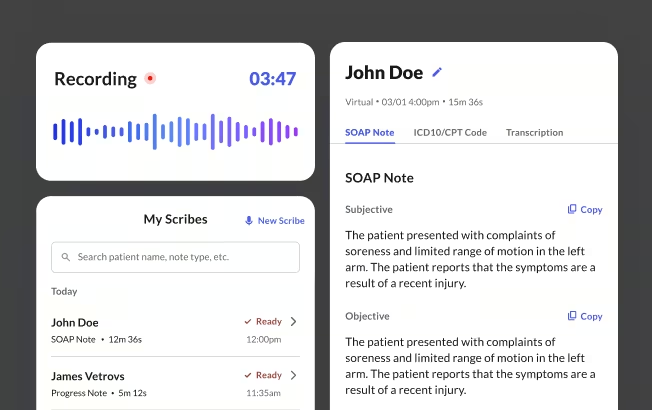
The first value moment lands within seconds. Immediately after the clinician clicks End Recording, a structured note appears with suggested ICD-10 and CPT codes generated from the conversation. The note captures the full clinical context of the encounter, and clinicians often say the AI caught things they would have missed.
Three Commure Scribe features fit a mental state assessment template workflow:
- Custom template builder. Practices match Commure Scribe to the mental health template they already use, including the risk assessment field and any specialty domains.
- AI Copilot. Surfaces clinical decision support inside the same drafting flow, so the assessment paragraph reflects the reasoning the clinician walked through.
- Admin Copilot. Helps with documentation tasks beyond the MSE, including prior authorization requests and patient emails.
The Capture → Edit → Finalize workflow keeps the clinician in control. Commure Scribe is HIPAA compliant and System and Organization Controls 2 (SOC 2) certified. 90%+ of providers using Commure Scribe report reduced clinical documentation time and digital fatigue, and 91% report feeling less fatigued.
Disclaimer
This article and the linked mental state assessment template are for informational and educational purposes only, do not constitute legal, medical, or professional advice, and do not guarantee compliance with any specific regulation.
Mental state assessment Template Download
Download a copy of this template
Thanks! Your mental state assessment template is ready.
Click below to download.

Frequently Asked Questions
The mental state assessment is the broad clinical write-up of appearance, behavior, mood, thought, and cognition during a visit. The Mini-Mental State Examination is a specific cognitive screening tool that fits inside the cognition domain. The MMSE is licensed and needs permission for clinical use. The SLU Mental Status Exam is a public-domain alternative.
HIPAA does not require a specific format, but the mental state assessment entry contains PHI and follows the Privacy Rule (45 CFR 164.502-514). CMS Conditions of Participation require documentation that supports the level of service billed (42 CFR 482-485). Payers and auditors typically expect a documented mental state assessment for visits billed under behavioral health codes.
Start with one of our Category C templates that already includes a dedicated risk assessment field. Add specialty-specific items the practice needs and remove fields it does not use. Have one clinician or office manager own template updates, and review the template once a year or after any rule change.
A focused mental state assessment for a routine follow-up typically takes two to four minutes when domains come through observation during the conversation. A new patient or an evaluation after a positive screen needs a full domain-by-domain assessment. That can take 10 to 15 minutes by itself.
Yes. An AI medical scribe drafts the structured mental state assessment entry from the visit conversation, and the clinician reviews and edits before finalizing. The template stays the source of truth for what belongs in the chart, including the risk assessment line. The clinician always reviews before signing.
Sources
- Volcevska S, Luck L, Elmir R, Dickens G, Murphy G. Nurses' experiences when conducting the mental state examination (MSE): A scoping review. International Journal of Mental Health Nursing. 2024;33(2):224-240. https://pubmed.ncbi.nlm.nih.gov/37817424/
- U.S. Department of Health and Human Services. HIPAA Privacy Rule (45 CFR 164.502-514). https://www.hhs.gov/hipaa/for-professionals/privacy/laws-regulations/index.html
- U.S. Department of Health and Human Services. "Does HIPAA provide extra protections for mental health information compared with other health information?" (45 CFR 164.508(a)(2)). https://www.hhs.gov/hipaa/for-professionals/faq/does-hipaa-provide-extra-protections-mental-health-information-compared-other-health.html
- Choi KR, Kim D, et al. Instructional Design Strategies for Teaching the Mental Status Examination. PMC9708777. https://pmc.ncbi.nlm.nih.gov/articles/PMC9708777/
- Johns Hopkins Medicine. The Perspectives Approach at Johns Hopkins Psychiatry. https://www.hopkinsmedicine.org/psychiatry/education/perspectives
- Strub RL, Black FW. The Mental Status Examination. NCBI Bookshelf NBK320. 1990. https://www.ncbi.nlm.nih.gov/books/NBK320/
- Roopesh B. Mental Status Examination. StatPearls. NBK546682. Updated 2024. https://www.ncbi.nlm.nih.gov/books/NBK546682/
- Saint Louis University. SLU Mental Status Exam. https://www.slu.edu/medicine/internal-medicine/geriatric-medicine/aging-successfully/assessment-tools/mental-status-exam.php
- SAMHSA. 42 CFR Part 2: Confidentiality of Substance Use Disorder Patient Records. https://www.samhsa.gov/about-us/who-we-are/laws-regulations/confidentiality-regulations-faqs