



Release of Information Form for Mental Health: Free Template
Two editable forms with plain guidance on HIPAA's required elements, psychotherapy notes, minors, client records requests and 42 CFR Part 2 records.
Written by the Commure Scribe Team
Published: September 25, 2026
•
8 min read
Updated September 25, 2026
Last updated: September 2026
What You Need to Know About Release of Information Forms for Mental Health
- A release of information form for mental health is a HIPAA authorization that lets a practice share client records.
- HIPAA says a valid authorization must contain six core elements and three required statements (45 CFR 164.508).¹
- Use one form for the clinical record and a separate form for psychotherapy notes, then have counsel review both.
Which Records Can a Mental Health Release of Information Form Cover?
A mental health release of information (ROI) form covers the clinical record. That record includes diagnosis, treatment plan, test results and progress notes in the chart. Three kinds of records or requests need a different path.
- Psychotherapy notes. These need a separate authorization.¹
- Substance use disorder program records. Records from a federally assisted substance use disorder (SUD) treatment program follow 42 CFR Part 2 consent rules. Compliance with the updated Part 2 rule was required by February 16, 2026.²
- A client's request for their own records. This is usually a right of access request with its own rules.
State confidentiality laws or professional ethics may set stricter limits on sharing mental health information.³
What Should a Release of Information Form for Mental Health Include?
A release of information form for mental health should include nine HIPAA items, each in its own labeled section.¹
- Information to release (Section 4). Describe the records in a "specific and meaningful fashion."¹ Checkboxes list record types, and psychotherapy notes stay off this form.
- Who releases it (Section 2). Name the practice or clinician who will share the records.¹
- Who receives it (Section 3). Name the person or group who will get the records.¹
- Purpose (Section 5). Describe each reason for the release. When the client starts the request, "at the request of the individual" is enough.¹
- End date or event (Section 6). Write the date or the event that ends the authorization.¹
- Signature and date (Section 8). The client signs and dates it. If a parent, guardian or other personal representative signs, the form must describe their authority.¹
- Right to take it back (Section 7). State that the client can take back the authorization in writing. Add the exceptions and how to do it, or refer to your notice of privacy practices.¹
- Care does not depend on signing (Section 7). State whether treatment, payment, enrollment or eligibility for benefits can depend on signing.¹
- Sharing again (Section 7). Warn that the recipient may share the records again, and HIPAA may no longer protect them.¹
The form must be written in plain language.¹ When your practice asks a client to sign, give the client a copy of the signed form.¹ Keep the signed form for six years from the date it was created or last in effect, whichever is later (45 CFR 164.530(j)).⁴
HIPAA's list leaves out two items that some forms include.
- A maximum length. HIPAA sets no federal limit on how long an authorization lasts.¹ Your state may set one, so check your state's rules.
- A reproductive health attestation. A federal court vacated most of the 2024 HIPAA reproductive health privacy rule on June 18, 2025.⁵ Verify the current status with your legal counsel.
For releases outside behavioral health, use a general HIPAA authorization form.
Why Do Psychotherapy Notes Need a Separate Authorization?
HIPAA requires an authorization before psychotherapy notes are shared for almost any reason, including with another treating provider.⁶ That authorization can be combined only with another psychotherapy notes authorization.¹ A psychotherapy notes checkbox on the general release form would break that rule.¹
- What counts. HHS defines psychotherapy notes as a mental health professional's notes that record or analyze the conversation in a private, group, joint or family counseling session.⁶ To count, the notes must be kept separate from the rest of the client's medical record.⁶
- Narrow exceptions. The clinician who wrote the notes can use them to treat the client.¹ Other exceptions include the practice's own supervised training programs and its defense in a legal action the client brings.¹ A few disclosures that other HIPAA rules require or permit are also exempt.¹
- No HIPAA right of access. HIPAA's right of access has an exception for psychotherapy notes, for clients and their personal representatives.³
- Information blocking. The Office of the National Coordinator for Health Information Technology (ONC) says information blocking rules leave these notes out of electronic health information.⁷ ONC adds that the test is whether a note meets HIPAA's definition, whatever type of mental health professional wrote it.⁷
A note written into the chart is part of the clinical record, which the general release form covers. Only notes kept apart from the record can meet the definition.⁶ Keep those notes separate with a psychotherapy notes template.
How Do You Fill Out a Mental Health ROI So It Stays Valid?
Fill in every core element, give the client a copy, and check any form you receive before you send records.
- List record types and dates. Check each record type and add a date range. A line that says only "all records" may not meet HIPAA's "specific and meaningful" standard.¹
- Name the recipient and method. Add contact details, then mark written records, verbal discussion or both.
- Pick a purpose. Check a purpose, or check "At my request" when the client starts the release.
- Describe a representative's authority. Parents of minors are generally their personal representatives.⁸ Exceptions can apply when state law lets a minor consent to their own care, or when the minor may be endangered.³ Requirements vary by state, so check your state's rules.
- Give a copy and log releases. Give the client a copy when your practice asked for the signature.¹ Log each release in Section 9.
- Log any revocation. A written revocation does not undo releases already made in reliance on the form.¹
Before you send records on someone else's form, check it for HIPAA's five defects. Any one of them makes the form invalid.¹
- It has expired, or you know its end event has happened.
- A required element is missing or left blank.
- You know the client took it back.
- It wrongly combines authorizations, such as psychotherapy notes with other records, or wrongly makes care depend on signing.
- You know that key information on it is false.
A form signed by a representative with no description of their authority is missing a core element.¹
When Is an ROI the Wrong Form for Mental Health Records?
Skip the ROI when HIPAA already permits the disclosure, when clients want their own records, or when Part 2 rules apply.
Sharing That Needs No Authorization
HIPAA permits three kinds of sharing without a signed release.³
- Treatment and care coordination. Providers may share the medical record with other providers for treatment and care coordination.³ Psychotherapy notes still need an authorization.⁶
- Family and others involved in care. A provider may talk with people involved in the client's care if the client does not object.³ If the client cannot agree, the provider may use professional judgment about the client's best interests.³
- Serious and imminent threats. A provider may warn people who can prevent or lessen a serious and imminent threat, consistent with applicable law and ethics.³
A Client's Own Records Request
A client's request for their own records falls under the HIPAA right of access (45 CFR 164.524). An authorization only permits sharing, but access requires it, with some exceptions.⁹ The practice must act on an access request within 30 days.¹⁰
Clients can also have a copy sent to a person they name through a signed, written request.⁹ When clients ask for their own copy, HIPAA limits the fee to a reasonable, cost-based amount.¹⁰
Part 2 Records
42 CFR Part 2 rules apply to records from a federally assisted SUD treatment program, including Part 2 records a practice receives.²
- Single consent. One consent can cover all future treatment, payment and health care operations.²
- Separate consents. SUD counseling notes need their own consent.¹¹ Consent for legal proceedings cannot be combined with any other.²
- Each disclosure. Include a copy of the consent or a clear explanation of its scope with each one.²
Use a Part 2 consent for these records in place of this HIPAA template. Talk to your legal counsel before you respond to a subpoena, court order or attorney letter.
Requirements vary by state, so have counsel review your forms. For wider privacy tasks, use a HIPAA compliance checklist.
How Does Commure Scribe Support Mental Health Record Keeping?
Clients sign release forms outside the session, and the records those forms release start as session notes. For behavioral health sessions, those notes can start as a draft from Commure Scribe.
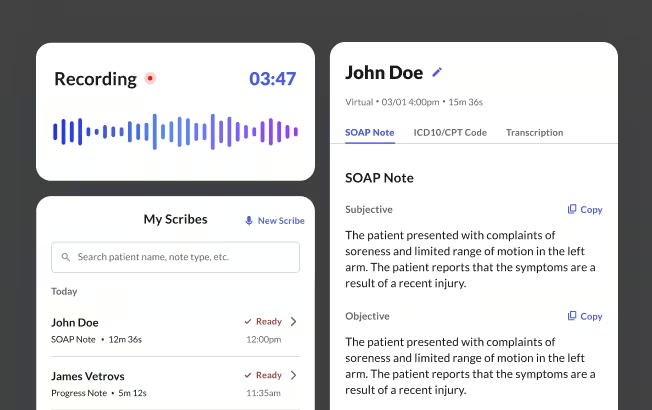
Within seconds of ending the recording, a structured SOAP note appears and suggested ICD-10 and CPT codes are generated. The clinician edits and approves the note before it enters the chart. While the note drafts, the clinician can stay present in the room with the client.
Keep psychotherapy notes apart from the drafted chart note, since the general release form covers the chart. Audio is stored and encrypted. It is not used for AI training or any purpose other than generating the clinical note.
Keep session records ready to release
Commure Scribe drafts each therapy session note from the conversation. The clinician can review and approve it before a records request arrives. You can try it for 7 days without a credit card, or see current Commure Scribe plans.
This article is for informational and educational purposes only, does not constitute legal, medical, or professional advice, and does not guarantee compliance with HIPAA.
Mental Health Release of Information Form Template Download
Download a copy of this template
Thanks! Your mental health release of information form template is ready.
Click below to download.
Thanks! Your psychotherapy notes authorization template is ready.
Click below to download.

Frequently Asked Questions
HIPAA generally lets a therapist share the clinical record with a client's psychiatrist for treatment. That sharing needs no separate authorization to release mental health records. Psychotherapy notes still need one. Requirements vary by state, so check your state's rules and your ethics code.
A release stays valid until the end date or event written on it. HIPAA requires one or the other and sets no federal maximum. Your state may set a limit, so check your state's rules.
A parent can generally sign as a minor's personal representative. Exceptions can apply when state law lets the teen consent to their own care. The form must describe the parent's authority. Requirements vary by state, so check your state's rules.
Yes, a client can take it back at any time in writing. Releases the practice made in reliance on the form before then still stand. The template includes a revocation page, and staff can log the date it arrives.
Yes, add your practice name, logo, recipients and record types to the release of information form for mental health. Keep the rights statements in plain language, and keep the psychotherapy notes authorization as its own document. Ask your legal counsel before you merge the form into intake paperwork.
Sources
- Electronic Code of Federal Regulations. "45 CFR 164.508, Uses and disclosures for which an authorization is required." eCFR. Up to date as of September 11, 2026. https://www.ecfr.gov/current/title-45/subtitle-A/subchapter-C/part-164/subpart-E/section-164.508
- U.S. Department of Health and Human Services, Office for Civil Rights. "Fact Sheet 42 CFR Part 2 Final Rule." HHS.gov. Last reviewed January 30, 2026. https://www.hhs.gov/hipaa/for-professionals/regulatory-initiatives/fact-sheet-42-cfr-part-2-final-rule/index.html
- U.S. Department of Health and Human Services, Office for Civil Rights. "HIPAA Privacy Rule and Sharing Information Related to Mental Health." HHS.gov (PDF). Date not shown. https://www.hhs.gov/sites/default/files/hipaa-privacy-rule-and-sharing-info-related-to-mental-health.pdf
- Electronic Code of Federal Regulations. "45 CFR 164.530, Administrative requirements." eCFR. Up to date as of September 14, 2026. https://www.ecfr.gov/current/title-45/subtitle-A/subchapter-C/part-164/subpart-E/section-164.530
- U.S. Department of Health and Human Services, Office for Civil Rights. "HIPAA and Reproductive Health." HHS.gov. Last reviewed June 27, 2025. https://www.hhs.gov/hipaa/for-professionals/special-topics/reproductive-health/index.html
- U.S. Department of Health and Human Services, Office for Civil Rights. "Does HIPAA provide extra protections for mental health information compared with other health information?" (FAQ 2088). HHS.gov. Last reviewed September 12, 2017. https://www.hhs.gov/hipaa/for-professionals/faq/2088/does-hipaa-provide-extra-protections-mental-health-information-compared-other-health.html
- Office of the National Coordinator for Health Information Technology. "Does the 'electronic health information' definition's exclusion of psychotherapy notes apply to notes of sessions conducted by a type of mental health professional other than a psychiatrist?" HealthIT.gov. Last updated September 12, 2025. https://healthit.gov/faq/does-electronic-health-information-definitions-exclusion-psychotherapy-notes-apply-notes/
- U.S. Department of Health and Human Services, Office for Civil Rights. "Information Related to Mental and Behavioral Health, including Opioid Overdose." HHS.gov. Last reviewed February 13, 2026. https://www.hhs.gov/hipaa/for-professionals/special-topics/mental-health/index.html
- U.S. Department of Health and Human Services, Office for Civil Rights. "Why depend on the individual's right of access to facilitate the disclosure of PHI to a third party..." (FAQ 2041). HHS.gov. Last reviewed May 30, 2025. https://www.hhs.gov/hipaa/for-professionals/faq/2041/why-depend-on-the-individuals-right/index.html
- Electronic Code of Federal Regulations. "45 CFR 164.524, Access of individuals to protected health information." eCFR. Up to date as of September 14, 2026. https://www.ecfr.gov/current/title-45/subtitle-A/subchapter-C/part-164/subpart-E/section-164.524
- Electronic Code of Federal Regulations. "42 CFR 2.31, Consent requirements." eCFR. Up to date as of September 11, 2026. https://www.ecfr.gov/current/title-42/chapter-I/subchapter-A/part-2/subpart-C/section-2.31