



AI Scribes for Nurse Practitioners: Feature Comparison
Eight AI scribes compared for NP practices on the note, the code basis, the route into the EHR and the price, with every claim sourced.
Written by the Commure Scribe Team
Published: October 15, 2026
•
14 min read
What You Need to Know About AI Scribes for Nurse Practitioners
- The best AI scribe for nurse practitioners handles multi-problem visits, shows the basis for each suggested code and fits how notes reach your electronic health record (EHR).
- The eight compared here differ on those points and on how fully they publish prices.
- Pick by your EHR and billing path first, then run a trial on your own busiest clinic day.
Which AI Scribe Is Best for Nurse Practitioners?
The best AI scribe for a nurse practitioner (NP) turns a multi-problem primary care visit into a note organized by problem. It also shows the basis for each suggested code and fits how notes reach your electronic health record (EHR). Which tool comes closest depends on your EHR, billing path, practice size and budget. To start a 7-day trial with no card, get suggested ICD-10 and CPT codes and build your own templates, look at Commure Scribe. For problem-by-problem notes and explained E/M coding, look at Dragon Copilot. For published prices and a push into a browser-based EHR, look at Freed. To start free with a template that numbers each problem, look at Heidi Health. To see the medical decision making (MDM) behind each suggested code, look at Nabla.
The eight vendors market general clinical features to NPs. None lists co-signature routing for a collaborating physician or fields for incident-to billing. This comparison looks at what your primary care visits need: multi-problem notes, the basis for suggested codes, the route into your EHR, price and trial.
A 2026 review in The Journal for Nurse Practitioners says cost has limited NP access to in-person scribes.¹ An in-person scribe cost a net $33,000 a year on average as of 2021.¹ The review estimates hundreds of dollars per month for AI scribe licensing.¹
This page is written for NPs in independent and small practices to larger group practices. The eight scribes appear in alphabetical order in every table and profile, so position is not a ranking. Three tools sold only to health systems are described separately.
AI Scribes for Nurse Practitioners at a Glance
Your EHR, billing path and practice type narrow the list of AI scribes for nurse practitioners faster than any feature. Find your need in the first column to see every scribe that documents it.
In the comparison table, check availability first, since some features reach only larger groups through a sales call.
What Each AI Scribe Documents for NP Practices
Each profile covers price, coding, the route into your chart and one thing to test before you commit.
Commure Scribe
Best for: you if you want suggested codes now and a path from copy/paste to EHR integration as your group grows.
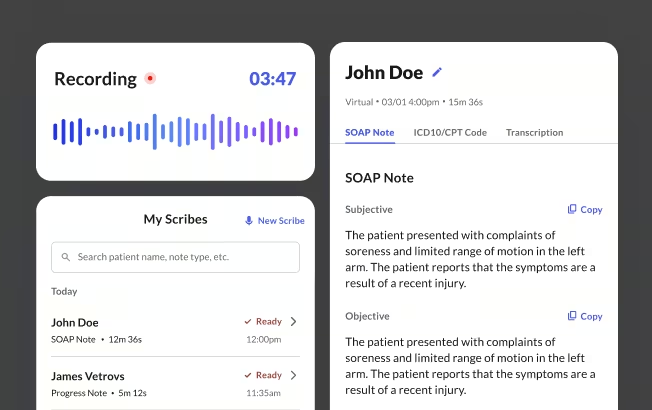
You can record visits on any device, in person or by telehealth, with Commure Scribe, and it recognizes multiple speakers. Within seconds of ending the recording, you see a structured SOAP note with suggested ICD-10 and CPT codes. The codes sit in a separate tab, and you always have the option to review the note before finalizing it.
In an independent practice or small group, you copy and paste through a Chrome extension overlay. Larger groups can get EHR integrations by contacting Commure's sales team. Advanced integrations and admin controls are gated to higher tiers. Specialty templates and a custom template builder let you shape the note to a primary care visit.
The 7-day trial needs no credit card, and group pricing is quoted. Before a group rollout, confirm the sync path for your EHR and how your NPs will check suggested codes against the billing path they use.
Dragon Copilot
Best for: you if you work in a health system that already licenses Microsoft's clinical tools.
Dragon Copilot documents problem-by-problem notes and E/M coding with an explanation. If you run a small practice, you can't buy it on published terms. Microsoft sells subscriptions through its customer, partner and enterprise agreements.² A Flex license includes 10 AI-assisted sessions a month, extra sessions cost $0.25 each, and the license's monthly fee is not listed.² No trial is published.
If you choose the primary care or family NP specialty setting, you get Family Medicine output.³ The psychiatric and mental health NP setting gives you Psychiatry output.³ Microsoft's US specialty reference shows a Family Medicine assessment and plan built problem by problem, with a three-problem example.⁴ Coding prompts support "ICD-10, HCC, E&M, SNOMED CT, CPT, and more," including a suggested E/M level with an explanation.⁵ HCC stands for hierarchical condition category, the code set used for risk adjustment.
The note lands inside Epic's Haiku, Canto and Hyperdrive apps, and Microsoft names no other EHR on that page.⁶ Microsoft DAX, an earlier product in this line, was tested in a randomized trial of 238 physicians.⁷ Its drop in note time did not differ significantly from the control group.⁷ athenahealth announced in December 2025 that Dragon Copilot would be offered inside athenaOne's Ambient Notes, scheduled for the first half of 2026.⁸ If your practice runs athenaOne, ask whether that option is live for your contract. If you work in a health system, ask whether its license already covers NPs before you plan a separate purchase.
Freed
Best for: you if your practice runs a browser-based EHR and you want published prices and a push into the chart.
Freed publishes a dollar price for every self-serve plan. Plans run from $39 a month for Starter, which caps output at 40 notes a month.⁹ Premier costs $119 a month, or $104 billed annually.⁹ Groups are priced by quote, and the 7-day trial needs no credit card.⁹ The lower plans show sale prices, so confirm them on the day you buy.
Premier adds ICD-10 and CPT coding and EHR push.⁹ The push maps and transfers the note into an open chart in a browser-based EHR.¹⁰ Freed lists SimplePractice, Practice Fusion, athenahealth, Tebra, eClinicalWorks, Elation, AdvancedMD browser instances and NextGen Office among the EHRs it has verified.¹⁰ On Starter and Core, you get five transfers in total.¹⁰ In the template builder, a "Problem-Based" format puts "both an assessment and a plan within the same block" for each problem.¹¹
Freed's NP page names "Optimized ICD-10, CPT, and E/M codes" but does not describe how an E/M level is chosen.¹² The Groups plan adds SSO, admin dashboards and medical assistant users.⁹ Test the push into your own EHR during the trial on a day with your most complex visits.
Heidi Health
Best for: you if you practice solo in primary care and want to start free and see a multi-problem note structure before paying.
Heidi Health is the only scribe here with an ongoing free plan, so you can test it on real visits before any budget decision. The Clinician plan has a 14-day trial, and the Teams plan is sold through Heidi's team.¹³ In the US, the Clinician plan costs $150 per user per month, or $110 billed annually.¹³ A Max seat with a higher usage limit costs $409 a month.¹³
Heidi's template library includes a GP consult template that numbers each issue in the visit.¹⁴ Each issue gets its own history fields and its own assessment, which fits a multi-problem visit in primary care.¹⁴ Heidi's coding feature suggests ICD-10 and SNOMED codes, and you confirm, adjust or add codes in the note.¹⁵ The page lists no CPT codes, E/M levels or HCC codes.¹⁵ On October 14, 2026, it asked visitors to join a waitlist for access.¹⁵
EHR integration and single sign-on (SSO) are listed as custom on the Teams plan only.¹³ On the free and Clinician plans, expect to copy the note into your EHR. Ask whether the coding waitlist applies to your account before you count on code suggestions.
Nabla
Best for: you if you want to see why a code was suggested before you enter it.
Nabla's E/M tab shows you a suggested CPT or HCPCS code beside a predicted MDM level across problems addressed, data reviewed and risk.¹⁶ Coding is "MDM-based coding only," with no time-based option, and "Nothing is submitted automatically."¹⁶ The tab covers outpatient family medicine, general medicine, internal medicine and pediatrics.¹⁶
Nabla was one of two scribes tested in a randomized trial of 238 physicians across 14 specialties.⁷ Average note time with Nabla fell 41 seconds, from 4 minutes 30 seconds to 3 minutes 49 seconds.⁷ The control group's time fell 18 seconds.⁷
The homepage is titled for health systems, lists no price and offers a "Try it for free" sign-up.¹⁷ It names Epic, athenahealth, Oracle Health, NextGen and Greenway Health, and Nabla Connect lets an organization embed Nabla in its own systems.¹⁷ Ask what your practice would pay and how the note reaches your EHR at your size.
Sunoh.ai
Best for: you if your practice runs eClinicalWorks and you want the draft imported into the progress note.
Sunoh.ai starts at $149 per user per month "for a limited time," against a crossed-out $199 price.¹⁸ eClinicalWorks says Sunoh is "fully integrated" and imports content into the eClinicalWorks progress note.¹⁹ A free Chrome extension, EHR Sync, pushes finalized notes into browser-based EHRs, including athenahealth, Tebra and Practice Fusion.²⁰
The pages reviewed document no code suggestions. No trial length is published. The eClinicalWorks page adds that "Additional monthly charges may apply."¹⁹ Budget at the $199 figure, since the lower rate is promotional.
Twofold
Best for: you if you're a psychiatric NP or your visits are therapy-heavy and you want a low published price.
Twofold publishes a self-serve price with a 7-day trial that needs no credit card.²¹ The Personal plan costs $69 a month, or about $49 a month billed annually at 29% off, and a first-month discount is advertised.²¹ It suggests ICD-10 and CPT codes and picks time-based CPT codes from session length.²² No Twofold page reviewed mentions E/M levels or HCC codes.
Built-in templates include SOAP, SOAP for Mental Health, DAP and intake formats, plus BIRP notes.²³ One SOAP option combines the assessment and plan into a single section.²³ You copy and paste into your EHR from any section of the note.²⁴ The security page says Twofold "signs a Business Associate Agreement with every healthcare organization that uses the platform."²⁵ It is also "currently undergoing SOC 2 Type II certification."²⁵
Twofold's pages disagree on group terms. The help center sets a two-seat minimum for groups.²⁶ The groups page says the plan "starts at 3 clinicians."²⁷ Confirm group pricing and seat minimums in writing.
VoiceboxMD
Best for: you if you want published monthly tiers and a plain statement of what the product does not do.
VoiceboxMD's NP page states what the product does not do. It says the product "has no E/M leveling feature" and "gives no incident-to or split/shared billing guidance."²⁸ It suggests ICD-10 and CPT codes and shows the note text that supports each one.²⁸ Code suggestions come on the $79 and $99 plans.²⁹
Plans cost $49, $79 or $99 a month, with group pricing on request.²⁹ Monthly plans include a 7-day trial and annual plans a 14-day trial, and a card is collected at checkout.³⁰ The desktop app types your dictated text into whatever EHR field you have open.²⁸ VoiceboxMD "does not connect to your EHR or read what is in it."²⁸ A business associate agreement (BAA) is provided to every subscriber.²⁹
The NP page describes "one structured note per encounter," with SOAP and history and physical (H&P) formats built in.²⁸ Check how a three-problem visit comes out before you rely on the assessment and plan.
Built for Health Systems, Not NP Practices
If you work in a health system, Abridge, Ambience or Commure Ambient AI may already be licensed where you practice. All three are sold to health systems on unpublished terms, so they sit outside the comparison tables.
Abridge says it has "Partnered with 300+ health systems."³¹ Ambience describes itself as "trusted enterprise-wide at the most complex health systems in the country."³² Ambience lists "ICD-10, HCC/MCC/CC classifications, and E&M levels" among its coding outputs, with the clinician there to attest.³² For enterprise health systems, Commure sells Commure Ambient AI.³³ Its autonomous coding generates CPT and ICD-10 codes, modifiers, charge headers and quality measures.³³ If your health system holds any of these contracts, ask whether it covers advanced practice clinicians.
What Does the Research Show for Nurse Practitioners?
Four studies of ambient AI scribes include NPs or other advanced practice clinicians, all in health systems or academic medical centers. Only one, a 15-clinician pilot, studied advanced practice providers alone.
Rotenstein's team found the effects were "greatest for primary care specialists, advanced practice clinicians, female clinicians."³⁵ In the Wright pilot, the share of AI-drafted content each clinician kept ranged from 20% to 93%.³⁴ Clinicians in that pilot used the scribe on two of every three notes.³⁴
Your own practice, where you own the business, sign the notes and buy the software, is a different setting. Run your own trial on your busiest days, and measure chart closure and edit time.
How Does an AI Scribe Fit NP Billing, HIPAA and Consent Rules?
Medicare billing, HIPAA and state recording laws apply whichever AI scribe for NPs drafts your note. Settle them before your first recorded visit.
If you bill Medicare under your own national provider identifier (NPI), you are paid up to 85% of the physician rate.⁴⁰ Incident-to billing under a supervising physician is paid at 100% of the fee schedule only when every CMS condition is met.⁴¹ The physician must have done the initial service for this course of treatment and stay actively involved. Because the physician must have done that initial service, a new problem only you have seen does not qualify.⁴¹ The service must be an integral part of the patient's normal treatment and commonly provided in the office.⁴¹ It must also be included in the physician's bill, an expense to the physician and in line with state law.⁴¹ Incident-to does not apply in a hospital or skilled nursing facility.⁴² It needs direct supervision, though behavioral health services can be done under general supervision.⁴¹ Incident-to services that you supervise are paid at 85%.⁴¹ You choose the billing path, and your note has to support it.
The visit level rests on medical decision making (MDM) or total time. CMS lets you "choose the visit level based on the level of MDM or the amount of time you spend with the patient."⁴³ Total time means your reportable time on the patient's care on the date of service.⁴³ Nabla documents MDM-based levels only. Twofold suggests time-based CPT codes from session length, which is not E/M total time. VoiceboxMD has no leveling feature. Check each suggested code against your note before you finalize it. In a facility setting, a visit you share with a physician is billed under CMS's split or shared visit rules.⁴³ Those rules don't apply to office visits.⁴³
Any scribe vendor that handles protected health information (PHI) for your practice is your business associate under HIPAA. HHS lists "the vendor of an app, that provides transcription services to a physician" as an example.⁴⁴ You need "satisfactory assurances, in the form of a contract or other written arrangement," that the vendor will safeguard the data.⁴⁴ The vendor must also have its own agreement with any subcontractor that handles PHI.⁴⁴ If you're in independent practice, vet each vendor's privacy standards yourself, the NP journal review advises.¹
A quality improvement study at an academic health center involved 18 clinicians and 103 patients.⁴⁵ Patient comfort with recording varied with trust in the clinician and with how well patients understood the tool, so explain the scribe before you record.⁴⁵ The authors recommend "flexible, multimodal approaches that include education, digital tools, and opt-out options."⁴⁵ Each state has its own audio recording and consent rules, so confirm yours.¹
The scribe hears audio only, which changes how you run the exam and review the draft. If you use a scribe, "including artificial intelligence technology," Medicare guidance tells you to sign the entry yourself.⁴⁶ Build these habits into each recorded visit:
- Say the exam out loud. The scribe "cannot 'see' the visit," so describe each finding as you examine.¹
- Name the sections. State the plan aloud, for example, so the draft places it in the right section.¹
- Check every system marked normal. A scribe may call a body system "within normal limits based on minimal verbal prompts."¹
- Read for added words. AI scribes "can sometimes confabulate and insert words not specifically said during the visit."¹
How Was This Comparison Built?
Each AI scribe is described from its vendor's pricing pages, product pages and help center, and none is scored or ranked.
The same rules apply to all eight. "Not documented" means the pages reviewed did not describe the feature, not that the product lacks it. Vendor-reported time savings and accuracy figures are left out.
No product was tested. Vendor pages were read through a text-extraction tool between October 11 and October 14, 2026, so check quoted wording against each live page.
Where Does Commure Scribe Stand?
Commure has confirmed, but not yet published, details on the per-problem layout, how suggested codes are checked, quality controls and group administration.
On public pages, Commure Scribe documents no ready-made per-problem template, no E/M basis, no HCC codes and no independent study. At self-serve sizes, notes reach the EHR by copy and paste. Dragon Copilot, Freed and Heidi Health publish a per-problem layout. Dragon Copilot and Nabla show an E/M basis, and Freed and Sunoh.ai push into listed EHRs. Nabla and Microsoft's earlier DAX were tested in a randomized trial.
How Does Commure Scribe Fit an NP Practice?
Commure Scribe follows a Capture, Edit, Finalize workflow, so you can stay present in the room while the visit is recorded. Within seconds of clicking End Recording, you see a structured SOAP note. Suggested ICD-10 and CPT codes are generated with it. You always have the option to review the note before finalizing it.
The suggested codes sit in a separate tab. You can check each one against the visit's billing path before finalizing, whether your own NPI or incident-to where every condition is met. Specialty templates and a custom template builder let you set up the note sections a primary care, psychiatric or pediatric visit needs. Commure Scribe works across a wide range of specialties, including family medicine, internal medicine, psychiatry and pediatrics, among others.
Verified integrations cover several EHRs your practice may run, including athenahealth, eClinicalWorks, Elation, Tebra, Practice Fusion, AdvancedMD, and SimplePractice. In an independent practice or small group, you copy and paste through a Chrome extension overlay. In a larger group, you can contact Commure's sales team for EHR integrations. AI Copilot helps with documentation tasks generated from the encounter, such as prior authorization requests and patient emails.
More Guides for NP Practices Choosing an AI Scribe
These guides cover the privacy, specialty and EHR details you'll weigh next when choosing an AI medical scribe for nurse practitioners.
- Ten platforms rated across specialties and practice sizes: best AI medical scribes.
- Business associate agreements, data handling and audit readiness: HIPAA-compliant AI note-taking.
- Scribes scored for psychiatric visits and behavioral health notes: best AI scribe for psychiatry.
- Scribes compared on how notes reach eClinicalWorks: eClinicalWorks AI scribe.
- Scribes compared on how notes reach athenahealth: best AI scribe for athenahealth.
- Coding, EHR integration and pricing in one vendor review: Nabla AI review.
Try Commure Scribe on a full clinic day
Commure Scribe is one of the eight scribes compared above, and a full clinic day is a fair test of any of them. Record a few multi-problem visits during the 7-day trial and check each suggested code against your billing path. Compare options by practice size on Commure Scribe pricing and plans.
Vendor details were checked against each vendor's own pages between October 11 and October 14, 2026. Prices and features change, so confirm current terms with each vendor before you buy.
This article is for informational and educational purposes only, does not constitute legal, medical, or professional advice, and does not guarantee documentation, coding or reimbursement outcomes.
Frequently Asked Questions
The best AI scribe for nurse practitioners organizes a multi-problem visit by problem, shows the basis for each suggested code and fits how notes reach your EHR. Commure Scribe is one of eight compared here. If you practice solo and want an ongoing free plan, look at Heidi Health. If you work in a health system with a Microsoft license, look at Dragon Copilot. If your practice runs a browser-based EHR, look at Freed. Run your own trial before you choose, since no study covers an independent NP practice.
Commure Scribe is HIPAA compliant and SOC 2 certified. For any AI scribe for NPs, you need a business associate agreement before the vendor handles PHI. Your practice still owes its own HIPAA risk analysis. VoiceboxMD provides a BAA to every subscriber. Twofold says it signs one with every organization that uses it. For the other scribes, ask for the signed BAA before a free plan or trial records a patient.
Commure Scribe publishes its plan for independent practices and small groups and quotes plans for larger groups. Among the others, published self-serve prices run from $39 to $150 per clinician per month at current rates. Heidi Health's Clinician plan costs $150 a month, or $110 billed annually. Freed lists $39 to $119 a month. VoiceboxMD lists $49 to $99 a month. Twofold costs $69 a month, or about $49 a month billed annually. Sunoh.ai lists a starting price of $149 per user per month for a limited time, against a crossed-out $199 price.
These AI scribes draft documentation and leave the clinical work to you. You still examine, decide and sign. If you use a scribe, "including artificial intelligence technology," Medicare guidance tells you to sign the entry yourself. The studies that included NPs measured documentation time, chart closure and burnout.
The scribe works from audio, so a finding you leave unspoken never reaches the draft. The Journal for Nurse Practitioners review says the scribe "cannot 'see' the visit." To document your exam, "the provider must verbalize the aspects of the examination." It also warns that a scribe may call a body system normal from minimal verbal prompts.
Commure Scribe offers a 7-day trial with no credit card, which expires. Heidi Health is the only scribe here with an ongoing free plan, with usage limits. Freed offers a 7-day trial with no card. Twofold does the same. VoiceboxMD collects a card at checkout for its trial. Nabla offers a free sign-up, but its terms are not published.
Sources
- Eikenhorst A, Allred M. "Listening Between the Lines: AI Scribe Technology Advancing NP Care." The Journal for Nurse Practitioners. 2026;22(1):105613. https://doi.org/10.1016/j.nurpra.2025.105613. 2026.
- Microsoft. Dragon Copilot licensing guidance. https://www.microsoft.com/licensing/guidance/Dragon-Copilot. 2026.
- Microsoft Support. AI specialty mapping. https://support.microsoft.com/en-us/topic/ai-specialty-mapping-f35629f6-906d-4697-a5e8-78b1e63d1af8. 2026.
- Microsoft (Nuance). Dragon Copilot US specialty reference. https://csocontent.nuance.com/Hub/Dragon-Copilot/US-Specialty-Presentation.pdf. 2026.
- Microsoft Support. Use AI prompts for coding. https://support.microsoft.com/en-us/dragon-copilot/physicians/use-ai-prompts-for-coding. 2026.
- Microsoft Support. Dragon Copilot in mobile EHR apps. https://support.microsoft.com/en-us/dragon-copilot/physicians/dragon-copilot-in-mobile-ehr-apps. 2026.
- UCLA Health. "UCLA study finds AI scribes may reduce documentation time and improve physician well-being." Press release on Lukac et al., NEJM AI. https://www.uclahealth.org/news/release/ucla-study-finds-ai-scribes-may-reduce-documentation-time. 2025.
- athenahealth. "athenahealth Collaborates with Microsoft to Offer Microsoft Dragon Copilot as Ambient Notes Option for Ambulatory Clinicians." Press release, December 9, 2025. https://www.athenahealth.com/press-releases/athenahealth-collaborates-with-microsoft-to-offer-microsoft-dragon-copilot. 2025.
- Freed. Pricing. https://www.getfreed.ai/pricing. 2026.
- Freed Help Center. EHR push. https://help.getfreed.ai/en/articles/11328264-magic-push. 2026.
- Freed Help Center. Structured templates: editing the assessment and plan section. https://help.getfreed.ai/en/articles/11408952-structured-templates-editing-assessment-plan-section. 2026.
- Freed. AI scribe for nurse practitioners. https://www.getfreed.ai/specialty/nurse-practitioners. 2026.
- Heidi Health. Pricing (US). https://www.heidihealth.com/en-us/pricing. 2026.
- Heidi Health. Main template: GP consult, template library. https://www.heidihealth.com/en-gb/templates/main-template-gp-consult-1b1b1f64. 2026.
- Heidi Health. Medical coding. https://www.heidihealth.com/en-us/product/coding. 2026.
- Nabla Help Center. E/M coding: how it works. https://help.nabla.com/en/articles/9875458. 2026.
- Nabla. Ambient AI documentation for health systems. https://www.nabla.com/. 2026.
- Sunoh.ai. Pricing. https://www.sunoh.ai/pricing. 2026.
- eClinicalWorks. Sunoh.ai medical scribe technology for clinical documentation. https://www.eclinicalworks.com/sunoh-ai-medical-scribe-technology-for-clinical-documentation/. 2026.
- Sunoh.ai. EHR Sync. https://sunoh.ai/ehr-sync/. 2026.
- Twofold. Pricing. https://www.trytwofold.com/pricing. 2026.
- Twofold. AI scribe with billing support. https://www.trytwofold.com/solutions/ai-scribe-with-billing-support. 2026.
- Twofold Help Center. Supported note templates. https://help.trytwofold.com/en/articles/9780287-supported-note-templates. 2026.
- Twofold Help Center. Editing and finalizing notes. https://help.trytwofold.com/en/articles/9780281-editing-and-finalizing-notes. 2026.
- Twofold. Security. https://www.trytwofold.com/security. 2026.
- Twofold Help Center. Twofold Groups. https://help.trytwofold.com/en/articles/13529190-twofold-groups. 2026.
- Twofold. For groups. https://www.trytwofold.com/for-groups. 2026.
- VoiceboxMD. AI scribe for nurse practitioners. https://www.voiceboxmd.com/ai-scribe-for-nurse-practitioners. 2026.
- VoiceboxMD. Pricing. https://www.voiceboxmd.com/pricing. 2026.
- VoiceboxMD. Home page. https://www.voiceboxmd.com/. 2026.
- Abridge. Customers. https://www.abridge.com/customers. 2026.
- Ambience Healthcare. Home page. https://www.ambiencehealthcare.com/. 2026.
- Commure. Commure Ambient AI. https://www.commure.com/ambient-ai. 2026.
- Wright A, Seaters D, DeLemos C. "Navigating Collective Bargaining Barriers to the Implementation of AI Scribe Technology Among Ambulatory Advanced Practice Providers: Mixed Methods Quality Improvement Study." JMIR Formative Research. 2026;10:e92364. https://formative.jmir.org/2026/1/e92364. 2026.
- Rotenstein LS, et al. "Changes in Clinician Time Expenditure and Visit Quantity With Adoption of Artificial Intelligence-Powered Scribes: A Multisite Study." JAMA. 2026. https://jamanetwork.com/journals/jama/article-abstract/2847319. 2026.
- Mass General Brigham. "AI Scribes Linked to Modest Reductions in EHR Documentation Time." https://news.massgeneralbrigham.org/en/ai-scribes-linked-to-modest-reductions-in-ehr-documentation-time. 2026.
- Olson KD, Meeker D, Troup M, et al. "Use of Ambient AI Scribes to Reduce Administrative Burden and Professional Burnout." JAMA Network Open. 2025;8(10):e2534976. https://doi.org/10.1001/jamanetworkopen.2025.34976. 2025.
- You JG, et al. "Ambient Documentation Technology in Clinician Experience of Documentation Burden and Burnout." JAMA Network Open. 2025. https://doi.org/10.1001/jamanetworkopen.2025.28056. 2025.
- Mass General Brigham. "Ambient Documentation Technologies Reduce Physician Burnout." https://news.massgeneralbrigham.org/en/ambient-documentation-technologies-reduce-physician-burnout. 2025.
- Electronic Code of Federal Regulations. 42 CFR 414.56, Payment for nurse practitioners' and clinical nurse specialists' services. https://www.ecfr.gov/current/title-42/chapter-IV/subchapter-B/part-414/subpart-B/section-414.56. 2026.
- Centers for Medicare & Medicaid Services. Incident To Services & Supplies. https://www.cms.gov/medicare/payment/fee-schedules/physician-fee-schedule/advanced-practice-non-physician-practitioners/incident-services-supplies. 2026.
- Electronic Code of Federal Regulations. 42 CFR 410.26, Limitations on coverage of certain services furnished incident to a physician's professional service. https://www.ecfr.gov/current/title-42/chapter-IV/subchapter-B/part-410/subpart-B/section-410.26. 2026.
- Centers for Medicare & Medicaid Services, Medicare Learning Network. Evaluation and Management Services (MLN006764). https://www.cms.gov/files/document/mln006764-evaluation-management-services.pdf. 2026.
- U.S. Department of Health and Human Services, Office for Civil Rights. Business Associates. https://www.hhs.gov/hipaa/for-professionals/privacy/guidance/business-associates/index.html. 2026.
- Lawrence K, et al. "Informed Consent for Ambient Documentation Using Generative AI in Ambulatory Care." JAMA Network Open. 2025. https://doi.org/10.1001/jamanetworkopen.2025.22400. 2025.
- Centers for Medicare & Medicaid Services, Medicare Learning Network. Complying with Medicare Signature Requirements (MLN905364). https://www.cms.gov/files/document/mln905364-complying-medicare-signature-requirements.pdf. 2025.
- U.S. Department of Health and Human Services, Office for Civil Rights. Guidance on Risk Analysis. https://www.hhs.gov/hipaa/for-professionals/security/guidance/guidance-risk-analysis/index.html. 2026.
.jpeg)

.jpeg)

.jpeg)
.jpeg)