



DeepCura Review: Pricing, EHRs and Evidence
What DeepCura publishes on price, integration and security, and the gaps worth checking first.
Written by the Commure Scribe Team
Published: October 4, 2026
•
10 min read
Updated October 4, 2026
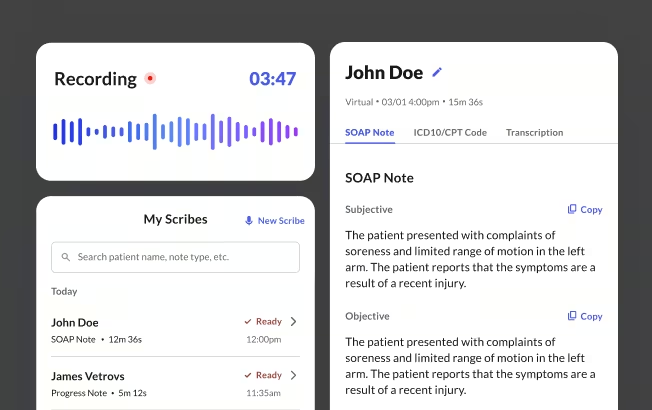
DeepCura bundles an ambient scribe with receptionist, billing, intake and fax agents at $129 per provider per month. It publishes no SOC 2 report.
What You Need to Know About DeepCura
- DeepCura charges independent practices $129 per provider per month. One price covers an ambient scribe plus receptionist, billing, intake and fax agents, with 1,000 credits per seat.
- Every EHR write-back comes at the entry price, but depth varies: three systems take notes into the chart and the rest are paste.
- Check the security page first, since DeepCura publishes a Cloud Application Security Assessment (CASA) Tier 2 assessment rather than a System and Organization Controls 2 (SOC 2) report.
What Is DeepCura, and Who Is It Built For?
DeepCura is built for practices that want one subscription covering more than the note. The vendor states that the platform runs an ambient scribe alongside receptionist, billing, intake and fax agents. Those features are included at a single per-provider price.¹ The buyer is a practice weighing how many separate tools it wants to pay for.
Scope matters before price. A clinician comparing DeepCura to a note-only scribe is comparing different things, and price alone will not show it. Three questions decide fit: what the platform writes into the chart, what it charges as seats are added, and what its security posture certifies.
DeepCura publishes its per-seat price, and it publishes no independent evaluation of the product. For a ranked view across the wider field, see the guide to the best AI medical scribes.
How Much Does DeepCura Cost?
DeepCura publishes its rates rather than quoting them on request. A seat costs $129 per provider per month, or $999 per provider per year.¹ The annual term saves $549 against twelve monthly payments. Each seat includes 1,000 monthly credits, and a standard note costs one credit. A buyer can price a seat without contacting sales.
Larger seat counts carry published discounts, bracketed rather than flat. Each seat bills at its own bracket's rate, so a practice pays a blended average.
- Seats one and two: $129 each per month
- Seats three to five: $116 each per month
- Seats six to ten: $110 each per month
- Seats eleven and above: $101 each per month
DeepCura publishes worked totals. Three seats cost $374 a month, a blended $125 per provider, and ten seats cost $1,156, a blended $116.¹ Fifty seats reach a blended $104. The headline $101 applies to the eleventh seat onward, not to a whole team.
Those tiers apply to monthly billing. The vendor states that a $59 monthly add-on lifts a seat from 1,000 to 2,000 credits.¹ The add-on is the only published route past the included allowance. A practice running high visit volume should work out its credit use before committing.
There is no free plan. The vendor states that every new account gets a free trial, with credits to explore all features.¹ You start without a credit card. What happens once the trial allowance is spent is not published. Category pricing across vendors is covered in the guide to AI scribe pricing.
What Does DeepCura Actually Do?
DeepCura generates a clinical note and then routes suggested chart updates through a clinician approval step. The review screen shows each suggested update with its verbatim quote and the exact second of audio behind it. The vendor states that "Nothing touches the chart without your click."² The approval step is a described mechanism rather than a general assurance.
Coding sits alongside the note. The platform proposes an E/M level with its reasoning, adding ICD-10 diagnoses and add-on CPT codes such as 90833 and 96127 when the note supports them.² It flags undercoding and overcoding risk before claim submission.² A research feature checks the note against indexed literature, clinical guidelines and FDA drug labels. It sorts what it finds by severity, with sources shown inline.²
Three details come from the vendor rather than from inference. The platform runs general-purpose models with configurable templates instead of specialty-tuned models.³ It covers 50 or more specialties and lists 34 languages.³ DeepCura keeps visit audio with the encounter by default, which is what makes the audio timestamp on each suggestion possible.⁴
Which EHRs Does DeepCura Write Back To?
DeepCura's integration table lists eight live EHRs, with a ninth in certification.² Its own headline figure says "7+ native EHR integrations," and depth varies by system. The homepage names athenahealth, eClinicalWorks and AdvancedMD for notes, diagnoses and orders written into the chart. On any other EHR, "the note is yours to paste."² DeepCura describes only athenahealth as bidirectional. Integration is included on every plan rather than gated to a higher tier.
Some systems carry a named destination and others appear without one.
- OptiMantra, where the note lands in the S, O, A and P fields
- AdvancedMD, where the charge posts to the encounter
- athenahealth, where the charge posts to the encounter
- eClinicalWorks, where content arrives as "Add EM" and "Add CPT" lines
- Practice Fusion, through a native integration
- Epic, where the note is filed as a document
- Charm Health, where the SOAP note saves into the encounter
- OpenEMR, included at no extra cost
DeepCura lists Veradigm as in certification, so a practice on Veradigm cannot count on it yet.² For Epic, the vendor states that notes push in per section through Fast Healthcare Interoperability Resources (FHIR) R4 DocumentReference resources.⁴ Naming the destination field for each system lets a practice picture the handoff before buying. How write-back differs across vendors is covered in the guide to EHR integrations.
What Does the Evidence Behind DeepCura Show?
The published evidence is a security assessment rather than a clinical one. DeepCura carries a CASA Tier 2 verification.² It describes its own practices as "SOC 2-aligned," which is the vendor's wording rather than a finished audit.⁴ CASA is an application-security program run through the App Defense Alliance and tied to Google API access, and it does not evaluate note quality.
The vendor states that it is fully HIPAA compliant and provides a Business Associate Agreement to all covered entities.⁴ DeepCura encrypts data in transit at Transport Layer Security (TLS) 1.2 or above, and at rest with 256-bit Advanced Encryption Standard (AES).⁴
Third-party validation is the shortest part of the record. No KLAS Research rating and no peer-reviewed research appear on the pages reviewed.²
One sourcing point matters for anyone researching DeepCura. The vendor publishes a network of comparison and review articles covering other scribes, authored by its founder and chief executive. Several rank DeepCura first: its fifteen-scribe roundup scores it 9.25 out of 10.³ Others use an unranked fit table, and at least one discloses that DeepCura publishes the guide and is among the tools discussed. That network is vendor marketing rather than independent assessment.
What Does DeepCura Not Publish?
DeepCura publishes no SOC 2 report. Its pages call the product "SOC 2-aligned," which names practices, not a finished audit.⁴ The one assessment it names is CASA Tier 2, verified by TAC Security.⁵ The Terms of Service commit to sending that report on request.⁵
No accuracy figure appears on the pages reviewed, self-reported or otherwise, and DeepCura publishes no test protocol.² The two scale figures DeepCura publishes, 6,000 or more active clinicians and more than a million clinical encounters, carry no stated basis.²
The retention policy is published without an outer limit. DeepCura's Terms of Service say audio is kept in encrypted form until the clinician deletes the note, asks for deletion, or closes the account.⁵ Evidence-audio retention can be switched off, and nothing is stored once transcription ends. The vendor commits to confirm deletion within seven business days.⁵
How Commure Scribe Compares on the Same Dimensions
The scribe product Commure sells is Commure Scribe, an ambient AI scribe used by 75,000+ clinicians across 25M+ patient encounters annually.
On integration breadth, Commure Scribe carries 60+ EHR integrations, against the eight DeepCura publishes as live. Commure Scribe is HIPAA compliant and SOC 2 certified, with onshore data storage, and its retention terms are published.
Audio is stored and encrypted for one year active and then archived. The archive period runs to a six-year minimum, with an expedited 14-day option. A user can permanently delete transcripts and notes at any time. Audio is never used for AI training or product improvement. Commure Scribe detects 90+ languages automatically, with no manual selection step, where DeepCura lists 34.
On the note, value arrives immediately after the clinician clicks End Recording. A structured SOAP note appears within seconds. Suggested ICD-10 and CPT codes sit in a separate tab for the clinician to check. The clinician always has the choice to review and finalize the note before it enters the chart. Recording runs up to two hours continuously per session. AI Copilot handles documentation tasks generated from the encounter, such as prior authorization requests and work excuse letters.
Two limits run the other way. At one to five providers, Commure Scribe moves the note by copy and paste through a Chrome extension overlay. DeepCura includes write-back at its entry price. One-click sync belongs to medium and large group practices, and pricing above five providers is custom rather than published. A solo practice comparing published per-seat costs across seat counts will find DeepCura's figures easier to model.
Related guides
The guides below cover the wider category, what vendors charge, and how a note reaches the chart.
- For a ranked view of the wider field by practice size and EHR, start with best AI medical scribes.
- For what vendors across this category charge, and which publish a figure at all, see AI scribe pricing.
- For what write-back, one-click sync and copy and paste each mean for the clinician moving a note, see EHR integrations.
- For how ambient documentation works before comparing products, see AI medical scribe.
- For the systems a scribe has to write into, start with best EMR software.
- For the note format DeepCura saves into the Charm Health encounter, see SOAP notes.
- For what its intake agent collects before the visit, see patient intake forms.
- For the first of the three systems DeepCura writes into, see athenahealth AI scribe.
- For the second, see eClinicalWorks AI scribe.
- For the third, see AdvancedMD AI scribe.
Test a scribe against your own visits
A DeepCura review covers what the vendor publishes. Only a trial on your own visits shows how a note reads afterward. Current Commure Scribe terms are published under Commure Scribe pricing and plans.
Verified against DeepCura's own published pages on September 26, 2026. Pricing and integrations in this category change often. Check current details with the vendor before deciding.
This article is for informational and educational purposes only, does not constitute legal, medical, or professional advice, and does not guarantee any particular documentation, coding, or security outcome.
Frequently Asked Questions
DeepCura charges $129 per provider per month, or $999 per provider per year, with 1,000 monthly credits per seat. DeepCura brackets its seat discounts rather than applying one flat rate, so your blended rate falls as you add seats. It reaches about $116 per provider at ten seats and about $104 at fifty, on monthly billing. A $59 monthly add-on doubles the credit allowance.
DeepCura states that it is fully HIPAA compliant and provides a Business Associate Agreement to all covered entities. It has no published SOC 2 report. The vendor describes its practices as "SOC 2-aligned" and publishes a CASA Tier 2 verification instead. CASA assesses application security rather than note quality.
DeepCura lists eight as live: OptiMantra, AdvancedMD, athenahealth, eClinicalWorks, Practice Fusion, Epic, Charm Health and OpenEMR. Veradigm is described as in certification. Depth varies. The homepage names athenahealth, eClinicalWorks and AdvancedMD for writing into the chart, and says the note is yours to paste on any other EHR. Integration is included on every plan rather than gated to a higher tier.
Yes. Every new account gets a free trial, with credits to explore all features. You start without a credit card. There is no permanent free plan, and DeepCura does not publish what happens once the trial allowance is spent.
DeepCura proposes an E/M level with its reasoning, plus ICD-10 diagnoses and add-on CPT codes such as 90833 and 96127. It flags undercoding and overcoding risk before claims go out. The published material names add-on codes rather than a full procedural code set. A practice billing procedure-heavy visits should confirm coverage beyond add-ons.
Sources
- DeepCura. "Pricing." https://www.deepcura.com/plans-pricing 2026.
- DeepCura. "Beyond the EHR: The Electronic Health Workforce (EHW)." https://www.deepcura.com/ 2026.
- Cowan, Fernando. "15 Best AI Medical Scribes in 2026 (Ranked & Compared)." DeepCura. https://www.deepcura.com/resources/compare/best-ai-medical-scribes 2026.
- Cowan, Fernando. "Best AI Scribe for Epic (2026)." DeepCura. https://www.deepcura.com/resources/ai-scribe-epic 2026.
- DeepCura. "Terms of Service." https://www.deepcura.com/resources/terms-of-service 2026.
.jpeg)



.jpeg)


.jpeg)
.jpeg)