





The Complete Guide to SOAP Notes: Format, Templates, Examples, and Best Practices (test)
Written by the Commure Scribe Team
Published: April 9, 2026
•
min read
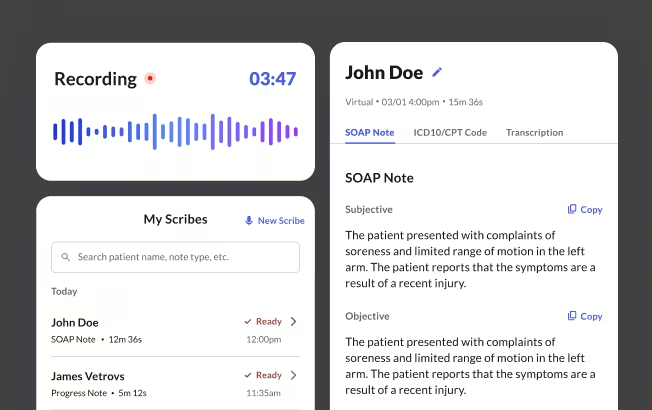
What does each section of a SOAP note contain?
A SOAP note has four sections, each with a distinct job. Subjective captures what the patient reported. Objective captures what the clinician observed and measured. Assessment is the clinical interpretation. Plan is every action taken or recommended. Most documentation problems come from mixing up what belongs where.
In the Subjective section, document the chief complaint and history of present illness in the patient's own words. Include:
- Onset, duration, quality, and severity of symptoms
- Aggravating and alleviating factors
- Relevant context and associated symptoms
- Past medical history, family history, and social history
- Current medications as reported by the patient
Common errors in S:
- Using a clinical label instead of the patient's report "patient reports dyspnea" instead of "patient reports shortness of breath"
- Interpreting symptoms instead of recording them
- Leaving the chief complaint vague when the patient used specific words
In the Objective section, record everything you observed and measured. Everything in O must be independently verifiable. Include:
- Vital signs
- Physical exam findings
- Lab values, imaging results, and point-of-care test results
- Range of motion, gait, wound dimensions, and neurological findings
- Mental status exam findings when directly observed
If the patient says they feel anxious, that belongs in S, not O. However, the clinician can report in physical exam that the patient "appears/acts anxious."
Common errors in O:
- Using global summaries instead of measurements ("ROM exercises performed" without the measured range)
- Including clinical interpretations that belong in A
- Omitting normal findings, which matters for billing and legal review
In the Assessment section, state your clinical interpretation of the S and O data. For a simple visit, this is a working or confirmed diagnosis. For a complex visit, list each problem in order of priority. A common error is restating the chief complaint ("patient presents with knee pain") instead of stating clinical judgment ("right medial knee pain, likely early osteoarthritis, no signs of effusion or instability on exam").
The Assessment is the most consequential section for billing. ICD-10 codes on a claim must be supported by what is written in A. Vague assessments, like "patient doing better" or "symptoms improving," create denial risk.
In the Plan section, document every action taken or recommended, organized by problem. Include:
- Medications: drug, dose, route, frequency, and duration
- Referrals, labs, and imaging ordered
- Patient education provided
- Follow-up timing and return-to-care instructions
The plan should be specific enough that a colleague could act on it without calling you. "Continue current management" is not a plan. "Continue metformin 1000mg BID, recheck HbA1c in 3 months, patient counseled on dietary changes, follow up in 3 months" is a plan.
Common errors in P:
- Vague entries that omit the specific action
- Missing patient education
- No follow-up timing: a clinical and billing requirement
What does a complete SOAP note look like in practice?
Primary care notes manage multiple problems. Psychiatry notes center on mental status and safety. Physical therapy notes focus on functional measurement and progress.
Example 1: Primary care, established patient follow-up
S: 45-year-old male presents for type 2 diabetes follow-up. Reports good medication adherence. No hypoglycemic episodes since last visit. Fatigue improved. No new complaints.
O: BP 128/82, HR 74, weight 194 lbs (down 3 lbs). FBG 118 per patient report. HbA1c 7.1% from last week.
A: Type 2 diabetes mellitus, improving glycemic control. Weight trending down. BP within goal range.
P: Continue metformin 1000mg BID. Reinforce dietary progress. Recheck HbA1c in 3 months. Patient counseled on weight management. Follow up in 3 months or sooner if symptoms change.
Example 2: Psychiatry, established patient medication management
S: 32-year-old female presents for MDD medication management. Reports mood "about a 6 out of 10." Sleep improved since sertraline increase 4 weeks ago. Appetite low. Denies SI/HI. No new stressors.
O: Alert and oriented x3. Affect appropriate, mildly constricted. Speech normal in rate and volume. Thought process is linear. No psychomotor changes. PHQ-9 score: 11 (moderate).
A: Major depressive disorder, moderate, partial response to sertraline 100mg. Sleep improving. Appetite and energy suboptimal.
P: Continue sertraline 100mg daily. Add mirtazapine 7.5mg QHS for appetite and sleep. Patient counseled on new medication and side effects. Return in 4 weeks or call if adverse effects. Repeat PHQ-9 at next visit.
Example 3: Physical therapy, initial evaluation
S: 58-year-old male referred for right shoulder pain after rotator cuff repair 8 weeks ago. Pain 5/10 at rest, 8/10 with overhead reach. Unable to lift arm above shoulder height. Home exercises done inconsistently due to pain.
O: ROM right shoulder: flexion 85°, abduction 70°, external rotation 30°. Strength: 3/5 flexion, 3/5 abduction. Incision healed. No swelling or erythema. Mild forward head posture, elevated right shoulder girdle.
A: Right shoulder post rotator cuff repair, 8 weeks post-op. ROM and strength deficits consistent with surgical timeline. Forward head posture contributing to impingement pattern.
P: Begin PT: PROM progressing to AROM, scapular stabilization, rotator cuff strengthening. HEP reviewed and corrected. Patient educated on posture and load management. Goal: 120° flexion and 4/5 strength in 6 weeks. Next visit in 3 days.
What are the most common SOAP note mistakes, and which ones affect billing?
Most SOAP note errors fall into three categories: wrong-section placement, vague language, and copy-forward habits. Wrong-section errors undermine credibility. Vague language creates billing exposure. Copy-forward notes generate audit risk and continuity failures.
Placing clinical interpretations in the wrong section is one of the most common structural errors. Documenting a diagnosis in S ("patient is diabetic") instead of the patient's report ("patient reports managing diabetes with metformin") conflates your knowledge with theirs. Documenting exam findings in A instead of O skips the measurement that makes a finding verifiable and billable.
Vague language in Assessment and Plan creates the most billing and compliance risk. A 2022 study of 203,728 US ambulatory physicians found that those in the top decile of note length spent 39% more time in the EHR after hours.¹ They also closed 5.6 fewer visits on the same day. Heavy copy-paste users showed the same pattern. A short, specific note is more defensible than a long, vague one.
ICD-10 codes must be supported by what is written in A. If the assessment reads "knee pain" but the claim is coded for osteoarthritis, a payer audit will flag it. A vague plan that omits patient education, follow-up timing, or clinical reasoning will not support higher-complexity E&M codes.
Copy-forward notes are a compliance risk most practices underestimate. Carrying a previous note forward without updating the objective findings creates a record that does not reflect the visit. It is common under time pressure, but it creates audit exposure and continuity risk.
Omitting safety documentation is a specific risk in behavioral health. For psychiatry and mental health notes, documenting whether SI and HI were assessed, and the result, is both a clinical standard and a legal protection. A note that omits this is incomplete regardless of how thorough the rest is.
What SOAP note template works best for your practice size?
The template you actually use beats the perfect template you abandon mid-visit. Over-engineered templates get worked around rather than followed. The goal is a template that captures what matters for your most common visit types.
For an independent practice, a focused template works best:
- A few structured fields per section
- ROS targeted to the chief complaint, not exhaustive
- Plan section with space for 2–3 problem entries
A family medicine solo practice has different needs than a solo psychiatrist. The template should reflect the specialty, not a generic format.
For a small group practice, the template serves a second purpose: standardization. When all clinicians document the same visit type the same way, the practice can:
- Audit note quality consistently
- Support cross-coverage without providers decoding each other's style
- Onboard new hires faster
Clinicians who build their own systems create a practice-level risk that compounds over time.
For a medium group practice, template management becomes a system problem. Who owns the templates? How are updates communicated? At this scale, EHR-native templates with admin controls are standard. The conversation shifts from "what should the template include" to "how do we ensure consistent use."
Specialty-specific templates matter more than most practices admit. A psychiatry SOAP template built on a primary care format forces mental health clinicians to adapt it constantly. Templates for behavioral health, physical therapy, and primary care should be built from the ground up for each discipline.
Alternative formats are worth knowing:
- DAP (Data, Assessment, Plan): combines S and O into one section; shorter, used where the S/O distinction matters less
- BIRP (Behavior, Intervention, Response, Plan): widely used in behavioral health counseling; focuses on the therapeutic interaction
- APSO: leads with Assessment and Plan; common in inpatient handoffs
If your practice spans specialties, clinicians should use the format that fits their discipline.
How does SOAP compare to DAP, BIRP, and other documentation formats?
SOAP is the most widely used outpatient format, but the right choice depends on your specialty and the type of encounter. Primary care and physical therapy typically use SOAP. Behavioral health counseling commonly uses DAP or BIRP. Inpatient handoffs often use APSO or SBAR.
DAP (Data, Assessment, Plan) merges S and O into a single Data section. This makes the note shorter and removes the decision about which section a finding belongs in. DAP is common in behavioral health and counseling. The tradeoff: a reader cannot always tell what the patient reported versus what the clinician observed, which matters for billing.
BIRP (Behavior, Intervention, Response, Plan) is widely used in counseling and mental health therapy. The four sections cover:
- What the patient did or said (Behavior)
- What the clinician did in response (Intervention)
- How the patient responded (Response)
- Next steps (Plan)
BIRP does not suit medical encounters that involve physical examination. For psychotherapy, it is a better fit than SOAP.
APSO (Assessment, Plan, Subjective, Objective) leads with the clinician's conclusion. A provider reading during a handoff sees the assessment and plan first. Less common in outpatient settings.
SBAR (Situation, Background, Assessment, Recommendation) is for provider-to-provider communication, not documenting encounters. Standard for nursing-to-physician handoffs in hospitals.
Format
Best for
S/O distinction
Speed
SOAP
Outpatient medical, primary care, PT, psychiatry
Explicit
Moderate
DAP
Behavioral health, counseling
Combined
Faster
BIRP
Psychotherapy, mental health therapy
Not applicable
Moderate
APSO
Inpatient, emergency handoffs
Explicit (reversed)
Faster for readers
SBAR
Provider-to-provider communication
Not applicable
Fast
The comparison above is based on standard clinical documentation practice and publicly available professional guidance. It is a directional framework, not a substitute for specialty-specific guidance from your professional association.
How does AI change the SOAP note workflow for outpatient practices?
With an ambient AI scribe, the clinician records the encounter rather than typing during or after it. Within seconds of clicking End Recording, a structured SOAP note appears:
- Subjective from what the patient reported
- Objective from exam findings discussed aloud
- Assessment with working diagnoses
- Plan with action items
Suggested ICD-10 and CPT codes appear in a separate tab for review on paid tiers. The clinician then reviews, edits, and signs. The workflow is Capture, Edit, Finalize.
The most consistent finding across studies is the patient presence benefit. A study of 22 physicians found that 68% of patient-engagement comments were positive, with clinicians describing more eye contact and greater ability to stay present in the room rather than focused on a screen.² For psychiatry in particular, where attention to the patient is the therapeutic instrument, this shift in focus matters.
The evidence on time savings is real but modest. The only published randomized controlled trial of LLM-powered AI scribes covered 238 physicians across 14 specialties at UCLA Health. It found a 41-second reduction in per-note time for one tool. The other tool did not reach statistical significance.³ A multicenter study of 263 clinicians across six health systems found burnout dropped from 51.9% to 38.8% after 30 days.⁴ A Penn Medicine study of 46 clinicians found 20.4% less time in notes and 30% less after-hours documentation work.7
AI-generated notes are consistently longer, not shorter, with the Penn Medicine study finding a 20.6% increase in note length even as clinician time fell.7
A study of 8,581 clinicians across 5 health centers found that AI scribe adoption cut documentation time by 16 minutes per 8-hour day and added 0.49 visits per week.8 Primary care clinicians and advanced practice clinicians saw the largest gains. After-hours EHR time did not change significantly.
How do you evaluate an AI-generated SOAP note before signing?
The review step is where errors get caught before they enter the permanent record. A 2025 review in npj Digital Medicine found that modern AI scribes have an error rate of about 1–3%, with errors including hallucinations, critical omissions, and contextual misreadings that differ in kind from the word-level errors in older dictation systems.⁶ Patient consent for recording should be documented before the first visit is recorded.
Use this checklist for each AI-generated note before signing:
- Consent: Is patient consent for recording documented per your state's requirements?
- S section: Does it reflect what the patient reported, in their words? Is the chief complaint specific?
- O section: Are vital signs and exam findings accurate? Do any values need confirming against the EHR source?
- A section: Does the assessment support the ICD-10 codes being billed? Are all active problems addressed?
- P section: Is every action listed: prescriptions, referrals, labs, patient education, follow-up timing?
- Overall: Would a colleague covering this patient have what they need from this note?
For a new AI scribe workflow, plan for an adjustment period. Record the first visit, review the output, and note what the system captured well and what needed editing.
Commure Scribe
Commure Scribe is an ambient AI documentation platform used by 20,000+ clinicians across independent and group practices. It records the clinical encounter and generates a structured SOAP note within seconds of the visit ending.
Accuracy and languages: 99.4% transcription accuracy across 90+ languages with automatic detection. No manual language selection needed.
EHR integration: One-click sync with 60+ EHRs, including eClinicalWorks, Athenahealth, AdvancedMD, Elation, SimplePractice, and WebPT.
Data practices: Recordings are encrypted and retained per HIPAA requirements. Audio is not used for AI training or model improvement. HIPAA-compliant and SOC 2 certified.
Outcomes: 90%+ of providers report reducing clinical documentation time and digital fatigue . Average chart close time: 43 seconds.
What You Need to Know
- SOAP notes organize every patient encounter into four sections: Subjective, Objective, Assessment, and Plan. Mixing up what belongs where is a common source of vague, underbillable notes.
- The format has been standard since the 1960s and is used across virtually every outpatient specialty.
- Ambient AI tools now draft a structured SOAP note seconds after the visit ends. The clinician always reviews before signing.
What is a SOAP note?
A SOAP note organizes a patient encounter into four sections: Subjective, Objective, Assessment, and Plan. Each section has a specific job. The SOAP note format covers both initial evaluations and ongoing progress notes across virtually every outpatient specialty.
SOAP notes were introduced in the 1960s by Dr. Lawrence Weed at the University of Vermont. His goal was simple: replace free-text documentation with a consistent format any provider could read and act on.
The format serves several functions at once:
- Supports continuity of care when multiple providers see the same patient
- Provides the basis for billing and reimbursement
- Creates a legal record of the encounter
- Helps clinicians organize their thinking at the point of care
SOAP notes are the primary documentation format in most outpatient medical specialties, though counseling and inpatient teams often use other formats such as DAP, BIRP, APSO, or SBAR.
SOAP Note Template PDF Download
Download a copy of this template

Try the #1 AI Scribe for Free
No Credit Card Required. Join 20,000 Clinicians.