



Best Scribe for Urgent Care in 2026: 8 AI Scribes Scored
Eight AI scribes scored for urgent care groups on where the note lands, what a multi-site rollout costs and what each vendor publishes.
Written by the Commure Scribe Team
Published: September 29, 2026
•
15 min read
Updated September 29, 2026
Commure publishes this page and sells Commure Scribe. It is scored on the same criteria and weights as the other seven entries, and the result is published either way.
What You Need to Know About the Best Scribe for Urgent Care
- The best scribe for urgent care drafts the note, work letter and instructions while your clinicians focus on the patient.
- Freed, DeepCura, Commure Scribe and Heidi Health tie for first, within 0.18 points of each other on a 10-point scale.
- Start with your EHR, since it decides whether clinicians paste each note or never touch it.
What Is the Best Scribe for Urgent Care?
The best scribe for urgent care lets your clinicians look at the patient instead of the screen and close the chart before the next room. Which one fits depends on the EHR your sites run. Four third-party AI scribes tie for first on this page. If your sites run Experity, its own AI Scribe is the only one here documented to write straight into the chart.
About 28% of people had at least one urgent care visit in 2024, according to the National Center for Health Statistics (NCHS).¹ Many of those visits end with a note, a work letter and discharge instructions. When a scribe drafts all three, the patient leaves with clear instructions and a return-to-work note. The clinician also spends less of the shift catching up on charts. The criteria here weigh what gets your clinicians there, for a group with several sites.
Human scribe services are covered separately rather than scored, because they publish no per-visit price or product details to compare. For care outside urgent care, see the wider ranking of the best AI medical scribes.
Which Urgent Care Scribe Fits Your Group?
Your EHR and your group's size narrow the list faster than any feature. Find your setup in the first column.
The comparison table shows what a group shopping for an urgent care scribe can buy today. A low score can mean a tool can't do something or that your group can't buy it. Availability has its own column for that reason.
The scorecard ranks all eight on the weighted total. Tied entries share a rank, shown as T-1 for a tie at first. A dagger (†) marks a cell based on company confirmation rather than a public page.
The total counts a not-assessable cell (n/a) as zero. The renormalized total leaves those cells out and rescales the rest. On that basis, Abridge (4.25) and Sunoh.ai (4.06) fall within one tie band. The top four stay the same.
Which Urgent Care Scribe Should You Shortlist?
Each profile covers what the scribe costs a group, what it changes for your clinicians and the one thing to test before you buy seats.
Freed
Best for: urgent care groups on a browser-based EHR that want published per-clinician prices and letters drafted with the note.
Rank: Tied for 1st
Freed gives you a price you can budget from the website. Starter costs $39 a month and Core costs $79.² Premier costs $104 a month billed annually, or $119 billed monthly.² Groups are priced by quote.² The lower plans currently show sale prices, so confirm them on the day you buy. The 7-day trial needs no credit card.²
Premier is the plan an urgent care clinician would likely need. It adds EHR push, ICD-10 and CPT codes, and patient instructions, letters and referrals.² One recording can produce the note, the work letter and the discharge instructions. The patient isn't left waiting while the clinician types them. Freed says its push works with "any browser-based EHR," and it suggests E/M codes as well.³ The Groups plan adds admin dashboards, note sharing and seats for medical assistants.²
Freed doesn't name Experity. Test the push into your own EHR during the trial, on live visits at one site, before you buy seats for the group.
DeepCura
Best for: multi-site groups that want to price every seat before a sales call and need EHR integration on the base plan.
Rank: Tied for 1st
DeepCura has the most complete public pricing on this page. It costs $129 per provider per month or $999 per year.⁴ The monthly rate drops to $101 per seat at 11 or more providers.⁴ Staff who only read or edit notes get free seats.⁴ Extra credits cost $59 a month.⁴ The free trial needs no credit card.⁴
Every plan includes EHR integration. Clinicians at a small urgent care site don't have to paste notes while the group decides on a higher tier. DeepCura names Epic, athenahealth, eClinicalWorks and AdvancedMD.⁴ It also generates ICD-10, CPT and E/M codes.⁴ Its own urgent care ranking says it also handles work-comp forms and work status notes.⁵ No DeepCura product page describes those features yet, so they score as named only.
Experity isn't on DeepCura's integration list. Ask how the integration reaches your EHR. Check that the monthly credits cover a full shift, too.
Commure Scribe
Best for: urgent care groups on athenahealth or eClinicalWorks that want suggested codes and can buy one-click EHR sync through a quoted group plan.
Rank: Tied for 1st
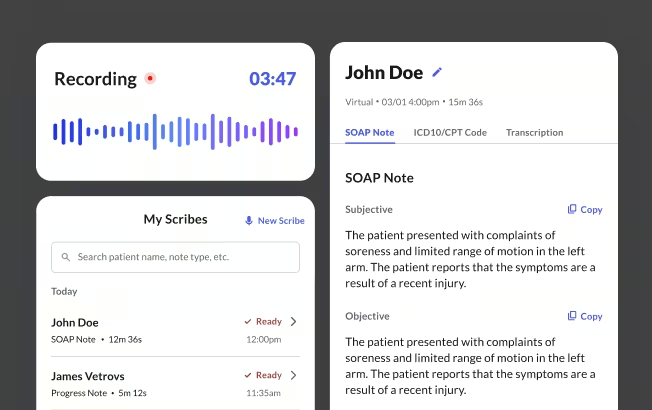
Visits can be recorded on any device, in person or by telehealth, with Commure Scribe. It recognizes multiple speakers. Within seconds of the recording ending, a structured note appears with suggested ICD-10 and CPT codes. The clinician can stay present in the room, then review and finalize the note before it enters the chart.
How much pasting your clinicians do depends on group size. Practices of one to five providers copy and paste through a Chrome extension overlay. Medium and large groups can get one-click sync through a quoted plan. Advanced integrations and admin controls are gated to higher tiers. The named EHR list includes eClinicalWorks, plus athenahealth. Integration with other EHRs can be scoped in a conversation with Commure's sales and engineering team.
AI Copilot drafts work excuse letters and patient emails from the encounter.
The 7-day trial needs no credit card. Before a multi-site rollout, confirm the sync path for your EHR and the admin controls your group needs.
Heidi Health
Best for: groups that want a free pilot and published per-clinician rates, with coding and EHR push bought on a quoted plan.
Rank: Tied for 1st
Heidi Health is the only tool here with an ongoing free tier, so a site can pilot it with no budget approval. Its Clinician plan costs $150 per user per month, or $110 billed annually.⁶ It comes with a 14-day trial.⁶ The pricing page shows rates by region, so confirm the US figures when you buy. The Teams plan adds team management, shared templates and single sign-on (SSO).⁶ It is priced by quote.
EHR integration and coding are on Teams only.⁶ On the lower plans, clinicians paste notes and code visits themselves. Heidi describes pushing notes into athenahealth, into eClinicalWorks through Vim and into Epic.⁷ Its coding feature suggests ICD-10 and SNOMED codes for the clinician to confirm.⁸ It doesn't list CPT or E/M codes, which drive urgent care billing.
Heidi can generate patient handouts during the visit, so patients leave with written instructions.⁹ Its template library includes a user-written fit-to-work certificate.¹⁰ Heidi leads the tied group on independent evidence. Ask whether Teams coding will cover CPT and E/M for your visits.
Dragon Copilot
Best for: urgent care sites run by an Epic health system that already licenses Microsoft's clinical tools.
Rank: 5
Dragon Copilot is bought through the health system, not by an urgent care group on its own. Microsoft sells it through enterprise and partner agreements, with a pay-as-you-go rate of $0.25 per AI-assisted session.¹¹ There is no published per-user price and no trial.¹¹ It scores 9.0 on independent evidence, second only to Abridge.
Its Emergency Medicine AI model drafts from what the physician says aloud, so the physician can narrate the plan to the patient and the note builds from it. It covers medical decision-making, orders, disposition and critical care time.¹² The note lands inside Epic's Haiku, Canto and Hyperdrive apps.¹³ Microsoft's emergency medicine guide doesn't mention urgent care.¹²
Ask whether your urgent care sites are already covered by the health system's license before you plan a separate purchase.
Sunoh.ai
Best for: groups on eClinicalWorks or another listed EHR that want a published per-user price and no long-term contract.
Rank: 6
Sunoh.ai costs $149 per user per month for a limited time, down from a $199 list price.¹⁴ There is no long-term contract.¹⁴ Setup and round-the-clock support are included.¹⁴ A trial is offered, but the page doesn't say how long it lasts.¹⁴
Sunoh.ai markets itself as an AI scribe for urgent care and works across EHRs.¹⁵ Its list names athenahealth, eClinicalWorks, Epic and others, but not Experity. Clinicians edit the draft before importing it into the chart.¹⁴ Neither page mentions coding, work notes or multi-site admin, so a group would need to ask about all three.¹⁵
Budget at the $199 list price, since the $149 rate is promotional.
Abridge
Best for: urgent care run by an Epic health system that already contracts with Abridge.
Rank: 7
Abridge has the strongest independent evidence on this page, with a score of 10. Its emergency medicine product runs inside Epic's ASAP emergency module in Haiku and Hyperspace, announced January 29, 2025.¹⁶ Early adopters include Emory Healthcare, Johns Hopkins Medicine and Mayo Clinic.¹⁶
An urgent care group can't buy Abridge on its own terms. The announcement names no price, trial or urgent care use.¹⁶ Cost, trial and admin can't be assessed, which pulls its total down.
Ask whether your health system's Abridge contract extends to its urgent care sites.
Experity AI Scribe
Best for: urgent care groups already on Experity EMR that want the note written straight into the chart.
Rank: 8
For clinicians at an Experity site, this is the only scribe here that skips the paste step. Experity says structured data from AI Scribe "flows directly into Experity EMR."¹⁷ It also supports "accurate coding for ICD, CPT, and E/M."¹⁸ It leads this page on EHR handoff.
The low total reflects what Experity doesn't publish. The pages reviewed list no price, trial, admin controls or work-note output.¹⁷ Experity's per-patient time savings are its own figures, and self-reported figures score zero for every entry.¹⁷
Ask Experity for a per-provider price and whether one site can pilot before a group contract.
Should an Urgent Care Group Use a Human or AI Scribe?
Human scribes saved more charting time than AI scribes in the one head-to-head study found, and neither raised physician output per shift. The table sets out the main findings from emergency care, the closest setting studied.
The head-to-head study shows a link, not a cause. In the second study, AI scribe use clustered in chair-based care and lower-acuity patients, the part of emergency care closest to urgent care.²¹ Use was lower for patients who needed an interpreter.²¹ A scribe only gives time back on the visits where clinicians turn it on, so a pilot should track how often they do.
AI drafts also need a careful read. In a randomized trial at one academic center, doctors said AI notes "occasionally" had clinically significant errors.²² Medicare guidance tells clinicians who use a scribe, "including artificial intelligence technology," to sign the entry.²³
Cost is harder to compare. The human scribe services reviewed here publish no per-visit price, so pricing one against an AI scribe for urgent care starts with a quote. For how in-person scribes work, read the guide on emergency scribes. Remote scribes are covered under virtual medical scribe.
Should You Use Your EHR's Built-In Scribe or a Third-Party One?
The trade-off is simple. A built-in AI scribe for urgent care writes straight into your chart but publishes no price or trial. A third-party scribe publishes both, and your group tests the handoff into the EHR.
Experity says nearly 50% of urgent care centers use its software.²⁴ It launched AI Scribe on October 13, 2025.²⁵ The company says the note "auto-populates directly into the patient chart."²⁵ None of the seven third-party scribes on this page names Experity in its published EHR list. For an Experity site, a third-party scribe likely means copy and paste until you confirm otherwise.
Experity reports that more than 450 clinics have used AI Scribe.²⁶ It also reports that clinics cut documentation time from 394.6 to 239.8 minutes per day.²⁶ Those figures come from Experity rather than an independent study, so they aren't scored.²⁶
athenaOne Ambient Notes: available only inside athenaOne (not ranked)
athenaOne sites have a built-in option too. athenahealth markets Ambient Notes as part of athenaOne for Urgent Care.²⁷ Its October 30, 2024 launch release says the tool is "embedded directly in the clinical workflow" for athenaOne customers.²⁸ The athenahealth pages reviewed list no separate price, trial, admin, coding or work-note terms.²⁸
EHR handoff and cost could be scored, which is 43% of the weight. Only athenaOne customers can buy it. It is described here rather than ranked for both reasons. For athenaOne groups, third-party options are compared in the guide to the athenahealth AI scribe.
How Were These Urgent Care Scribes Scored?
Each urgent care scribe was scored 0 to 10, in half-point steps, on seven criteria weighted for a multi-site group. Scores come from vendor pages and peer-reviewed research. Three marked cells come from company confirmation instead.
The same rules apply to all eight entries. A feature behind a tier or contract a group can't reach earns nothing. A missing fact makes a cell not assessable (n/a) instead of earning a middling score. Vendor-reported figures, such as time saved per patient, score zero.
A 10 means an outside top standard, such as a peer-reviewed study of the product. An 8 means documented with one gap, and 6 to 7 means documented with real limits. Partial documentation earns 4 to 5, a feature named only earns 2 to 3, and 0 means absent.
Totals within 0.20 of the highest total in a group share a rank, and the same threshold applies to every entry. The main total counts n/a cells as zero. The renormalized total rescales over the weight that could be assessed.
Where does Commure Scribe land?
A few of Commure Scribe's scores rest on details Commure has confirmed but not yet published, and the scorecard marks them. The documented-only total sits beside its main total in the scorecard.
Commure publishes this page and sells Commure Scribe. It is scored on the same criteria and weights, and the result is published either way. On the main total, Commure Scribe ties for first at 6.14, 0.14 behind Freed. Freed scores higher on cost and coding and matches it on the other five criteria.
DeepCura scores higher than Commure Scribe on EHR handoff, cost and trial. Heidi Health scores higher on evidence, and Experity AI Scribe leads on EHR handoff.
More Guides for Urgent Care Groups
These guides cover the documents, costs and EHR choices around an urgent care scribe rollout.
- What a defensible work or school note needs to contain: urgent care doctor's note.
- Per-provider costs, hidden fees and contract terms across vendors: AI scribe pricing.
- Five scribes compared on how notes reach eClinicalWorks: eClinicalWorks AI scribe.
- Business associate agreements, data handling and audit readiness: HIPAA-compliant AI note-taking.
- The scribe role from in-person scribes to ambient AI: what a medical scribe does.
- How ambient scribes draft a note and what clinicians review: AI medical scribe.
Chart a Saturday rush before you sign
Commure Scribe is one of the eight scored above. A busy shift is a fair test for any urgent care scribe. The 7-day trial needs no credit card. Group options with one-click EHR sync appear when you see current Commure Scribe plans.
Vendor details on this page were checked against each vendor's own pages on September 28, 2026. Prices and features change, so confirm current terms with each vendor before you buy.
This article is for informational and educational purposes only, does not constitute legal, medical, or professional advice, and does not guarantee documentation, coding or reimbursement outcomes.
Frequently Asked Questions
In the one head-to-head study found, human scribes cut physician charting time by 3.3 minutes per note. AI scribes cut it by 1.6 minutes. Output per shift hour was the same. AI scribes publish prices and trials. The human scribe services reviewed here publish no per-visit price, so cost depends on a quote.
Commure Scribe groups can scope an Experity integration with Commure's sales and engineering team. Experity AI Scribe is the only scribe here documented to write into Experity EMR today. None of the third-party scribes names Experity in its published EHR list. Freed pushes notes to browser-based EHRs, so test that push on live visits during its 7-day trial. That makes Experity's own tool the best scribe for urgent care sites on Experity when the handoff matters most.
Yes, some can. Commure Scribe's AI Copilot drafts work excuse letters and patient emails from the encounter. Freed lists patient instructions, letters and referrals on its Premier and Groups plans. Heidi Health can generate handouts during the visit. DeepCura claims work status notes only on its own ranking page. Review each note against your state's and the employer's requirements before it goes to the patient.
Several do. Commure Scribe generates suggested ICD-10 and CPT codes in a separate tab for the clinician to check. DeepCura generates ICD-10, CPT and E/M codes on its plans. Freed covers the same code sets on Premier and Groups, and Experity names them for its AI Scribe. Heidi Health suggests ICD-10 and SNOMED codes on its quoted Teams plan, without CPT or E/M. Check each suggested code against the note before a claim goes out.
Commure Scribe publishes its plan for one to five providers and quotes plans for larger groups. Among the others, published prices range from $39 to $199 per clinician per month. DeepCura lists $101 to $129 per seat per month, depending on group size. Freed lists $39 to $119 per clinician per month and quotes group plans. Sunoh.ai lists $149 per user per month for a limited time, against a $199 list price. Experity, Abridge and athenahealth publish no price for their tools.
Sources
- Cohen RA, Briones EM. "Urgent Care Center and Retail Health Clinic Use: United States, 2024." NCHS Data Brief No. 562. Centers for Disease Control and Prevention. https://www.cdc.gov/nchs/products/databriefs/db562.htm. 2026.
- Freed. Pricing. https://www.getfreed.ai/pricing. 2026.
- Freed. AI scribe for emergency medicine. https://www.getfreed.ai/lp/ed-scribe. 2026.
- DeepCura. Plans and pricing. https://www.deepcura.com/plans-pricing. 2026.
- DeepCura. Best AI scribe for urgent care (vendor-authored ranking that places DeepCura first). https://www.deepcura.com/resources/best-ai-scribe-for-urgent-care. 2026.
- Heidi Health. Pricing (US). https://www.heidihealth.com/en-us/pricing. 2026.
- Heidi Health. Integrations. https://www.heidihealth.com/en-us/integrations. 2026.
- Heidi Health. Coding. https://www.heidihealth.com/en-us/product/coding. 2026.
- Heidi Health. Heidi Scribe. https://www.heidihealth.com/en-us/scribe. 2026.
- Heidi Health. Medical Certificate (fit-to-work confirmation after treatment) template, community template library. https://www.heidihealth.com/en-us/templates/medical-certificate-fit-to-work-confirmation-after-treatment-58a52bed. 2025.
- Microsoft. Dragon Copilot licensing guidance. https://www.microsoft.com/licensing/guidance/Dragon-Copilot. 2026.
- Microsoft Support. Dragon Copilot emergency department documentation guidance. https://support.microsoft.com/en-us/dragon-copilot/physicians/verbalization-emergency-department. 2026.
- Microsoft Support. Dragon Copilot in mobile EHR apps. https://support.microsoft.com/en-us/dragon-copilot/physicians/dragon-copilot-in-mobile-ehr-apps. 2026.
- Sunoh.ai. Pricing. https://sunoh.ai/pricing. 2026.
- Sunoh.ai. AI medical scribe for urgent care. https://sunoh.ai/ai-medical-scribe-for-urgent-care. 2026.
- Abridge. Abridge Inside for Emergency Medicine announcement. https://www.abridge.com/press-release/abridge-inside-for-emergency-medicine-announcement. 2025.
- Experity. AI Scribe. https://www.experityhealth.com/aiscribe. 2026.
- Experity. AI solutions. https://www.experityhealth.com/ai-solutions. 2026.
- Dutta S, You JG-T, Dunham L, Cash R, Meeker M, White BA, Joseph JW. "Medical Scribe and Ambient Artificial Intelligence Impact on Emergency Physician Documentation Burden and Clinical Productivity." Annals of Emergency Medicine. https://www.sciencedirect.com/science/article/abs/pii/S0196064426002660. 2026.
- Gottlieb M, Palter J, Westrick J, Peksa GD. "Effect of Medical Scribes on Throughput, Revenue, and Patient and Provider Satisfaction: A Systematic Review and Meta-analysis." Annals of Emergency Medicine. https://www.sciencedirect.com/science/article/abs/pii/S0196064420305977. 2021.
- Preiksaitis C, Alvarez A, Winkel M, Karamatsu M, Brown I, Sama N, Morris L, Lee J, Gubbels A, Wahl E, Frye A, Rose C. "Ambient Artificial Intelligence Scribe Adoption and Documentation Time in the Emergency Department." Annals of Emergency Medicine. https://www.sciencedirect.com/science/article/abs/pii/S0196064425014581. 2026.
- UCLA Health. "UCLA study finds AI scribes may reduce documentation time and improve physician well-being." Press release on Lukac et al., NEJM AI. https://www.uclahealth.org/news/release/ucla-study-finds-ai-scribes-may-reduce-documentation-time. 2025.
- Centers for Medicare & Medicaid Services. "Complying with Medicare Signature Requirements." MLN905364. https://www.cms.gov/files/document/mln905364-complying-medicare-signature-requirements.pdf. 2025.
- Experity. News release on the 2025 Black Book urgent care EHR ranking (vendor claim). https://www.experityhealth.com/news/experity-receives-1-urgent-care-ehr-ranking-in-2025-black-book-market-research-report. 2026.
- Experity. AI Scribe launch news release. https://www.experityhealth.com/news/experity-takes-a-significant-step-toward-the-touchless-emr-with-ai-scribe. 2025.
- Siwicki B. "Urgent care clinics boost revenue and throughput with AI scribe." Healthcare IT News (figures reported by Experity). https://www.healthcareitnews.com/news/urgent-care-clinics-boost-revenue-and-throughput-ai-scribe. 2026.
- athenahealth. athenaOne for urgent care blog post. https://www.athenahealth.com/resources/blog/top-7-reasons-to-choose-athenaone-for-urgent-care. 2024.
- athenahealth. Ambient Notes launch press release. https://www.athenahealth.com/press-releases/athenahealth-launches-ai-powered-ambient-notes. 2024.

.jpeg)
.jpeg)

.jpeg)