



Free E-Prescribing Software for Physicians (2026)
Which tools send prescriptions at no cost, what controlled substances add, and when Medicare or your state requires EPCS.
Written by the Commure Scribe Team
Published: September 19, 2026
•
16 min read
Verified against vendor pricing pages, vendor FAQs and federal rules on September 16, 2026. E-prescribing prices and plan terms change, so check current terms with each vendor before signing up. Commure publishes this page and sells Commure Scribe, which does not e-prescribe and is not ranked here.
What You Need to Know About Free E-Prescribing Software for Physicians
- Pick eNavvi for free prescribing, Doximity Prescribe for phones, MDToolbox-Rx for safety checks, or CharmHealth inside an EHR.
- MDToolbox-Rx (6.33) and eNavvi (6.25) tie for first of 10, one leading on safety checks and the other on price.
- Before choosing free e-prescribing software for physicians, check whether Medicare Part D or your state requires controlled-substance e-prescribing.
Which E-Prescribing Software Is Free for Physicians?
eNavvi's Core plan, Doximity Prescribe and DocUpdate send non-controlled prescriptions at no cost with no time limit, as of September 16, 2026. WENO Online also describes a free option, and its current fee sheet could not be read to confirm the terms. None of the four is confirmed to send controlled substances at no cost.
Ten tools are ranked here by need and by a published score, with prices and safety checks side by side. They fall into three price models.
- Free with no time limit: eNavvi, WENO Online, Doximity Prescribe and DocUpdate.
- Low-cost plans that include controlled substances: MDToolbox-Rx, RXNT, iPrescribe and Veradigm ePrescribe.
- Prescribing inside an EHR: CharmHealth and Practice Fusion.
Trials and EHR add-ons are not counted as free e-prescribing here. A 30-day trial ends in a paid plan, and a free EHR plan can still charge for prescribing.
At every tool with a confirmed price, electronic prescribing of controlled substances (EPCS) costs extra or comes inside a paid plan. Medicare Part D and state law decide whether you need EPCS. Drug Enforcement Administration (DEA) rules set what EPCS software must prove.
Top Picks by Need and Side-by-Side Comparison
For most physicians, eNavvi is the best place to start: non-controlled prescribing costs nothing, and EPCS is a $20 monthly add-on in the same tool. Prescribers who want interaction and PDMP checks built in should look at MDToolbox-Rx. CharmHealth suits practices that want prescribing inside an EHR, and Doximity Prescribe suits phone-first prescribers.
Two facts sort the rows: whether you prescribe controlled substances and whether you already pay for an EHR. A physician who sends only non-controlled prescriptions can use free e-prescribing software and pay nothing.
Prices, EPCS and Network at a Glance
Ten tools were scored, and MDToolbox-Rx and eNavvi tie for first on opposite strengths. MDToolbox-Rx scores highest on documented safety tools and costs $28 a month billed annually after a 30-day trial.¹ eNavvi charges nothing for non-controlled prescriptions and publishes nothing on interaction checks.²
Scorecard
Each total below is the weighted sum of five criterion scores out of 10, and "=" beside a rank marks a tie.
Free E-Prescribing Tools With No Time Limit
Four products offer free e-prescribing software with no end date as of September 16, 2026, and they rank from 1= to 8. Before relying on one of them, check three things.
- Who funds the tool, since eNavvi and Doximity Prescribe publish nothing on how their free tiers are paid for.
- Which safety checks run before a prescription leaves your hands, since none of the four documents a check on the prescriber's side.
- Whether you prescribe controlled substances, since none of the four is confirmed to send them at no cost.
eNavvi
Best for: physicians who want free non-controlled prescribing and a low-cost EPCS add-on from the same tool.
eNavvi ranks 1= at 6.25.
- Price: The Core plan lists non-controlled prescribing at "$0/forever" as of September 16, 2026.³
- Controlled substances: EPCS costs $20 a month or $200 a year, after a one-month EPCS trial.³ EPCS signing uses Microsoft Authenticator as the second factor, and the EPCS plan reads "Drummond-certified" and "Live on Surescripts."³
- Safety checks: The pricing and FAQ pages say nothing on interaction checks, medication history or prescription drug monitoring program (PDMP) access, so eNavvi scores 1.0 on safety.²
- Access: Prescribing runs in any browser, apart from any EHR.² The pricing page names Persona for identity assurance level 2 (IAL2) proofing on the free Core plan.³
- Check before choosing: eNavvi's subscription terms let it change its fees, and a change reaches an existing customer only after a plan switch or restart.⁴
The same terms say eNavvi "will not sell Customer Data," and no page says how the free tier is funded.⁴ The EPCS certification report is not viewable on the site, which is the one gap in the highest EPCS score here, 8.0.
WENO Online
Best for: prescribers who want a free option marketed with free EPCS and will confirm current fees with Weno first.
WENO Online ranks 6= at 4.38.
- Price: Its maker describes "a free and paid option for prescriber users."⁵ The dollar amounts sit in a fee sheet image that could not be read on September 16, 2026.
- Controlled substances: The homepage markets the product "with FREE EPCS."⁶ Weno says prescribers sign EPCS orders with two-factor authentication, and it reports "two approved DEA audits" without naming the two-factor method or the auditor.⁵
- Safety checks and network: The pages read say nothing on interaction checks or PDMP access.⁶ Weno describes its network as "independent from the Surescript's network."⁵
- Check before choosing: Ads show to all users, an ad-free upgrade is available, and the homepage states there are no refunds.⁶ Whether identity proofing costs extra on the free option is unconfirmed.
Doximity Prescribe
Best for: clinicians who prescribe from a phone and never send controlled substances.
Doximity Prescribe ranks 6= at 4.25.
- Price: Doximity lists Prescribe as "completely free" for verified US physicians, nurse practitioners and physician assistants.⁷ Its May 15, 2026 launch post adds "No subscription. No per-prescription fees."⁸
- Controlled substances: Doximity publishes nothing on controlled substances.⁷ Its network partner, Photon, states that its network "does not support the transmission of controlled substance prescriptions."⁹
- Access: Prescribe is built into Doximity Dialer, with no separate EMR to log into.⁷ It works on the web and in the iOS and Android apps.¹⁰
- Patient side: The patient gets a text to pick a pharmacy and see an estimated price.⁷
- Check before choosing: Prescribe is not open to Doximity enterprise users.⁷ Doximity has not published how Prescribe is funded, or anything on interaction checks or PDMP access.⁷
DocUpdate
Best for: prescribers who send only non-controlled prescriptions from a phone app, need no EHR connection and accept curated updates from pharma partners.
DocUpdate ranks 8 at 4.00.
- Price: Its FAQ answers "Yes, DocUpdate is completely free for providers."¹¹ The company funds the tool by partnering "with select, specialty-relevant pharma companies to share curated updates relevant to your practice."¹¹
- Safety checks: The FAQ states that "Pharmacies run drug–drug and allergy checks before dispensing."¹¹ That describes no check on the prescriber's side, so DocUpdate scores 0 on safety.
- Network and access: According to DocUpdate, every prescription routes through Surescripts to 95% of US pharmacies, and the tool does not integrate with an EHR.¹¹
- Privacy: The FAQ states that DocUpdate "operates under a formal Business Associate Agreement (BAA)."¹¹
- Check before choosing: On controlled substances, the FAQ answers "Not yet," with the feature on the roadmap.¹¹
Low-Cost Standalone Tools With Controlled Substances
Four standalone tools publish a paid route to EPCS, and MDToolbox-Rx leads them at 6.33. They price controlled substances in three ways.
- iPrescribe folds EPCS into its base license.
- MDToolbox-Rx and RXNT charge more for EPCS than for non-controlled prescribing.
- Veradigm ePrescribe lists EPCS with a plan that starts at $59 a month.
MDToolbox-Rx
Best for: prescribers who want interaction checks and PDMP lookups inside the prescription writer.
MDToolbox-Rx ranks 1= at 6.33, with the highest safety score on this page, 8.5.
- Price: The E-Prescribe Pro plan costs $28 a month billed annually, or $30 month to month, after a 30-day trial with no credit card.¹ Syncing it with other office software costs a one-time $700 setup fee.¹
- Controlled substances: EPCS needs the E-Prescribe Complete plan, at $35 a month billed annually or $38 month to month.¹ Signing uses a token code or a push notification, and no identity proofing method is published.¹²
- Safety checks: According to MDToolbox, the prescription writer checks drug-drug, drug-allergy and drug-disease interactions at alert levels the user sets.¹³ It also shows medication history from pharmacies and payers, real-time benefit and formulary checks, and state PDMP lookups.¹³
- Access and network: The software runs in browsers, on iPads and in iOS and Android apps, and connects to Surescripts.¹³
- Check before choosing: MDToolbox calls its EPCS module certified without naming an auditor or certifying body.¹³
RXNT
Best for: prescribers who want medication history, formulary and PDMP checks in a standalone tool and will get the subscription price from RXNT.
RXNT ranks 3= at 5.08.
- Price: RXNT sells standalone e-prescribing "with a yearly subscription only."¹⁴ No dollar figure for that subscription appeared when the pricing page was read on September 16, 2026, which holds its cost score at 1.0.
- Controlled substances: EPCS adds an $85 annual fee for identity proofing and biometric authentication, according to the pricing page.¹⁴ A second RXNT page lists $75 a year for EPCS tokens.¹⁵
- Safety checks: RXNT describes drug and allergy interaction checks, real-time medication history and patient-specific formularies.¹⁶ The same page lists automatic PDMP integrations through Bamboo Health.¹⁶
- Access and network: RXNT's e-prescribing page lists iOS and Android apps and Surescripts certification.¹⁶
- Check before choosing: Confirm the current EPCS fee with RXNT, since its two pages differ. No identity proofing vendor or third-party auditor is named on the pages read.
iPrescribe
Best for: prescribers who send controlled substances from a phone and want EPCS included in one license price.
iPrescribe ranks 5 at 4.63.
- Price: The Mobile plan costs $30 per license per month, billed annually, with unlimited controlled and non-controlled prescriptions.¹⁷ Desktop access needs the $50 Practice plan, and no trial is published.¹⁷
- Controlled substances: EPCS carries no separate fee.¹⁷ iPrescribe uses ID.me for identity proofing.¹⁸
- Signing: Each controlled-substance prescription is signed with a password kept only for EPCS plus a one-time code from a device or app.¹⁹ No third-party audit is named, which keeps its EPCS score at 7.0.
- Safety checks: The pricing page lists drug and allergy interaction checks, patient medication history and in-workflow PDMP checks.¹⁷
- Check before choosing: The pricing page names no pharmacy network, so iPrescribe scores 1.0 on network.¹⁷
Veradigm ePrescribe
Best for: practices that want electronic prior authorization with standalone prescribing and will confirm what the $59 plan includes.
Veradigm ePrescribe ranks 9= at 3.60.
- Price: The standalone plan starts at $59 a month per prescriber, with no billing term published.²⁰ The same plan lists EPCS, electronic prior authorization and "Sponsored messages included."²⁰
- Safety checks: Interaction alerts, formulary checks, medication histories and PDMP access appear as feature names without a description of what each does.²⁰ That holds its safety score at 3.0.
- Network and certification: Veradigm states the product is certified by several e-prescribing networks and by the Office of the National Coordinator for Health Information Technology (ONC).²⁰
- Check before choosing: The page does not say whether every feature sits at $59.²⁰ Identity proofing, two-factor methods and supported platforms are not published on the page.
E-Prescribing Inside an EHR
Two EHRs sell electronic prescribing software at published prices, and neither includes it at no cost. CharmHealth charges for prescribing even on its free EHR plan, while Practice Fusion bundles EPCS into a paid subscription. Both are ranked because an independent physician can buy either one without a sales quote.
For a wider comparison of full EHRs, see the guide to the best EMR software. A solo physician choosing an EHR at the same time can compare options in the guide to the best EHR for solo practice.
CharmHealth
Best for: practices that want prescribing inside an EHR, including small practices that fit the free plan's limit of 50 encounters a month.
CharmHealth ranks 3= at 4.98.
- Price: The free EHR plan is "Limited to 50 encounters per month."²¹ E-prescribing is a $15 per provider monthly add-on on every plan, the free one included.²¹
- Controlled substances: EPCS costs $250 per provider per year, covers e-prescribing and is non-refundable.²¹ CharmHealth says its EPCS workflows are "certified by Surescripts and audited by Drummond for EPCS."²²
- Identity and signing: CharmHealth lists identity proofing and two-factor sign-in without naming either method.²² iPrescribe shows the reverse, naming its methods but no auditor, so both score 7.0 on EPCS.
- Safety checks: According to CharmHealth, prescribers get state PDMP data through the Appriss PMP Gateway and medication history from pharmacy benefit managers.²² It also lists real-time formulary coverage and prior authorization requests.²²
- Check before choosing: Prescribing needs a CharmHealth EHR account.²¹ Interaction checks and supported platforms are not published on the pages read.
Practice Fusion
Best for: practices that want EPCS bundled into a full EHR subscription at no additional charge.
Practice Fusion ranks 9= at 3.55.
- Price: Practice Fusion costs $199 per provider per month before taxes, with a required annual commitment and a two-week trial.²³
- Controlled substances: EPCS is "included in your Practice Fusion subscription at no additional charge."²⁴ Prescribers can use EPCS in all 50 states and the District of Columbia.²³
- Safety checks: According to Practice Fusion, prescribing runs automatic drug-drug and drug-allergy checks.²⁵ It also merges prescriptions from the patient's pharmacy into medication reconciliation.²⁵
- Access and network: Prescribing is not sold apart from the EHR and no network is named, so access and network each score 1.0.
- Check before choosing: Practice Fusion calls its EPCS feature certified without naming the certifier.²⁴ Identity proofing and two-factor methods are not published on the pages read.
Described but Not Ranked
Four more products came up in research and are described without a rank. None of them publishes a price an independent physician can act on. DrChrono, Tebra and Elation sell e-prescribing inside EHRs priced by quote.
- DrFirst publishes no price for Rcopia.²⁶
- The DrChrono pricing page sends each plan to a quote request.²⁷
- Tebra asks buyers to request a personalized quote.²⁸
- Elation replies to each inquiry with personalized pricing.²⁹
For EHRs that cost nothing to start, see the separate guide to a free EHR.
Do You Need EPCS, and What Does the Software Have to Do?
You need EPCS when Medicare Part D or your state requires it, and the software must meet DEA security rules. DEA itself leaves EPCS optional. Practitioners can still write and manually sign prescriptions for Schedule II to V drugs, according to DEA's 2023 guidance.³⁰
ONC measured EPCS use by practice size in 2019. About three in 10 solo practitioners used EPCS, compared with about half of physicians in practices of 11 or more.³¹
What DEA Requires of EPCS Software
A physician who chooses EPCS must follow 21 CFR Part 1311, in force since June 1, 2010.³² That rule sets three requirements for EPCS software and the prescriber who uses it.
- Identity proofing: "An individual practitioner must obtain a two-factor authentication credential" from an approved credential service provider or certification authority.³³
- Two-factor signing: the application must require two of three factors, which are something the prescriber knows, a biometric and a hard token.³⁴
- Third-party review: the vendor must have the application audited by a qualified third party or certified by an approved certification body.³⁰ The vendor must also give practitioners a copy of that report.³⁰
No tool on this page is confirmed to offer free EPCS. Before paying, ask the vendor to name its identity proofing and two-factor methods and to send its audit or certification report. A separate federal extension lets clinicians prescribe controlled medications by telemedicine without a prior in-person visit through December 31, 2026.³⁵
What Medicare Part D Requires
Since January 1, 2021, prescribers must send at least 70% of Part D controlled-substance prescriptions electronically.³⁶ The Centers for Medicare & Medicaid Services (CMS) applies this volume rule to Part D and Medicare Advantage drug plans.³⁷ CMS excepts three groups of prescribers.
- Prescribers with 100 or fewer qualifying Part D controlled-substance prescriptions in a year are exempt automatically.³⁷
- Prescribers in a declared emergency or disaster area are excepted.³⁷
- Prescribers granted a CMS-approved waiver are excepted.³⁷
The first compliance measurement year was 2023.³⁸ Non-compliance brings notices and "may be considered in CMS processes for assessing potential fraud, waste, and abuse."³⁷
What State Laws Require
Thirteen states had EPCS mandates in effect by February 2020, and 14 more had passed them.³⁹ Some state mandates cover non-controlled drugs too.
- New York has required e-prescribing for controlled and non-controlled drugs since March 27, 2016.⁴⁰
- Pennsylvania has required it for Schedule II to V drugs since October 24, 2019.⁴¹
- California has required most prescriptions to be electronic since January 1, 2022.⁴² Since January 1, 2023, prescribers who issue 100 or fewer a year can register with the Board of Pharmacy for an exemption.⁴²
Rules and exemptions differ by state, so verify your state's current rule with a healthcare attorney or compliance officer.
How Were These Tools Scored?
Each tool was scored from 0 to 10 on five criteria. The weights sum to 100 and fit an independent physician who wants the lowest-cost compliant way to prescribe. Every score is published, so any total on this page can be recomputed from the scorecard.
The safety weight reflects a 2010 study of standalone e-prescribing that followed 15 community-based providers whose system included clinical decision support.⁴³ Their error rates fell from 42.5 to 6.6 per 100 prescriptions one year after adoption.⁴³ The study was small and non-randomized.⁴³
That system checked doses, drug-allergy and drug-drug interactions, and duplicate therapies.⁴³ Its results describe a tool with those checks built in, which eNavvi, WENO Online and Doximity Prescribe do not document.
Scoring Rules and Limits
Five rules turn vendor documentation into numbers.
- A tool scores only on what an independent physician can buy without an enterprise contract.
- A fact the vendor does not publish scores as absent, never as a middling number.
- A 0 on EPCS means the tool does not support controlled substances.
- A feature that is named with no description of what it does stays in the 2 to 3 band.
- Vendor-reported user counts and time savings score 0.
Scores move in half points. A 9 needs every element documented and confirmable by a third party, and an 8 means fully documented with one gap. A 4 or 5 means the capability exists and a material part of it is undocumented.
No tool was tested with a live prescription. Vendor pages were read through a page-fetch tool on September 16, 2026, and two prices could not be read that day. One was WENO Online's current fee sheet, an image the tool could not open, and the other was RXNT's standalone subscription price.
Ties and Weight Sensitivity
Totals within 0.15 of each other are marked as tied with "=" beside the rank. First place is a tie that depends on the weights, and three alternative weightings were tested.
- Raising cost to 40, with EPCS at 20 and safety at 15, puts eNavvi first at 6.60 and MDToolbox-Rx second at 5.95.
- Shifting 5 points from safety to access also puts eNavvi first, at 6.55.
- Moving 5 points from cost to EPCS keeps MDToolbox-Rx first, at 6.45.
Where Commure Scribe Sits on This Page
Commure publishes this page and sells Commure Scribe, which is an AI medical scribe. The product does not e-prescribe, so no criterion here applies to it and it is not scored or ranked. Every score traces to a vendor page or a network partner's page, and no score rests on company confirmation.
How Commure Scribe Fits a Prescribing Visit
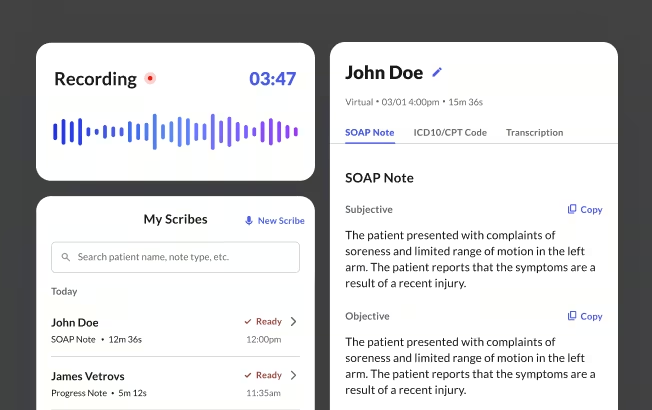
Commure Scribe is an AI medical scribe, and it does not e-prescribe or send anything to a pharmacy. It documents the visit where the prescribing decision is made, so the clinician can stay present in the room while the conversation is captured.
Each visit moves from recording to the chart in four steps.
- Capture: The conversation is recorded during the visit, and the note shows up right after the clinician clicks End Recording.
- Draft: Within seconds, the clinician sees a structured SOAP note, along with suggested ICD-10 and CPT codes.
- Review and finalize: The note captures the full clinical context of the visit. The clinician reviews and edits the draft, and always has the choice to finalize it before it enters the chart.
- Move to the EHR: At one to five providers, the finished note moves into the EHR by copy and paste through a Chrome extension overlay. Medium and large group practices can access one-click sync.
Commure Scribe lists 60+ EHR integrations. Three of them are EHRs named on this page: Practice Fusion, Tebra, and Elation.
More EMR and EHR Guides
These guides help a physician who is weighing prescribing inside an EHR against a standalone tool.
- Best EMR for small practices: The guide compares EMR options for small practices, a next step for a physician who wants prescribing inside a full EHR.
- Best EHR for mental health private practice: The guide compares EHRs for mental health private practices, a next step for psychiatric clinicians who prescribe controlled substances.
- Best internal medicine EMR: The guide compares seven options for internal medicine providers managing complex, multi-condition patients.
- EMR vs EHR: The guide explains the difference between the two system types and how to choose.
Chart the visit behind the prescription
Each prescription starts with a visit that still needs a note, and Commure Scribe drafts it for the clinician to review. It does not send prescriptions. Try it on your own visits during the 7-day trial, and see current Commure Scribe plans.
This article is for informational and educational purposes only, does not constitute legal, medical, or professional advice, and does not guarantee compliance with DEA, CMS or state prescribing rules.
Frequently Asked Questions
Yes, eNavvi's Core plan, Doximity Prescribe and DocUpdate offer free e-prescribing software for non-controlled prescriptions with no end date, as of September 16, 2026. WENO Online also describes a free option with ads, and none of the three verified tools sends controlled substances at no cost. A 30-day trial, such as MDToolbox-Rx's, ends in a paid plan.¹
No tool on this page was confirmed to offer it on September 16, 2026. WENO Online markets "FREE EPCS," and its current fee sheet could not be read to check identity proofing costs.⁶ eNavvi's EPCS add-on costs $20 a month.³ iPrescribe includes controlled substances in a $30 monthly license billed annually.¹⁷
CMS requires 70% of Part D controlled-substance prescriptions to be electronic, while DEA leaves EPCS optional.³⁶ Prescribers with 100 or fewer qualifying Part D controlled-substance prescriptions a year are exempt from that rule.³⁷ New York requires electronic prescriptions for non-controlled drugs too.⁴⁰
Published prices for e-prescribing software ran from $0 to $199 a month per provider on September 16, 2026. MDToolbox-Rx's standalone plan costs $28 a month billed annually after its trial.¹ Veradigm ePrescribe starts at $59 a month per prescriber.²⁰ Practice Fusion includes prescribing in a $199 monthly EHR subscription with an annual commitment.²³
DEA requires identity proofing, two-factor signing and a third-party audit or approved certification. Its 2023 guidance says Identity Assurance Level 2, which it likens to the rule's standard, "allows for either in-person or remote identity proofing."³⁰ A hard token used as one factor must be separate from the computer it gives access to.³⁴
Sources
- MDToolbox. "Pricing." https://mdtoolbox.com/pricing.aspx 2026.
- eNavvi. "FAQ." https://enavvi.com/faq 2026.
- eNavvi. "Pricing." https://enavvi.com/pricing 2026.
- eNavvi. "Terms and Conditions." https://enavvi.com/terms-conditions 2026.
- Weno Exchange. "EPCS." https://wenoexchange.com/epcs/ 2026.
- Weno Exchange. "WENO Online." https://wenoexchange.com/ 2026.
- Doximity. "Doximity Prescribe." https://www.doximity.com/prescribe 2026.
- Doximity. "Doximity launches free prescribing for physicians." https://blog.doximity.com/articles/doximity-launches-free-prescribing-for-physicians 2026.
- Photon Health. "FAQ." https://photonhealth.com/faq 2026.
- Doximity. "Doximity Prescribe: send scripts from Dialer." https://blog.doximity.com/articles/doximity-prescribe-send-scripts-from-dialer 2026.
- DocUpdate. "FAQ." https://www.docupdate.io/faq/ 2026.
- MDToolbox. "EPCS." https://mdtoolbox.com/epcs.aspx 2026.
- MDToolbox. "ePrescribing." https://mdtoolbox.com/eprescribing.aspx 2026.
- RXNT. "Pricing." https://www.rxnt.com/pricing/ 2026.
- RXNT. "Cost-effective electronic prescribing." https://www.rxnt.com/cost-effective-electronic-prescribing/ 2026.
- RXNT. "Electronic prescribing software." https://www.rxnt.com/software/electronic-prescribing/ 2026.
- iPrescribe. "Pricing." https://www.iprescribe.com/pricing 2026.
- iPrescribe. "iPrescribe." https://www.iprescribe.com/ 2026.
- DrFirst. "iPrescribe FAQs." https://help.drfirst.com/hc/en-us/articles/45293286314515-iPrescribe-FAQs 2026.
- Veradigm. "Veradigm ePrescribe." https://veradigm.com/eprescribe/ 2026.
- CharmHealth. "EHR pricing (US)." https://www.charmhealth.com/ehr/ehr-pricing-us.html 2026.
- CharmHealth. "EPCS." https://www.charmhealth.com/epcs/ 2026.
- Practice Fusion. "Pricing." https://www.practicefusion.com/pricing/ 2026.
- Practice Fusion. "EPCS." https://www.practicefusion.com/epcs/ 2026.
- Practice Fusion. "E-prescribing solutions." https://www.practicefusion.com/e-prescribing-solutions/ 2026.
- DrFirst. "ePrescribing." https://drfirst.com/eprescribing 2026.
- DrChrono. "Pricing." https://www.drchrono.com/pricing/ 2026.
- Tebra. "Pricing." https://www.tebra.com/pricing 2026.
- Elation Health. "Pricing." https://www.elationhealth.com/pricing/ 2026.
- Drug Enforcement Administration, Diversion Control Division. "Questions and Answers for Prescribing Practitioners (EPCS)." https://www.deadiversion.usdoj.gov/GDP/(DEA-DC-09R1)(EO-DEA022R1)_Questions_and_Answers_for_Prescribing_Practitioners_(EPCS)_7-24-2023.pdf 2023.
- Office of the National Coordinator for Health Information Technology. "Electronic Prescribing of Controlled Substances Among Office-Based Physicians, 2017-2019." https://healthit.gov/data/data-briefs/electronic-prescribing-controlled-substances-among-office-based-physicians-2017/ 2022.
- Drug Enforcement Administration. "Electronic Prescriptions for Controlled Substances." Federal Register. https://www.federalregister.gov/documents/2010/03/31/2010-6687/electronic-prescriptions-for-controlled-substances 2010.
- Electronic Code of Federal Regulations. "21 CFR 1311.105." https://www.ecfr.gov/current/title-21/section-1311.105 2026.
- Electronic Code of Federal Regulations. "21 CFR 1311.115." https://www.ecfr.gov/current/title-21/section-1311.115 2026.
- US Department of Health and Human Services. "HHS & DEA Extend Telemedicine Flexibilities for Prescribing Controlled Medications Through 2026." https://www.hhs.gov/press-room/dea-telemedicine-extension-2026.html 2026.
- Electronic Code of Federal Regulations. "42 CFR 423.160." https://www.ecfr.gov/current/title-42/chapter-IV/subchapter-B/part-423/subpart-D/section-423.160 2026.
- Centers for Medicare & Medicaid Services. "CMS Electronic Prescribing for Controlled Substances (EPCS) Program." https://www.cms.gov/medicare/e-health/eprescribing/cms-eprescribing-for-controlled-substances-program 2026.
- Centers for Medicare & Medicaid Services. "EPCS Frequently Asked Questions." https://www.cms.gov/files/document/epcs-frequently-asked-questions.pdf 2026.
- Everson J, Cheng AK, Patrick SW, Dusetzina SB. "Association of Electronic Prescribing of Controlled Substances With Opioid Prescribing Rates." JAMA Network Open. 2020;3(12):e2027951. https://pmc.ncbi.nlm.nih.gov/articles/PMC7753903/ 2020.
- New York State Department of Health. "Electronic Prescribing." https://www.health.ny.gov/professionals/narcotic/electronic_prescribing/ 2026.
- Pennsylvania Department of Health. "Electronic Prescribing." https://www.pa.gov/agencies/health/healthcare-and-public-health-professionals/electronic-prescribing 2026.
- Medical Board of California. "E-Prescriptions." https://mbc.ca.gov/Resources/Medical-Resources/e-prescriptions.aspx 2026.
- Kaushal R, Kern LM, Barrón Y, Quaresimo J, Abramson EL. "Electronic Prescribing Improves Medication Safety in Community-Based Office Practices." Journal of General Internal Medicine. https://pmc.ncbi.nlm.nih.gov/articles/PMC2869410/ 2010.
.jpeg)

.jpeg)


.jpeg)