



Medical Referral Letter Template: Free Download for Clinicians
A free, editable medical referral letter template with sample wording, section-by-section guidance, and compliance notes for US clinicians.
Written by the Commure Scribe Team
Published: June 13, 2026
•
5 min read
What you need to know about medical referral letter templates
- A complete medical referral letter template has eight required sections, from patient demographics to provider signature.
- 68% of specialists receive no information from the referring clinician before the visit.¹
- Structured templates improve referral quality by 18% in randomized trials.²
- HIPAA allows treatment disclosures between providers without patient authorization under 45 CFR 164.506; the minimum-necessary standard does not apply to these disclosures.
- Download the free editable medical referral letter template below and use it today.
Download the Free Medical Referral Letter Template
Note: This template is for informational purposes only and does not constitute legal or medical advice. Have your compliance officer review it before clinical use.
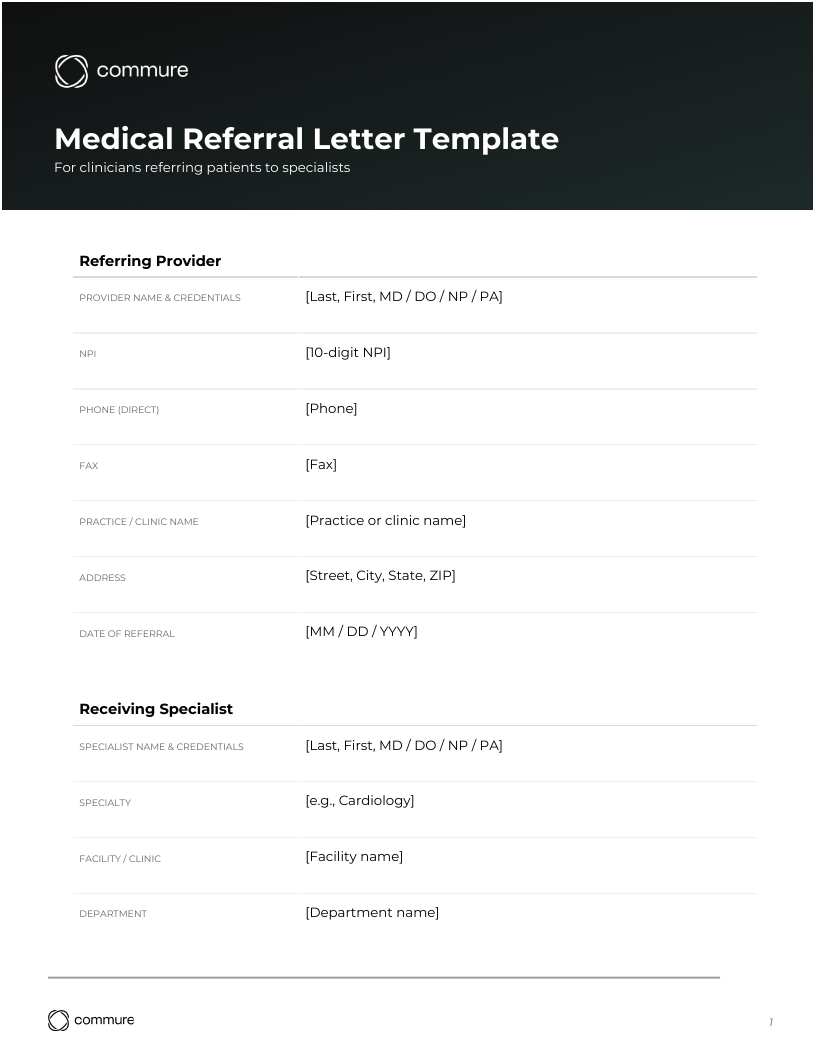
- Download the Referral Letter Template: editable DOCX, all eight required sections included
What is a medical referral letter template, and when do clinicians need one?
A medical referral letter template is a standardized document that a referring clinician completes when sending a patient to a specialist, surgeon, or other provider for evaluation or treatment. It tells the receiving provider what the referring clinician knows, what questions need answering, and what has already been tried.
Clinicians write medical referral letters for routine, urgent, and emergency consultations across any specialty. The letter is a legal record of the clinical handoff.³ It documents the patient's journey from primary care to specialist and provides the clinical basis for the visit.
Most medical referral letters cover outpatient consultations, from cardiology second opinions to behavioral health evaluations to physical therapy workups. The same core structure applies in all cases. What changes is the clinical content under each heading, not the headings themselves.
Types of medical referral letter templates
Different clinical situations call for slightly different medical referral letters. The core eight-section structure stays the same. What changes is the emphasis within each section.
Specialist referral letterThe most common type. A primary care provider refers a patient to a cardiologist, dermatologist, gastroenterologist, neurologist, or other specialist for further evaluation. The clinical question section is especially important here: state one specific question the specialist should answer.
Surgical referral letterRefers a patient to a surgeon or surgical department for assessment of a potential procedure. Include the patient's surgical history, current medications affecting anesthesia risk (anticoagulants, steroids), and any imaging that supports the surgical indication.
Mental health referral letterRefers a patient to a psychologist, psychiatrist, or counselor. Include relevant mental health history, current medications including psychiatric medications, prior treatment attempts, and any safety concerns the provider should know before the visit.
Diagnostic referral letterRefers a patient for a specific test (MRI, CT, biopsy, sleep study) rather than a clinical consultation. The clinical question section should state what the test is intended to rule in or out, not just order the test by name.
Rehabilitation referral letterRefers a patient to a physical therapist, occupational therapist, or rehabilitation specialist. Include functional limitations, prior therapy attempts, and whether the referral is post-surgical or for a chronic condition.
In each case, download the same medical referral letter template below and adapt the clinical content to the referral type.
What does a complete medical referral letter template include?
A complete medical referral letter template has eight sections. Specialists say the most common gaps in a doctor referral letter are missing medications, missing medical problems, and an unanswered clinical question.¹
1. Patient information
- Patient full legal name, date of birth, and medical record number (MRN) or account number
- Contact details and insurance information
- Insurance authorization number if your payer requires one
2. Referring and receiving provider details
- Referring provider: name, credentials, and National Provider Identifier (NPI)
- Receiving specialist: name, department, and facility
- Date of the referral
3. Urgency levelMark the referral as routine, semi-urgent, urgent, or emergency. This tells the specialist's office how fast to schedule the visit.
4. Clinical questionState one specific question for the specialist to answer. "Please evaluate for possible inflammatory bowel disease and advise on workup" is useful. "GI issues" is not. A specific clinical question gets a more useful reply and focuses the specialist's visit.
5. Relevant medical history
- Chief complaint and how long it has been present
- Past medical history, surgical history, and family history where relevant
- Social context that may affect care planning
6. Current medications and allergies
- All medications with dose and frequency
- Drug allergies with the type of reaction
- Over-the-counter drugs and supplements if relevant to the referral reason
7. Examination findings and test results
- Relevant exam findings
- Lab values, imaging results, or other test results with dates
- Attach full reports if available
8. Current management and specific request
- What has already been tried and whether it helped
- What you want the specialist to do: opinion only, further workup, a specific procedure, or ongoing shared care
- Provider signature, credentials, and a direct phone number for follow-up
Sample medical referral letter wording
The template below shows how each section reads when filled in. Replace the bracketed fields with your patient's information.
Date: [MM/DD/YYYY]
To: Dr. [Specialist Last Name], [Specialty], [Facility Name], [Department]
Re: [Patient Full Name], DOB [MM/DD/YYYY], MRN [number]
Urgency: Routine
Clinical question: Please evaluate [Patient Name] for possible [condition] and advise on further workup and management.
History: [Patient Name] is a [age]-year-old [sex] presenting with [chief complaint] for [duration]. Relevant history includes [relevant diagnoses, surgical history]. Current medications: [drug name, dose, frequency; one per line]. Allergies: [drug name: reaction type].
Examination and test results: [Key exam findings]. Recent labs/imaging: [test name: value, date, in/out of range]. Full reports attached.
What has been tried: [Treatments attempted and outcome].
I am requesting: [Opinion only / Further workup / Specific procedure / Ongoing shared care].
Sincerely,
[Provider Full Name, Credentials]
NPI: [10-digit NPI]
Direct phone: [Phone]
Adjust the clinical question and management sections for each specialty. The structure (one question, one request, one direct phone number) stays the same regardless of specialty.
Filled-in example: cardiology referral letter
The example below shows a completed medical referral letter using the same eight-section structure. All patient and provider information is fictional.
Date: 06/15/2026
To: Dr. Sarah Chen, Cardiology, University Medical Center, Department of Cardiology
Re: James Miller, DOB 03/22/1958, MRN 2847391
Insurance: BlueCross BlueShield, Member ID 00847321, Group 55129
Referring provider: Maria Rodriguez, MD, NPI 1234567890, Family Health Associates, 482 Oak Street, Springfield, IL 62701
Urgency: Semi-urgent
Clinical question: Please evaluate James Miller for possible atrial fibrillation and advise on workup and anticoagulation management. He has had three episodes of palpitations with associated shortness of breath over the past six weeks.
History: James Miller is a 68-year-old male presenting with intermittent palpitations and shortness of breath for six weeks. Relevant history: hypertension (2011), type 2 diabetes (2016), right knee replacement (2019). Current medications: metformin 500 mg twice daily; lisinopril 10 mg once daily; atorvastatin 40 mg once daily. Allergies: penicillin (hives).
Examination and test results: Irregular heart rate on auscultation, 88 bpm. BP 138/82. EKG 06/12/2026: irregular rhythm, no acute ST changes; report attached. HbA1c 7.1% (02/12/2026, in range). Fasting glucose 126 mg/dL (02/12/2026, borderline high).
What has been tried: Advised reduction in caffeine. No antiarrhythmic or anticoagulant medications started pending specialist evaluation.
I am requesting: Further workup including Holter monitor and echocardiogram, and recommendation on anticoagulation if atrial fibrillation is confirmed.
Sincerely,
Maria Rodriguez, MD
NPI: 1234567890
Direct phone: (555) 847-2291
How to fill out a medical referral letter template, step by step
Fill in each section in order. The structure mirrors SOAP notes: patient context and history first, objective findings next, then a specific clinical question and plan. When letters are incomplete, specialists often cannot address the problem in the first visit. That leads to repeat referrals.¹
Patient informationWrite the full name, date of birth, and MRN exactly as they appear in the chart. Add the insurance ID and any authorization number your practice already has.
Urgency levelCheck one level: routine, semi-urgent, urgent, or emergency. If you are not sure, pick semi-urgent. Add a note about your reasoning in the clinical question section.
Clinical questionWrite one sentence. Make it a question a cardiologist, neurologist, or internist could act on. Avoid broad terms. Use the patient's presenting symptom and what you want to know.
Medications and allergiesList every medication with the dose and how often the patient takes it. Note each allergy with the type of reaction, not just the drug name. Specialists need this before they can safely order tests or prescribe.
Test resultsPaste the key finding from each result. Include the value and date. Note whether it was in or out of range. Attach the full report if your workflow allows.
Current management and your requestState what you tried and what happened. Then say what you want the specialist to do. Choose one: opinion only, further workup, a specific procedure, or ongoing shared care.
Signature and contactSign with your credentials. Add a direct phone number. Specialists reach out before the visit when they can find you quickly. Without a contact number, the specialist sees the patient with no way to prepare.
What compliance rules apply to medical referral letters?
Three federal rules shape what goes in a medical referral letter template and how long to keep it.
HIPAA and treatment disclosuresMedical referral letters are treatment disclosures between providers. Under 45 CFR 164.506, a covered entity may share protected health information with another provider for treatment purposes without patient authorization. The minimum necessary standard does not apply to these disclosures. Share the clinical information the specialist needs to treat the patient. Do not attach records that have no bearing on the referral reason.
Medicare documentation requirementsCenters for Medicare & Medicaid Services (CMS) requires that the referring clinician document medical necessity in the chart. For therapy services, this may require a separate letter of medical necessity in addition to the referral. As of January 2025, a signed referral order satisfies the Medicare certification requirement for physical therapy, occupational therapy, and speech-language pathology.⁴ Keep a copy in the patient's record.
Anti-Kickback rulesThe Anti-Kickback Statute (42 U.S.C. § 1320a-7b(b)) prohibits referrals based on financial relationships between providers. Write the clinical reason for every referral. Do not include language about financial arrangements with the receiving specialist.
Amendments and addendaIf you update a referral letter after sending it, add a dated addendum. Do not alter the original document. This applies to any correction made after the letter is finalized.
State lawRequirements vary by state. Some states require specific forms, prior authorization steps, or mental health referral protections. Check your state's rules before sending.
This article provides general information only and is not legal or compliance advice. Consult your compliance officer or legal counsel for guidance specific to your practice.
How Commure Scribe supports medical referral documentation
When clinicians use Commure Scribe as their AI medical scribe, the clinical narrative is already structured before the referral letter is drafted. Commure Scribe listens to the encounter and, within seconds of the visit ending, generates a structured note for the clinician to review. The chief complaint, relevant history, exam findings, and management plan carry directly into the referral sections. Administrative fields (demographics, insurance IDs, NPI numbers) still require manual entry.
90%+ of providers using Commure Scribe report reduced clinical documentation time. HIPAA compliant and System and Organization Controls 2 (SOC 2) certified.
Disclaimer
This article provides general information only and does not constitute legal, medical, regulatory, or compliance advice. Healthcare regulations, including HIPAA and CMS requirements, change frequently. Requirements vary by state. Have your compliance officer or legal counsel review your referral letter process before clinical use.
Referral Letter Template Download
Download a copy of this template
Thanks! Your medical referral letter template is ready.
Click below to download.

Frequently Asked Questions
A medical referral letter template is a standardized document that a clinician completes when sending a patient to a specialist or other provider. It includes eight sections covering patient information, provider details, urgency level, clinical question, medical history, medications, test results, and a specific management request. Download the free editable version above.
A complete medical referral letter includes eight sections, from patient information and urgency level to test results and a specific management request to the specialist. The full breakdown and a filled-in sample are in this article. The download above includes all eight sections in an editable DOCX format.
One page is standard. Include the detail a specialist needs to prepare for the visit, no more. A letter that is too long delays review. One that is too short forces a callback before the appointment.
The five most common types are specialist referral letters, surgical referral letters, mental health referral letters, diagnostic referral letters, and rehabilitation referral letters. All five use the same eight-section structure. What changes is the clinical content and emphasis within each section.
Medicare does not always require a formal referral letter. However, CMS requires the referring clinician to document medical necessity in the chart. As of January 2025, a signed referral order satisfies the Medicare certification requirement for therapy services, including physical therapy, occupational therapy, and speech-language pathology.⁴
Yes. Replace the generic clinical question with a specialty-specific question ("Please evaluate for possible atrial fibrillation and advise on workup" for a cardiology referral, for example). The eight-section structure stays the same across all specialties.
An incomplete medical referral letter can prevent the specialist from fully addressing the problem at the first visit. That leads to repeat referrals and delays care.¹ Missing medications and an unanswered clinical question are the most common gaps.
Sources
¹ Gandhi TK, Sittig DF, Franklin M, Sussman AJ, Fairchild DG, Bates DW. Communication Breakdown in the Outpatient Referral Process. J Gen Intern Med. 2000;15(9):626–631. https://pmc.ncbi.nlm.nih.gov/articles/PMC1495590/
² Wåhlberg H, Valle PC, Malm S, Broderstad AR. Impact of referral templates on the quality of referrals from primary to secondary care: a cluster randomised trial. BMC Health Serv Res. 2015;15:353. https://link.springer.com/article/10.1186/s12913-015-1017-7
³ Ramanayake RPJC. Structured Printed Referral Letter (Form Letter); Saves Time and Improves Communication. J Family Med Prim Care. 2013;2(2):145–148. https://pmc.ncbi.nlm.nih.gov/articles/PMC3894031/
⁴ Centers for Medicare & Medicaid Services. Simplifying Documentation Requirements, Past Changes. https://www.cms.gov/simplifying-documentation-requirements-past-changes