



ROS Medical Abbreviation: Meaning and Free Template
What ROS means in a chart, the 14 systems CMS recognizes, and how to document an ROS that matches the visit after the 2021 office visit changes.
Written by the Commure Scribe Team
Published: November 10, 2026
•
8 min read
ROS is the medical abbreviation for review of systems. It is a series of questions about symptoms across 14 body systems, asked as part of the patient history.¹ In lab and research papers, the same letters stand for reactive oxygen species, a chemistry term with no link to the chart.
How Does the ROS Fit Into the Patient History?
CMS defines the ROS as "an inventory of body systems obtained through a series of questions seeking to identify signs and/or symptoms that the patient may be experiencing or has experienced."¹ It belongs to the history, after the history of present illness (HPI) and before the exam. Each answer is a positive or a negative. A pertinent negative is a denied symptom that bears on the problem, such as no chest pain in a patient with shortness of breath.
Psychiatric visits use a longer set of mental health domains, covered in the guide to the psychiatric review of systems.
Which 14 Systems Does a Review of Systems Cover?
CMS recognizes 14 systems for the ROS.¹ Use the CMS names below when you build or check a template.
- Constitutional symptoms: fever, weight loss, fatigue
- Eyes: vision change, eye pain
- Ears, nose, mouth and throat: hearing loss, sore throat, nosebleeds
- Cardiovascular: chest pain, palpitations, leg swelling
- Respiratory: cough, shortness of breath, wheezing
- Gastrointestinal: nausea, abdominal pain, change in stools
- Genitourinary: painful urination, frequency, blood in urine
- Musculoskeletal: joint pain, back pain, weakness
- Integumentary (skin and/or breast): rash, new lesions, breast lumps
- Neurological: headache, numbness, dizziness
- Psychiatric: low mood, anxiety, sleep problems
- Endocrine: heat or cold intolerance, excess thirst
- Hematologic/lymphatic: easy bruising, swollen glands
- Allergic/immunologic: seasonal allergies, frequent infections
The symptom examples after each system are sample prompts to adapt to the patient.
Endocrine and allergic/immunologic are the two systems on this list with no matching exam system. One analysis in Family Practice Management reads this as "recognition that these systems are easier to ask about than to examine."²
What Is the Difference Between a Problem Pertinent, Extended and Complete ROS?
The three levels come from the CMS 1997 guidelines and differ by how many systems you review.¹ They no longer affect E/M visit level selection under Medicare.³ Some coders call the first level "problem-focused," but CMS uses "problem pertinent."
- Problem pertinent ROS: asks about the one system tied to the problem in the HPI. Chart the positives and pertinent negatives for that system.
- Extended ROS: covers the related system plus a few more. Chart positives and pertinent negatives for two to nine systems.
- Complete ROS: covers at least 10 systems. List each system with a positive or pertinent negative answer by name. A note that all other systems are negative can cover the rest.
Here is how each level reads for a patient with five days of cough:
- Problem pertinent: Respiratory: positive for cough. Negative for shortness of breath and wheezing.
- Extended: Respiratory as above. Constitutional: positive for low-grade fever. Cardiovascular: negative for chest pain and leg swelling.
- Complete: The three systems above, plus ENT: positive for sore throat. Gastrointestinal: negative for nausea. All other systems reviewed and negative.
A focused sick visit may need only a problem pertinent ROS, while a new patient with vague symptoms may need a complete one.
Download the Free ROS Checklist Template
Note: This template is for informational purposes only and does not constitute legal or medical advice. Have your compliance officer review it before clinical use.
The checklist lists all 14 CMS systems with fields for positives, pertinent negatives and your review note.
How Is the ROS Different From the HPI and the Physical Exam?
The HPI tells the story of the main problem. The ROS records what the patient reports across body systems. The exam records what you see, hear and feel.¹
Chart each finding in the section it belongs to. A symptom the patient describes goes in the HPI or ROS, while a finding you observe goes in the exam.
A full HPI example appears in the guide to the history of present illness. Exam structure is covered in the guide to the physical examination format.
Does the ROS Still Matter After the 2021 E/M Changes?
For office visits, the ROS no longer sets the visit level. Since January 1, 2021, you pick the level for codes 99202 to 99215, except 99211, by medical decision making (MDM) or by total time.⁴ The AMA guideline states, "The extent of history and physical examination is not an element in selection of office or other outpatient services."⁴
The ROS still belongs in the note. Office visits "include a medically appropriate history and/or physical examination, when performed."⁴ You decide how much history the visit needs. Your care team can collect some of it, while patients or caregivers can supply it directly for you to review.⁴ The AMA notes the changes build on 2019 CMS relief that ended the need to "re-record elements of history and physical exam when there is evidence that the information has been reviewed and updated."⁵
As of January 1, 2023, CMS extended level selection by MDM or time to most E/M visit families. Some families use only MDM or only time.³ Emergency visits use MDM only.⁵ For all E/M visits, CMS says history and exam don't affect visit level selection.³
One early study after the 2021 change found "no meaningful changes in measures of note length or time spent in the EHR."⁶ A 10-system ROS on every office visit now adds length to the note without raising the level.
Commercial payers and other programs can set their own documentation rules. Check payer policy for visits outside Medicare.
How Do You Document a Review of Systems That Holds Up in an Audit?
Chart only the questions you asked and the answers you got. One study of emergency medicine residents found that 38.5% of documented ROS systems matched audio recordings of the visit.⁷ An ROS full of unasked questions may not represent what happened in the visit.
- Name positives and pertinent negatives one by one. Under the 1997 guidelines, CMS lets you write that all other systems are negative only after you list each system with a positive or pertinent negative answer.¹ That note applies to a complete ROS.
- Sign off on intake forms. Staff or a patient form can record the ROS, but you must add a note that supplements or confirms its answers.¹ For example, you can write "Patient ROS form reviewed and verified."
- Update a carried-forward ROS. You can reuse an ROS from an earlier visit only if the note shows you reviewed and updated it. Record any new findings or no change, plus the date and location of the earlier ROS.¹
- Watch copy-forward text. In one study of progress notes written for admitted patients, a typical note had 46% copied text and 36% imported text.⁸ Medicare contractor National Government Services warns that "cloned documentation will be considered misrepresentation of the medical necessity requirement."⁹
Rules on cloned notes vary by Medicare contractor and payer. Ask your billing lead or compliance officer how your payers review ROS sections.
How Commure Scribe Documents the ROS You Take
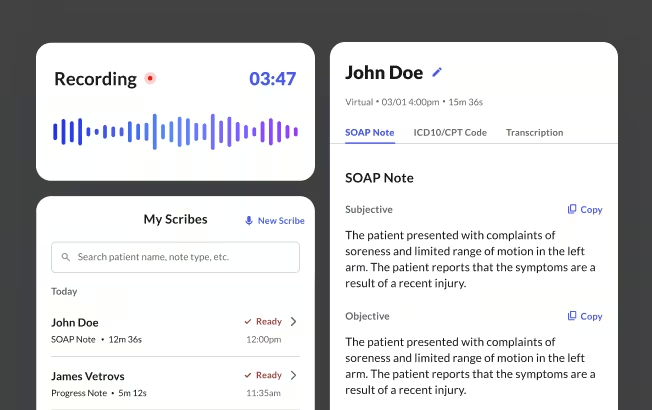
Commure Scribe, an AI medical scribe, records the visit and drafts the note from the conversation. The ROS in that draft starts from the symptoms your patient reported and denied in the room.
The workflow is Capture → Edit → Finalize. Within seconds of ending the recording, you get suggested ICD-10 and CPT codes and a structured SOAP note. You review the ROS with the rest of the note and edit it before you finalize. During the visit, you can stay present in the room instead of ticking boxes.
Commure Scribe offers specialty-specific templates and a custom template builder. You can set up the ROS section to follow the checklist on this page, with your specialty's systems listed first. Independent practices and small groups move the finished note into the EHR by copy and paste from an overlay that sits over the EHR. Larger groups can get EHR integrations by contacting Commure's sales team.
Draft the ROS From the Conversation
If you would rather not tick 14 systems by hand, Commure Scribe drafts the full note, ROS included, from the visit itself. Try it on a week of your own patient visits. When you are ready to choose a plan, see Commure Scribe pricing.
Review of Systems Template Download
Download a copy of this template
Thanks! Your review of systems template is ready.
Click below to download.

Frequently Asked Questions
The ROS medical abbreviation stands for review of systems. It is the part of the history where you ask about symptoms across the 14 body systems CMS recognizes, from constitutional symptoms to allergic/immunologic. In lab research, ROS can also mean reactive oxygen species, a term unrelated to the patient chart.
You can use it for a complete ROS. The CMS 1997 guidelines allow a note that all other systems are negative after you list each system with a positive or pertinent negative answer by name. Without that note, a complete ROS must list at least 10 systems one by one. Use the phrase only for systems you asked about.
Office visits need only the ROS the visit calls for. They include a medically appropriate history and/or physical examination, when performed. Since 2021, you choose codes 99202 to 99215, except 99211, by medical decision making or total time. The number of systems you review no longer raises the level. Chart the ROS the visit needs. Check the rules for payers outside Medicare.
A patient form or a staff member can record the ROS, but you must add a note that supplements or confirms its answers. For example, you can write "Patient ROS form reviewed and verified." Your note can confirm or add to the form's answers without copying them over. The AMA's 2021 office visit guidelines also let patients or caregivers supply history directly for you to review. Go over positive answers with the patient before you sign.
Keep all 14 CMS systems on the form so a complete ROS stays possible. Move the systems your specialty asks about most to the top. Swap the sample symptoms for the ones you screen for, such as joint swelling in rheumatology. Psychiatric visits need a fuller mental health section with its own domains.
Sources
- Centers for Medicare & Medicaid Services. 1997 Documentation Guidelines for Evaluation and Management Services. 1997. https://www.cms.gov/outreach-and-education/medicare-learning-network-mln/mlnedwebguide/downloads/97docguidelines.pdf
- Moore KJ. "Exam Documentation: Charting Within the Guidelines." Family Practice Management (American Academy of Family Physicians). 2010. https://www.aafp.org/pubs/fpm/issues/2010/0500/p24.pdf
- Centers for Medicare & Medicaid Services, Medicare Learning Network. Evaluation and Management Services (MLN006764). May 2026. https://www.cms.gov/outreach-and-education/medicare-learning-network-mln/mlnproducts/downloads/eval-mgmt-serv-guide-icn006764.pdf
- American Medical Association. CPT Evaluation and Management (E/M) Office or Other Outpatient (99202-99215) and Prolonged Services Code and Guideline Changes. Effective January 1, 2021. https://health.maryland.gov/pophealth/Documents/Local%20Health%20Department%20Billing%20Manual/AMA%20E%20M%202021%20Coding%20Changes.pdf
- American Medical Association. "CPT Evaluation and Management." 2026. https://www.ama-assn.org/practice-management/cpt/implementing-cpt-evaluation-and-management-em-revisions
- Apathy NC, Hare AJ, Fendrich S, Cross DA. "Early Changes in Billing and Notes After Evaluation and Management Guideline Change." Annals of Internal Medicine. 2022;175(4):499. https://doi.org/10.7326/M21-4402
- Berdahl CT, Moran GJ, McBride O, Santini AM, Verzhbinsky IA, Schriger DL. "Concordance Between Electronic Clinical Documentation and Physicians' Observed Behavior." JAMA Network Open. 2019;2(9):e1911390. https://pmc.ncbi.nlm.nih.gov/articles/PMC6751766
- Wang MD, Khanna R, Najafi N. "Characterizing the Source of Text in Electronic Health Record Progress Notes." JAMA Internal Medicine. 2017. https://pmc.ncbi.nlm.nih.gov/articles/PMC5818790
- National Government Services. "Cloned Documentation Could Result in Medicare Denials for Payment." 2019. https://icahn.mssm.edu/files/ISMMS/Assets/pdf/Cloned-documentation-Could-Result-in-Medicare-Denials-for-Payment_Policy_Educ.pdf