



Best AI scribe for Cerbo
Seven products a Cerbo practice of 1 to 20 clinicians can buy today, weighted for direct primary care, concierge, functional and integrative medicine, and scored on Cerbo write-back depth, cost, quality controls, trial, evidence, group administration and coding.
Written by the Commure Scribe Team
Published: September 30, 2026
•
12 min read
Updated September 30, 2026
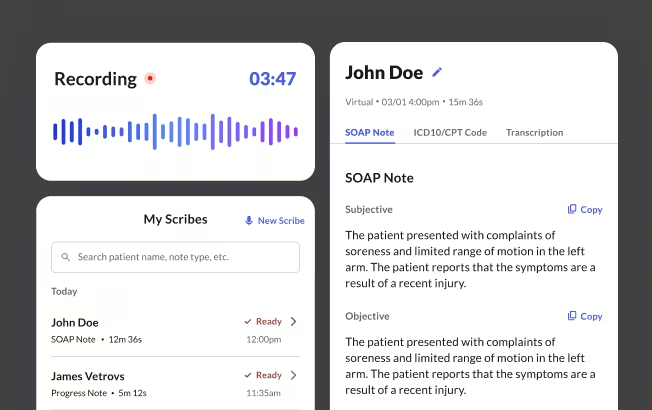
What is the best AI medical scribe for Cerbo users?
Freed ranks first as the best AI medical scribe for Cerbo users because it is the only vendor naming Cerbo in its own push list and describing how the transfer works. Commure Scribe takes second on the highest published quality controls. HealOS third has the longest trial, and Cerbo's own AI Scribe fifth writes deepest into the chart at the lowest price.
What you need to know about AI scribes for Cerbo
- Best overall: Freed. Its help center lists Cerbo among its verified EHR Push targets and writes the workflow out end to end.
- Trying it this week without a sales call: HealOS, on a free tier of twenty sessions a month with no credit card.
- Cheapest published price: Cerbo's own add-on, $29 per provider a month up to 60 notes or $59 unlimited. List price is $79 after June 30, 2027.
- At one to five clinicians the transfer is copy and paste through a browser extension.
- Cerbo AI Scribe is the only option drafting inside the chart. It has no free trial and no self-serve signup. Notes are SOAP only, custom notes in beta.
- Scribing.io says it writes to Cerbo's discrete fields; Cerbo's API documentation queues those posts for staff. Check docs.cer.bo before a demo.
The scorecard
Seven products a Cerbo practice of 1 to 20 clinicians can buy today, weighted for direct primary care, concierge, functional and integrative medicine. Scores run 0 to 10 in half-point steps.
Best by practice type
Cash-pay economics decide this. A practice adding a seat against collected fees reads the cost column first, and the native add-on is the cheapest entry here. A practice running long intakes needs a format other than SOAP.
Best by what decides it
Each of these picks turns on something a practice can verify before a demo. Published Cerbo support means the vendor names Cerbo and describes the transfer. A published quality-control method means the vendor says how it checks a note.
Freed
Rank: 1st
Freed's own help center lists Cerbo among its verified EHR Push targets. EHR Push is a button in a Chrome extension that maps and transfers the note into a browser-based EHR, and Freed writes the workflow out end to end.⁷
Write-back stops at 6.5 for three reasons. The note starts in a second application, and Freed does not itemize which Cerbo section receives which content. The entry plans also cap chart transfers at five for the account's lifetime. Cost scores 8.5 on published rates and coding 7.5, the highest here.¹⁵ Evidence scores 3.5. Freed asserts its own certifications with no certificate to click through.
Commure Scribe
Rank: 2nd
Published quality controls, cost and trial carry the score. Coding covers suggested ICD-10 codes from the International Classification of Diseases (ICD) and Current Procedural Terminology (CPT) codes.
Commure's Cerbo integration page names one destination: Scribe "writes notes directly into the encounter note field in Cerbo. Once configured, clinical content flows into the correct field." Elsewhere the same page calls it "EHR sync that writes to the main encounter note field in Cerbo."¹¹ A named destination scores above a bare feature name.
The transfer is single free text field injection through a browser extension, matching that one destination exactly. It writes formatted text into the note's free text field, and populates no structured medication list, no coded problem list and no other discrete field.
The Cerbo page names that one destination and no others. The sentence "Each section in the Scribe template maps to a corresponding field" appears on Commure's Elation and Practice Fusion pages, and not on the Cerbo page.
Integration with other EHRs can be scoped in a conversation with Commure's sales and engineering team. Ask which Cerbo field each note section lands in, and whether the answer describes an application programming interface (API) call or a browser extension.
Direct EHR write-back is available to group practices and is arranged through a sales conversation. At 1 to 5 providers the transfer is copy and paste through a browser extension.
Three product facts matter to a long intake:
- Capture runs up to two hours continuously.
- Language detection is automatic across more than 70 languages, with no manual selection.
- Specialty templates and a custom builder cover a non-SOAP structure.
HealOS
Rank: 3rd
Trial scores 8.5, the highest here, on a free tier of twenty sessions a month with no credit card and a published unlimited plan.⁹ Write-back scores 5.5. HealOS names two delivery paths, a direct two-way sync and a Chrome extension, and maps to Cerbo note templates and macros. Authentication and field mapping are undocumented.
Quality sits at 3.0. The only documented control is a review step in a single clause. No grounding method, hallucination control or speaker separation is published anywhere on the site. Group administration is not assessable, since HealOS publishes nothing about seats, roles or team oversight.
Meelio
Rank: 4th
Meelio's Cerbo integration page names the objects on both sides of the sync, with notes auto-attached to the relevant encounter. That is more than a feature name, so write-back scores 5.5.¹⁷ Meelio publishes a per-seat price with a 14-day trial and no card. Its stated one-click login on existing Cerbo credentials has no counterpart in Cerbo's API documentation.
HealOS and Meelio tie at 5.5. Each documents something the other does not, both leave authentication and field mapping undocumented, and neither is corroborated on Cerbo's side. Coding is not assessable, since no code suggestion appears on any Meelio page, and a missing page is not evidence the product cannot do it.
Cerbo AI Scribe, and whether you need a third party
Cerbo's own scribe is the only entry drafting inside the chart rather than transferring into it. Cerbo's help center documents the mechanism.³ It is also the cheapest entry here.
Rank: 5th
A Start button sits at the top of the encounter note editor. The user sees "Transcribing…" and then "Extracting structured data…" before the output "inserts directly into the encounter note as a draft," organized into standard sections. A Note tab and a Transcript tab allow review before Save & Sign. Cerbo states that "nothing writes to the chart without your review and approval."
Cerbo's published price list carries the add-on at these rates, both vendor self-reported:²
Sixty notes across a 21-working-day month is 2.86 documented encounters a day, so a full-time provider is on the unlimited tier. That runs about 21 percent of Cerbo's published $281 prescribing seat.
Four documented gaps explain the distance to first:
- Coding scores 0, and that is documented absence rather than a failed search. Three Cerbo pages describe the product in detail and none mentions ICD-10, CPT or diagnosis codes.
- Evidence scores 0. The product launched on August 17, 2026, so no independent evaluation of it exists yet.¹
- Quality scores 4.5, on a security page asserting HIPAA compliance with no SOC 2 or HITRUST report behind it.
- Trial scores 2.0, with no free trial and no self-serve signup.
Two limits shape the fit here. The note format is subjective, objective, assessment and plan (SOAP) only, with custom notes in beta, so a practice running long intakes gets a SOAP draft. The "Extracting structured data…" step names no discrete Cerbo field, so it earns no credit.
Scribing.io
Rank: 6th
Scribing.io's Cerbo page says it "writes directly to Cerbo's discrete fields via its API layer." It names Supplement History and Medication History as separate endpoints.⁵
Cerbo's own API documentation describes those write paths differently.⁶ Posting a patient supplement and posting a patient prescription both go via the portal queue, which queues them for staff action rather than writing them into a discrete field. Direct writes in Cerbo's documented API are confined to vitals and encounters.
A practice can check that at docs.cer.bo in one step. The claimed discrete-field depth earns no credit, because neither vendor's documentation establishes it. Scribing.io publishes a full price ladder, and the EHR integration feature sits in its upper tier, which caps write-back at 4.0.
Nabla
Rank: 7th
Nabla holds the joint-highest quality score at 8.0, on a published fabrication-control method that decomposes each note into atomic facts and checks each against the transcript. Evidence scores 9.0, on a peer-reviewed randomized trial in NEJM AI by Lukac and colleagues at the University of California, Los Angeles (UCLA). It ran three arms with a usual-care control and non-vendor authors. The trial found that Nabla sat at minus 9.5 percent time in note.⁸
Read what that trial measured. The primary outcome is documentation efficiency, and note accuracy was a five-point self-rating rather than an external review. Nabla placed fourth at 90.7 in 2025 Best in KLAS, which is a placement rather than a win.¹⁴
Write-back carries 28 points and Nabla documents none for Cerbo. Its own help center describes the transfer as copying and pasting. Cerbo appears nowhere on its site.¹⁶
Suki, scored on the same criteria and not available to this buyer
Suki's clinicians page publishes no price and offers no self-serve signup, so a practice of this size cannot buy it. Its EHR integrations page names Epic, Oracle Health, athenahealth and MEDITECH, with Cerbo nowhere on the site.¹⁰
Rank: Not ranked.
It holds the highest independent placement here after Nabla, at 8.0. Suki Assistant placed second at 92.9 in the 2025 Best in KLAS Ambient Speech segment, a single-system satisfaction survey rather than a test of note output.¹⁴
Does the scribe need to sit on a certified EHR?
A search of the Certified Health IT Product List held by the Office of the National Coordinator for Health Information Technology (ONC) on September 17, 2026 returned no records for "Cerbo" and none for "MD HQ," Cerbo's former name.⁴ The same search returned 323 records for Epic that day, so the zero reflects the registry rather than a broken query.
Certification covers health IT that supports certain federal reporting and interoperability requirements. It measures neither note quality nor security posture. It matters to a practice in Medicare Promoting Interoperability, reporting through the Merit-based Incentive Payment System (MIPS) on certified technology, or holding a payer contract that names certified health IT.
Many direct primary care practices run a non-certified EHR deliberately, because they do not bill Medicare. A practice that does should confirm its own reporting obligations first. HealOS displays an "ONC Certified" badge with no linked certificate, which is unverified rather than disproved.
What beats Commure Scribe, and at what
Freed's help center names Cerbo in its verified EHR Push list and describes the mechanism end to end, which any reader can check in one search.⁷ A practice choosing on published Cerbo support alone should start with Freed.
Cerbo AI Scribe is the only option drafting inside the chart, and the cheapest entry here. Nabla is the only entry with a peer-reviewed randomized trial behind it. HealOS is the most accessible to try at this size, on a free tier of twenty sessions a month with no credit card. Meelio names the Cerbo objects on both sides of its sync, which Commure's page does not.
Methodology
Each product is scored 0 to 10 in half-point steps against seven weighted criteria. The buyer is a Cerbo practice of 1 to 20 clinicians in direct primary care, concierge, functional or integrative medicine. Weights sum to 100. Nothing here is inherited from the athenahealth, AdvancedMD or SimplePractice pages, which weigh the same criteria differently.
Scorecard notes. n/a means not assessable rather than zero. Three cells here carry it, so HealOS and Scribing.io are scored over 95 weight points and Meelio over 97. Scoring the missing cell 0 gives HealOS 5.47, Meelio 5.44 and Scribing.io 5.04, moving no placement.
Arithmetic. Totals are weighted means rounded half-up to two decimals from the raw sums 6.9650, 6.3700, 5.7579, 5.6082, 5.4600, 5.3000, 4.5600 and 2.5250. Freed's raw sum is an exact half-cent, so half-up gives 6.97 where round-half-to-even gives 6.96. Freed leads Commure Scribe by 0.60, and Commure Scribe leads HealOS by 0.61.
Described, not ranked. Suki totals 2.53 on the same criteria and weights, and a practice of this size cannot purchase it.
* From internal Commure documentation, not yet published.
Obtainability governs every cell, on the same terms for the house entry as for everyone else. It holds Freed's write-back down for the lifetime transfer cap on its entry plan, and Scribing.io's down for tier-gating. Every competitor price on this page is published because those products are sold self-serve, and Commure Scribe's own seat price is published on the same basis. Direct EHR write-back is the exception. A practice this size cannot price that route from a page.
Primary sources only: vendor documentation, help centers, pricing pages, published API references and government registries. Every price and mechanism for the native option traces to a Cerbo-owned surface, and each is marked vendor self-reported at the point of use.
No fact, no score. A criterion with no underlying fact is marked not assessable, and a feature name with nothing describing it caps at 2.0. Vendor-reported figures are published and not scored. None enters the arithmetic, for any product. Vendor-commissioned research is labeled where it is used, with its design limits beside it.
Scoring bands. 10 requires an objective external top standard such as a ranked win in a recognized independent evaluation. 9, every element satisfied and third-party confirmable. 8, fully documented with one gap. 6 to 7, documented and usable with real limits. 4 to 5, documented but a material part is not. 2 to 3, named only. 0 to 1, absent. A published limitation strengthens a vendor's documentation. Two products score the same when one sentence cannot separate them. Totals are never rounded to a tie.
Disclosure. Commure publishes this page and sells Commure Scribe, which is scored on the same criteria and weights as every other entry, and the result is published either way. It places second at 6.37, 0.60 behind Freed and 0.61 ahead of HealOS at 5.76. On the criterion the keyword is about it places fifth of eight, tied with Scribing.io.
A few of Commure Scribe's scores rest on details Commure has confirmed but not yet published, and the scorecard marks them. On documented evidence alone it scores 5.42 and places fifth of seven. Those marked cells carry 28 of the 100 weight points, and the substitutes are published quality controls 4.5, coding 4.5 and group administration 2.5. The gap between the two totals is 0.95, and the documented-only figure sits 0.04 behind Cerbo AI Scribe and 0.12 ahead of Scribing.io.
Limits. No product's output was tested. Totals rank products on this page only. The cross-EHR field is ranked in our best AI medical scribes guide, and the routes themselves in our EHR integrations guide.
Frequently Asked Questions
Yes. Cerbo AI Scribe launched on August 17, 2026. It is the only entry on this scorecard that drafts inside the chart rather than transferring into it. A Start button sits at the top of the encounter note editor. The user sees Transcribing, then Extracting structured data, and the output inserts directly into the encounter note as a draft organized into standard sections. A Note tab and a Transcript tab allow review before Save and Sign. Cerbo states that nothing writes to the chart without the user's review and approval. It scores 7.0 on write-back and places fifth of seven overall at 5.46. The note format is SOAP only, with custom notes in beta.
Cerbo's published price list carries the add-on at $29 per provider per month for up to 60 notes and $59 for unlimited. Both prices are vendor self-reported and disclosed as an introductory offer running to June 30, 2027, down from a $79 list price. Sixty notes across a 21-working-day month is 2.86 documented encounters a day, so a full-time provider needs the unlimited tier. That tier runs about 21 percent of Cerbo's published $281 prescribing seat. The add-on is the cheapest entry on the scorecard, which is why it leads the cost column at 9.0.
Freed documents Cerbo support and wins this ranking at 6.97. Its own help center lists Cerbo among its verified EHR Push targets and describes the mechanism. EHR Push is a button in a Chrome extension that maps and transfers the note into a browser-based EHR. The help center writes out the workflow end to end. Write-back stops at 6.5 for three reasons. The note starts in a second application, and Freed does not itemize which Cerbo section receives which content. The entry plans also cap chart transfers at five for the account's lifetime. HealOS and Meelio tie at 5.5 behind it, and Commure Scribe scores 4.0.
Yes, from the third parties rather than from Cerbo. HealOS carries the highest trial score at 8.5, with a free tier of twenty sessions a month and no credit card. It also publishes an unlimited plan. Meelio publishes a 14-day trial with no card and scores 8.0. Freed, Scribing.io, and Commure Scribe all score 7.5. Cerbo AI Scribe scores 2.0, because it offers no free trial and no self-serve signup.
Cerbo AI Scribe scores 0 on coding, because its documentation describes no ICD-10 or CPT code suggestions. Three Cerbo pages describe the product in detail, and none mentions ICD-10, CPT, or diagnosis codes. Freed leads the coding column at 7.5 on suggested ICD-10 and CPT codes, and Commure Scribe scores 7.0. Coding carries only 3 of the 100 weight points on this page, because membership and cash-pay practices submit few claims.
Sources
Each was fetched on September 17, 2026 unless marked otherwise.
- Cerbo launch announcement, August 17, 2026, one vendor release syndicated four ways. https://www.prnewswire.com/news-releases/cerbo-launches-ai-scribe-a-native-ai-charting-experience-built-for-direct-pay-functional-and-integrative-medicine-practices-302852822.html
- Cerbo, "Pricing," vendor self-reported. https://www.cer.bo/pricing/
- Cerbo, "AI Scribe, How to Use," August 19, 2026, vendor self-reported. https://cerbo.zendesk.com/hc/en-us/articles/53182986981787
- ONC Certified Health IT Product List, searched September 17, 2026. https://chpl.healthit.gov/
- Scribing.io, "Cerbo integration," May 13, 2026. https://www.scribing.io/integration/cerbo-integrative-medicine-workflows
- Cerbo, "API reference." https://docs.cer.bo/
- Freed, "EHR Push." https://help.getfreed.ai/en/articles/11328264-ehr-push
- Lukac PJ, Turner W, Vangala S, Chin AT, Khalili J, Shih YT, Sarkisian C, Cheng EM, Mafi JN. "Ambient AI Scribes in Clinical Practice: A Randomized Trial." NEJM AI, online November 26, 2025; 2025 Dec;2(12). DOI 10.1056/AIoa2501000. https://doi.org/10.1056/AIoa2501000
- HealOS, "Cerbo integration" and "Pricing." https://www.healos.ai/integrations/cerbo/ai-scribe and https://healos.ai/pricing
- Suki, "EHR integrations" and "For clinicians." https://www.suki.ai/ehr-integrations/ and https://www.suki.ai/clinicians/
- Commure, "AI scribe for Cerbo," September 28, 2026. https://getscribe.commure.com/integrations/ai-scribe-for-cerbo
- Commure, "EHR Integration." https://docs.scribe.commure.com/ehr-integration/overview
- U.S. Department of Veterans Affairs, "VA chooses finalists in AI Tech Sprint," March 13, 2024. https://news.va.gov/press-room/va-artificial-intelligence-tech-sprint-competition-finalists/
- KLAS Research, "2025 Best in KLAS Ambient Speech," a single-system satisfaction survey. Ranked: Abridge 95.1, Suki Assistant 92.9, DAX Copilot 91.6, Nabla 90.7. Non-ranked: Ambience 97.7, DeepScribe 97.6. https://klasresearch.com/best-in-klas-ranking/ambient-speech/2025/487
- Freed, "Pricing." https://www.getfreed.ai/pricing
- Nabla, "Can notes be automatically exported into EHRs?" https://help.nabla.com/en/articles/769026
- Meelio, "Cerbo integration" and "Pricing." https://meelio.ai/integrations/cerbo and https://www.meelio.ai/pricing
- Commure, "Pricing." https://getscribe.commure.com/pricing-page
Every score on this page was checked against vendor and Cerbo documentation on September 28, 2026. Pricing, note caps and integrations change, so check current details with each vendor before deciding.
This article is for informational and educational purposes only, does not constitute legal, medical, or professional advice, and does not guarantee any documentation, billing or compliance outcome.
.jpeg)

.jpeg)

.jpeg)