



Best AI scribe for Practice Fusion
Six products a Practice Fusion practice of 1 to 100 clinicians can buy today, scored on write-back depth, cost, quality controls, trial, coding, group administration and evidence. Practice Fusion's own Scribe is described but not ranked.
Written by the Commure Scribe Team
Published: September 28, 2026
•
14 min read
Updated September 28, 2026
What is the best AI medical scribe for Practice Fusion users?
Commure Scribe ranks first as the best AI medical scribe for Practice Fusion users because it has the deepest chart write-back here and the highest published quality controls. Under five clinicians, Freed at second is the better start, since it publishes a Practice Fusion setup guide and sells self-serve. DeepCura third publishes the clearest pricing, and Tali AI fourth documents its own push.
What you need to know about AI scribes for Practice Fusion
- Best overall: Commure Scribe. It writes the note into Practice Fusion automatically or when you start the transfer, on desktop and mobile.
- Best under five clinicians: Freed. Premier runs $104 per provider a month billed annually, or $119 monthly, and the push is one click.
- Whole price ladder published: DeepCura. $129 a month per provider includes 1,000 credits, and above 2,000 credits nothing is published.
- At one to five clinicians you copy and paste. Practice Fusion's public API is read-only, so every third-party route is a browser push or a paste.
- The native option cannot be bought. Practice Fusion Scribe ties the recording to a scheduled appointment. Practice Fusion grants access, and nothing published says how to ask.
- Only a third party lists Suki as a Practice Fusion option. Its own integrations and partnerships pages name none, so check with Suki first.
Ranked scorecard
Best by segment
Practice size decides this. A practice buying without a sales conversation chooses among the products that publish a plan and a setup guide. A practice with an administrator can also reach the routes sold through a conversation.
Best by use case
The write-back column and the cost column pull in different directions, so the best pick changes with what a practice is optimizing. A practice wanting the fewest actions after a visit reads write-back first, and one needing a figure it can budget against reads cost.
The six products you can buy
Practice Fusion's public application programming interface (API) follows the Fast Healthcare Interoperability Resources (FHIR) standard, and it is read-only. No AI scribe vendor documents integrated-app write access. Every third-party route here is a browser push or a paste. What differs is how many actions it takes.
Commure Scribe
Rank: 1st
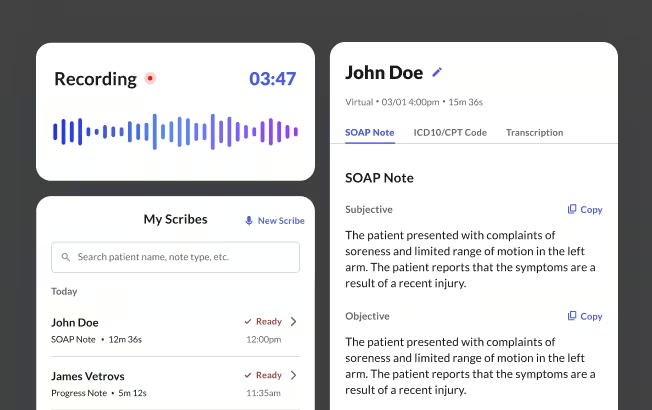
Commure Scribe writes the note into Practice Fusion either automatically or when the clinician starts the transfer, on desktop and mobile. Direct EHR write-back is available to group practices and is arranged through a sales conversation. At 1 to 5 providers the transfer is copy and paste through a browser extension overlay. That is a paste, not an API integration, a direct write-back, a bidirectional sync or a one-click sync. The published Practice Fusion integration page names no destination field.
What the plan page publishes
Competitor prices here are published because those products sell self-serve, and the Commure Scribe seat price sits on the plan page on the same basis. The write-back route is sold through a sales conversation, so a practice this size cannot price it from the page.
Freed
Rank: 2nd
Freed documents the whole sequence at https://help.getfreed.ai/en/articles/11722107-ehr-push-for-practice-fusion. You install the Chrome extension, open Practice Fusion, launch the extension and record. The last step is one action: "click Push to EHR. Your note will transfer automatically!" The article also states "automatic field mapping" into Practice Fusion's subjective, objective, assessment and plan (SOAP) fields, and it names the Chrome-profile and login prerequisites.
Four limits hold write-back at 6.5, below Tali AI. The mapping is asserted rather than enumerated, and the article states that a given account may lack the feature. According to Freed's own resource page at https://www.getfreed.ai/resources/practice-fusion-ai-scribe, users still "copy the generated note directly into Practice Fusion." The push also depends on the browser.
Premier is Freed's top self-serve plan, at $104 per month billed annually or $119 monthly. A custom-priced Groups tier above it carries single sign-on and admin dashboards. Coding scores 7.5, on ICD-10 codes from the International Classification of Diseases (ICD) and Current Procedural Terminology (CPT), at Premier plus a Coding Assistant from Core up. Published quality controls score 4.5, the second lowest in that column.
Buy it if you want a write-back you can read about, buy the same afternoon, and use without a sales call.
DeepCura
Rank: 3rd
DeepCura documents a paste precisely: install the extension, open Practice Fusion in the same browser, dictate, paste a SOAP-formatted note into the note field. According to the same page, no scribe holds a native bidirectional API integration with Practice Fusion, because no such API exists for clinical documentation. Write-back scores 3.5, above the generic copy-button entries, because the path is documented for Practice Fusion specifically and names the target field.
Cost scores 9.5, the highest cell here, because DeepCura publishes the whole ladder.
What DeepCura publishes
Above 2,000 credits a month DeepCura publishes no price, so a high-volume practice has to ask. Coding scores 7.5 on ICD-10 and E/M with undercoding and overcoding flags. Independent evidence scores 5.0 on a Cloud Application Security Assessment Tier 2 certificate at https://www.deepcura.com/resources/pdf/deepcura-casa-certification.pdf. Tali AI and Freed both beat it on write-back depth.
Buy it if you want to model documentation cost to the dollar and will accept a paste.
Tali AI
Rank: 4th
Tali AI publishes the deepest third-party path a practice can buy today and sells it self-serve. Its Practice-Fusion-specific setup page at https://sales.tali.ai/practicefusion gives five steps. It states that "Copy to EHR" auto-populates all four sections of the SOAP note, "removing any need to copy and paste." The free plan gives 14 days of the paid tier, then 5 AI scribes and 60 minutes of dictation a month, priced in Canadian dollars.
Real limits hold write-back at 7.0. The path depends on the browser, and Tali AI states the four sections as a count rather than naming them. It documents no chief complaint write and no structured-field write. There is no appointment binding either, so it populates whichever chart is open. Published quality controls score 2.0, the lowest here, on a security page naming no review gate, grounding method or hallucination control. Coding scores 3.0 against 7.5 for Freed and DeepCura.
Buy it if you want a documented multi-section push today and will carry the clinical-safety documentation gap yourself.
Nabla
Rank: 5th
Nabla holds the strongest independent evidence in this category, and it documents no Practice Fusion route. Lukac and colleagues at the University of California, Los Angeles (UCLA) published a three-arm randomized trial with a usual-care control in NEJM AI, doi 10.1056/AIoa2501000. The trial found that Nabla sat at minus 9.5% time-in-note against control, with no vendor affiliation among the authors. Read it as a time finding. The primary outcome is documentation efficiency, and note accuracy was a self-rating rather than a blinded review. Nabla placed fourth at 90.7 in the 2025 Best in KLAS Ambient Speech ranking, so the cell scores 9.0 rather than 10.
Nabla's published EHR list at https://www.nabla.com/ehr names Altera Digital Health, athenahealth, Epic, Greenway, NextGen Healthcare and Oracle. It indicates ten more without naming them, and Practice Fusion is not among the six. A Practice Fusion user gets the generic route at https://help.nabla.com/en/articles/4857090, a copy option for the full note and for each section. That is band 2 to 3, named only, so write-back scores 2.0. The 0 there means cannot do rather than cannot buy. No Nabla page publishes a price, holding cost at 3.5.
Buy it if you weight peer-reviewed evidence above chart integration, and check Nabla's integrations page before you buy.
Suki
Rank: 6th
Suki placed second in the 2025 Best in KLAS Ambient Speech ranking at https://klasresearch.com/best-in-klas-ranking/ambient-speech/2025/487.
Suki also publishes a KLAS return-on-investment validation study across FMOL Health, McLeod Health and Rush University Medical Center. Independent evidence scores 8.0 on that record.
Suki publishes no Practice Fusion route. Its closed integrations list names Epic, Oracle Health, athenahealth and MEDITECH, and Practice Fusion appears on neither that list nor the partner list. Write-back scores 0.5, and that 0 means cannot do rather than cannot buy. No Suki page publishes a price or a trial, holding cost at 2.0 and trial at 0.5. Group administration is not assessable: admin.suki.ai resolves as a login surface documenting nothing about seats, roles or oversight.
One correction worth making. A comparison page ranking for this keyword lists Suki as a Practice Fusion option, and Suki's own integrations and partnerships pages do not. Check with Suki first.
Practice Fusion Scribe, the native option
Practice Fusion has its own ambient scribe. Two pages ranking for this search tell readers it does not. It is the only option here that ties a recording to a scheduled appointment. A practice cannot elect it, so a practice without access is choosing among the ranked six.
Rank: Not ranked. A practice cannot request access.
Practice Fusion Scribe records the visit, transcribes it, drafts a structured note, and links each generated statement back to the conversation it came from. The app opens on upcoming sessions pulled from the Practice Fusion schedule and binds the recording to a specific appointment. Write-back scores 7.5 on that appointment binding.
We left it out of the ranking because a practice cannot buy it. Practice Fusion grants access, and a Practice Admin then accepts an Early Adopters agreement once. Nothing published tells a practice how to ask. practicefusion.com/pricing/ never names Scribe, and practicefusion.com/scribe does not exist. Cost scores 2.0 and trial 2.5 on that gate, both meaning cannot buy rather than cannot do, so the cells are published without a rank.
Coding carries the not-assessable mark. The cited source says nothing about it, and the help articles that would are unreadable to this pass. The total therefore runs over the remaining 92 weight points and is rescaled, from the raw figure 4.7446. Independent evidence scores 0.0 as a documented absence, and that 0 means cannot do.
The Amazon Web Services (AWS) HealthScribe AI Service Card sets the documented scope, dated November 28, 2023 and republished at https://scribe.practicefusion.com/apps/scribe/browser/assets/aws-healthscribe.pdf. The card covers general medicine and orthopedic practices, US English, a maximum of four speakers, and batch processing rather than real time. It excludes physical exam findings that were not spoken aloud, requires human review before final documentation, and never mentions Practice Fusion. Practice Fusion republishes two AWS figures, 84% or higher word recognition and 72% for factual completeness and correctness combined. Those figures are AWS testing its own service. They appear with attribution and enter no total, like every vendor-reported figure here including ours.
Try it first if you already have access, practice general medicine or orthopedics, see English-speaking patients, and want a draft note in the chart and nothing else. A practice needing a second language, more than four voices, or a price it can plan against should read the ranked six.
What beats Commure Scribe, and at what
Tali AI documents a deeper write-back into Practice Fusion, naming the SOAP sections its push fills. Freed publishes a Practice Fusion setup guide and sells its push self-serve. DeepCura publishes the whole price ladder and a trial with no card. Nabla holds the only randomized trial here, and Suki the highest ranked placement after it.
Methodology
Each product scores 0 to 10 in half-point steps against seven criteria weighted for a practice of 1 to 100 clinicians. Weights sum to 100, derived for this keyword. Totals round half-up to two decimals, and every cell carries a primary source.
Scorecard notes. Totals round half-up to two decimals from raw sums of 7.520, 6.555, 6.450, 5.840, 4.480 and 2.054. Suki's group cell is not assessable, so its total runs over the remaining 93 weight points and is rescaled. First leads second by 0.965 raw and 0.96 published, second leads third by 0.105 and 0.11. Practice Fusion has its own native scribe product, Practice Fusion Scribe. We did not rank it because a practice cannot request it. Access has to be granted.
* From internal Commure documentation, not yet published.
Obtainability governs every cell. Products score at the tier this buyer can purchase. A practice this size cannot reach a capability that needs a grant, so that capability earns nothing. The native option therefore scores 2.0 on cost and is described rather than ranked. Practice Fusion's read-only public API caps documented third-party write-back at 7.5. Direct EHR write-back from Commure Scribe is available to group practices and is arranged through a sales conversation. At 1 to 5 providers the transfer is copy and paste through the Chrome extension overlay. Where documentation and landing pages disagree, the documentation is scored.
Bands. Each 0 also states whether it means cannot do or cannot buy.
No fact, no score. A criterion with no underlying fact is marked not assessable, and two cells carry that mark: Suki's group administration and Practice Fusion Scribe's coding. That entry's total then runs over the remaining weight, rescaled. A feature name with nothing describing what it does caps at 2.0. Vendor-reported accuracy, satisfaction and time-savings figures appear with attribution and enter no total, for every product including ours.
Close means tied, at the criterion level. Commure Scribe and Tali AI tie at 4.0 on independent evidence. Both cleared the same Department of Veterans Affairs (VA) AI Tech Sprint finalist screen at the same stage, published March 13, 2024 at https://news.va.gov/press-room/va-artificial-intelligence-tech-sprint-competition-finalists/. A finalist screening selects submissions rather than evaluating a shipped product, so it stays below the 7 band.
Disclosure. Commure publishes this page and sells Commure Scribe, scored against the same criteria and weights as every other product here, with the result published either way. It places first at 7.52.
Commure Scribe places first at 7.52, ahead of Freed at 6.56 and DeepCura at 6.45. Nabla and Suki beat it on independent evidence, DeepCura on cost and trial, Freed and DeepCura on coding.
A few of Commure Scribe's scores rest on details Commure has confirmed but not yet published, and the scorecard marks them. On documented evidence alone it scores 5.45 and places fourth of the six ranked entries. Those three cells carry 55 of the 100 weight points, and the documented-only figure substitutes:
- Practice Fusion write-back, 4.0
- Published quality controls, 4.5
- Group administration, 2.5
Limits. No product's output was tested. No independent study of any vendor's Practice Fusion write-back exists, so nothing reaches the 9 to 10 band there. Practice Fusion Scribe, Nabla and Suki publish no price, and the route carrying Commure Scribe's write-back score is quote-only. Totals rank these products only, and the cross-EHR field is ranked in our best AI medical scribes guide, and the routes themselves in our EHR integrations guide.
Verified against vendor and Practice Fusion documentation on September 25, 2026. Pricing and integrations change monthly, so check current details with each vendor before deciding.
This article is for informational and educational purposes only, does not constitute legal, medical, or professional advice, and does not guarantee any documentation, billing or compliance outcome.
Frequently Asked Questions
Yes. Practice Fusion has its own ambient scribe, Practice Fusion Scribe. It records the visit, transcribes it, drafts a structured note, and links each generated statement back to the conversation it came from. The scribe opens on upcoming sessions pulled from the Practice Fusion schedule and ties the recording to a specific appointment. One submit action files the note into that unsigned encounter. Access is by invitation: Practice Fusion grants it, and a Practice Admin then accepts an Early Adopters agreement once. Nothing published tells a practice how to ask. The pricing page never names Scribe, and practicefusion.com/scribe does not exist. For that reason, this page describes it rather than ranking it among the six products a practice can buy.
Third-party AI scribes reach Practice Fusion through a browser push or a copy and paste rather than an API integration. Practice Fusion's public FHIR API is read-only, and no AI scribe vendor documents write access through an integrated app. Freed documents a Chrome extension that pushes a note into Practice Fusion's SOAP fields. Tali AI documents a Copy to EHR action that it says auto-populates all four sections of the SOAP note. DeepCura documents installing an extension and pasting a SOAP-formatted note into the note field. Its stated reason is that no scribe holds a native bidirectional API integration with Practice Fusion, because no such API exists for clinical documentation. That read-only API caps documented third-party write-back at 7.5 on this scorecard.
Freed, at 6.56 of 10, is the pick for a practice under five clinicians buying self-serve. It documents a Practice-Fusion-specific push in its own help center. Freed sells the plan carrying that push self-serve, at $104 per month billed annually or $119 monthly. Tali AI, at 5.84, is the alternate, with a deeper push that scores 7.0 on write-back against Freed's 6.5. Tali AI also carries the thinnest clinical-safety documentation in this field, at 2.0. Commure Scribe leads the scorecard overall at 7.52. The route behind its write-back score is sold to group practices through a sales conversation. A practice of one to five providers pastes from a browser extension overlay instead.
DeepCura publishes the clearest price in this field and scores 9.5 on cost. It charges $129 per month per provider with 1,000 monthly credits, or $999 a year. Seat bands run $116 for three to five seats, $110 for six to ten, and $101 for eleven or more. A $59 add-on raises the allowance to 2,000 credits. DeepCura sets no seat minimums and offers one-click cancellation. Freed's Premier plan, which carries its Practice Fusion push, costs $104 per month billed annually or $119 monthly, with a custom-priced Groups tier above it. Commure Scribe publishes a free plan and a paid plan, with direct EHR sync on a custom-priced plan for medium and large group practices. Nabla, Suki, and Practice Fusion Scribe publish no price at all.
It depends on the practice size. Direct EHR write-back is available to group practices through a sales conversation, so a practice cannot price it from the published plans. At one to five providers, the transfer is copy and paste through a browser extension overlay. That route is a paste rather than any form of API integration or sync. The write-back score of 8.0 rests on internal Commure documentation that is not yet published, and the public integration page names no destination field. On documented evidence alone, that cell drops to 4.0 and the total falls from 7.52 to 5.45. Commure Scribe would then place fourth of the six ranked products rather than first.
Sources
- Commure, AI scribe for Practice Fusion integration page. https://getscribe.commure.com/integrations/ai-scribe-for-practice-fusion
- Commure, pricing page. https://getscribe.commure.com/pricing-page
- Freed, EHR push for Practice Fusion help-center article. https://help.getfreed.ai/en/articles/11722107-ehr-push-for-practice-fusion
- Freed, Practice Fusion AI scribe resource page. https://www.getfreed.ai/resources/practice-fusion-ai-scribe
- Freed, pricing page. https://www.getfreed.ai/pricing
- Freed, how it works page. https://www.getfreed.ai/how-it-works
- DeepCura, best AI scribe for Practice Fusion resource page. https://www.deepcura.com/resources/best-ai-scribe-for-practice-fusion
- DeepCura, plans and pricing page. https://www.deepcura.com/plans-pricing
- DeepCura, pricing help-center article. https://deepcura.zendesk.com/hc/en-us/articles/46866638232084-DeepCura-Pricing-Free-Pro-Enterprise-Plans
- DeepCura, home page. https://www.deepcura.com/
- DeepCura, Cloud Application Security Assessment Tier 2 certificate. https://www.deepcura.com/resources/pdf/deepcura-casa-certification.pdf
- Tali AI, Practice Fusion setup page. https://sales.tali.ai/practicefusion
- Tali AI, pricing page. https://tali.ai/pricing
- Tali AI, security and privacy page. https://tali.ai/security-privacy
- Tali AI, home page. https://tali.ai/
- Nabla, EHR integrations page. https://www.nabla.com/ehr
- Nabla Help Center, "Reviewing and editing generated notes." https://help.nabla.com/en/articles/4857090
- Nabla, home page. https://www.nabla.com/
- Suki, EHR integrations page. https://www.suki.ai/ehr-integrations/
- Suki, clinicians page. https://www.suki.ai/clinicians/
- Suki, solutions page. https://www.suki.ai/solutions/
- Practice Fusion, generating a note with Practice Fusion Scribe, help-center article. https://help.practicefusion.com/s/article/generate-a-note-using-practice-fusion-scribe
- Practice Fusion, getting started with Practice Fusion Scribe, help-center article. https://help.practicefusion.com/s/article/getting-started-with-practice-fusion-scribe
- Practice Fusion, App Marketplace help-center article. https://help.practicefusion.com/s/article/what-is-the-app-marketplace
- Practice Fusion, pricing page. https://www.practicefusion.com/pricing/
- Practice Fusion, FHIR integration guide. https://www.practicefusion.com/blog/fhir-integration-guide/
- Amazon Web Services, HealthScribe AI Service Card, November 28, 2023, republished by Practice Fusion. https://scribe.practicefusion.com/apps/scribe/browser/assets/aws-healthscribe.pdf
- Lukac PJ, Turner W, Vangala S, Chin AT, Khalili J, Shih YT, Sarkisian C, Cheng EM, Mafi JN. "Ambient AI Scribes in Clinical Practice: A Randomized Trial." NEJM AI, online November 26, 2025; 2025 Dec;2(12). DOI 10.1056/AIoa2501000. https://doi.org/10.1056/AIoa2501000
- KLAS Research, "2025 Best in KLAS Ambient Speech," a single-system satisfaction survey. Ranked: Abridge 95.1, Suki Assistant 92.9, DAX Copilot 91.6, Nabla 90.7. https://klasresearch.com/best-in-klas-ranking/ambient-speech/2025/487
- U.S. Department of Veterans Affairs, "VA chooses finalists in AI Tech Sprint," March 13, 2024. https://news.va.gov/press-room/va-artificial-intelligence-tech-sprint-competition-finalists/
.jpeg)

.jpeg)

.jpeg)