



Emotional Support Animal Letter Template: Free Download
What every licensed mental health provider needs to know before issuing an ESA letter, and what landlords can and cannot ask for.
Written by the Commure Scribe Team
Published: June 19, 2026
•
4 min read
Updated June 19, 2026
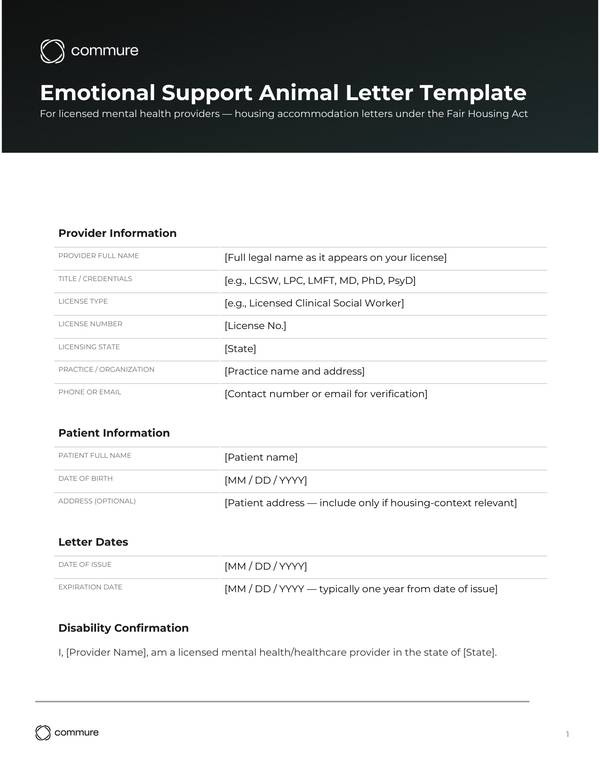
An emotional support animal (ESA) letter template helps a licensed mental health or healthcare provider record a patient's disability. The letter states that the patient needs the animal as a housing accommodation under the Fair Housing Act. Its seven parts start with the provider's credentials and the date of issue and expiration. The body confirms the disability and names the type of animal. A nexus statement links the animal to the disability. The close holds the provider's signature and a notice that the letter covers housing only.
What You Need to Know About Emotional Support Animal Letter Templates
- An emotional support animal letter is a signed clinical statement from a licensed provider confirming a patient has a disability and needs an emotional support animal for housing.
- HUD prohibits landlords from needing a specific form, notarization, or diagnosis disclosure. A letter on provider letterhead with the required elements is enough.¹
- This emotional support animal letter template covers all seven required fields. Have your compliance officer review it before clinical use.
Download the Free Emotional Support Animal Letter Template
Note: This template is for informational purposes only and does not constitute legal or medical advice. Have your compliance officer review it before clinical use.
- Download the Emotional Support Animal Letter Template: editable DOCX, all seven required sections included
What Is an Emotional Support Animal Letter and When Is One Needed?
An emotional support animal letter is a written statement from a licensed provider verifying that a patient's disability creates a need for an emotional support animal, and one is needed when a tenant requests a housing accommodation for that animal under the Fair Housing Act. The letter has one job. It confirms a patient has a disability. It also confirms the patient needs an emotional support animal to help manage it. Providers use this emotional support animal letter template to document that clinical determination for housing purposes. The letter is not a diagnosis form. It is not a prescription. It is not a public-access pass. It is also not a service dog letter. A service dog is individually trained to perform tasks and is covered by the ADA, which calls for a separate service dog letter.
The Fair Housing Act gives the letter its legal weight.¹ A valid letter lets a patient ask for a housing accommodation. That includes buildings with no-pet rules. The letter does not cover stores, restaurants, or public transit. It also does not apply to airline travel. The Air Carrier Access Act changed in January 2021.² Most airlines now treat emotional support animals as pets.
Only a licensed healthcare provider can write a valid emotional support animal letter. The provider must hold a license in the patient's home state. A letter from an online service is not valid without a real clinical relationship.
What a Valid Emotional Support Animal Letter Must Include
A valid emotional support animal letter has seven required parts. Each one serves a legal purpose. Missing any part gives a housing provider grounds to reject the request.
Provider credentials List your full name and title. Include your license type, license number, and the state that issued it. Add your office address and a contact phone number or email. Housing providers use this information to check your license.
Date of issue and expiration date Write the date you sign the letter. Add an expiration date exactly one year later. Most landlords only accept letters issued in the past 12 months.¹
Disability confirmation State the patient has a disability under the Fair Housing Act. You do not need to name the diagnosis. You do not need to describe treatment history. The law does not ask for it.¹
Nexus statement This is the most important part of the letter. Describe the connection between the animal and the patient's disability. Be specific. "The animal helps the patient maintain a daily routine and reduces anxiety" is stronger than "the animal provides comfort."
Type of animal Name the type of animal: dog, cat, or other. You do not need to give the animal's name or a registration number. No official emotional support animal registry exists.
Provider signature Sign the letter by hand or with a valid electronic signature. Print your name, credentials, and license number below it.
Notice of scope Add one line stating the letter is for housing purposes only. It does not grant public access rights or airline accommodations.
How to Complete the Emotional Support Animal Letter Template
Work through the emotional support animal letter from top to bottom. Each field has a specific purpose. Skipping a field or using vague language can cause a landlord to reject the request.
Your information Fill in your legal name exactly as it appears on your license. Write your full license number and the state that issued it. Include a phone number or email a housing provider can use to reach you.
The date fields Write today's date in the "Date of Issue" field. Set the expiration date to one year from today. If a patient comes back after the letter expires, write a new letter. Do not backdate or extend an old one.
The disability statement Use neutral, non-diagnostic language. Do not write a diagnosis in this field. Write something like: "This patient has a disability as defined under the Fair Housing Act." That is enough. HUD guidance says landlords cannot ask for more.¹
The nexus statement This field needs the most care. State how the animal helps the patient manage their disability. Link the animal to a specific function. Avoid vague language. Write something like: "helps the patient maintain a regular sleep and daily routine."
The animal field Write the type of animal only: dog, cat, bird, or other. Leave the name and breed blank. Breed is not a required field and landlords cannot use it to reject a request.¹
Your signature Sign in the signature field. Print your name, license type, and license number directly below your signature. Do not use a rubber stamp or auto-fill signature without personal review of the letter.
What Landlords Can and Cannot Ask For
Federal law sets limits on what housing providers can request from a tenant who submits an emotional support animal letter template. HUD issued clear guidance on this in January 2020.¹
Landlords cannot:
- Ask for a specific form or template
- Need notarization
- Ask for a statement under penalty of perjury
- Demand the patient's diagnosis or treatment history
- Apply breed or weight restrictions to deny an emotional support animal request¹
Landlords can:
- Ask for reliable documentation from a licensed healthcare professional
- Verify the letter comes from a provider licensed in the patient's state
- Deny a request if the animal poses a direct threat to others or would cause serious property damage
Pet fees and deposits A landlord cannot charge a pet deposit or pet fee for an emotional support animal. They also cannot raise rent because of the animal. Some tenants paid a pet deposit before getting an emotional support animal letter. They may be entitled to a refund.¹
Response time HUD says housing providers should respond within 10 days of getting the documentation.¹
State law note State laws on mental health documentation can be stricter than federal law. Check your state's requirements before issuing a letter. Requirements vary by state.² Working through a HIPAA compliance checklist can help confirm you are handling the patient's records correctly.
How Commure Scribe Works With Your Emotional Support Animal Letter
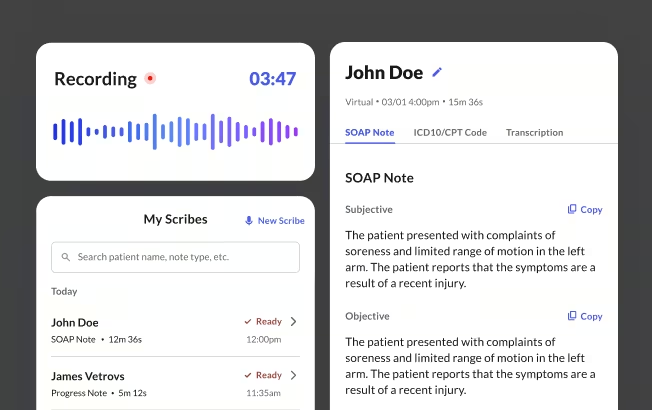
The nexus statement and disability confirmation in an emotional support animal letter both depend on a documented clinical picture: the patient's functional limitations and how their condition affects daily life. Commure Scribe captures the session and, within seconds of clicking End Recording, generates a structured clinical note for the provider to review and finalize. The clinician always has the option to review before anything enters the chart.
That note records the functional details a clinician later draws on when writing the nexus statement, so the letter rests on a real, contemporaneous record rather than recollection. Scribe's Admin Copilot can also generate the document for you.
90%+ of providers using Commure Scribe reduce clinical documentation time and digital fatigue, and it is proven across 25 specialties, including psychiatry and behavioral health. For a full comparison of AI medical scribe options by specialty and practice size, see the complete guide.
This article is for general informational and educational purposes only. It does not constitute legal, medical, or professional advice and does not guarantee compliance. Requirements vary by state, payer, and clinical setting and can change over time. Verify current details with your own compliance officer, legal counsel, or the relevant authority before relying on this information.
Emotional Support Animal Letter Template Download
Download a copy of this template
Thanks! Your emotional support animal letter template is ready.
Click below to download.

Frequently Asked Questions
A licensed mental health or healthcare professional must write the emotional support animal letter template. This includes licensed clinical social workers (LCSWs), licensed professional counselors (LPCs), licensed marriage and family therapists (LMFTs), psychologists, psychiatrists, and primary care physicians. The provider must hold an active license in the state where the patient lives. A letter from an unlicensed provider or an online service without a real clinical evaluation is not valid.
Most housing providers accept an emotional support animal letter template issued within the past 12 months. The template includes an expiration date field set to one year from the date of issue. If a patient's letter expires, write a new one after reassessing their need. Do not extend or backdate an old letter.
A landlord cannot charge a pet deposit, pet fee, or increased rent when a tenant presents a valid emotional support animal letter template. They also cannot apply breed or weight restrictions to deny a request. A landlord can only deny a request on two grounds. The animal must pose a direct threat to others. Or it must cause serious physical damage to the property.¹
Many airlines now treat emotional support animals as pets, since the Department of Transportation revised its Air Carrier Access Act rules in January 2021. These airlines may charge standard pet fees. Trained psychiatric service dogs that meet each airline's requirements may qualify for in-cabin travel as service animals.²
Yes. The emotional support animal letter template is a starting point. Providers should adapt the nexus statement to reflect each patient's specific functional needs. Generic language weakens the letter. Practices specializing in psychiatry or behavioral health may want to add session frequency or treatment context to strengthen the nexus statement without disclosing a diagnosis.
Sources
¹ U.S. Department of Housing and Urban Development. "Assessing a Person's Request to Have an Animal as a Reasonable Accommodation Under the Fair Housing Act." HUD Notice FHEO-2020-01, January 28, 2020. https://www.hud.gov/helping-americans/assistance-animals
² U.S. Department of Transportation. "Traveling by Air with Service Animals." Final Rule, 14 CFR Part 382, effective January 11, 2021. https://www.transportation.gov/airconsumer/passengers-disabilities