



Medical Clearance Form Template (Free Download)
A clearance form that records the risk picture, medication plan and recommendation, with add-ons for dental and sports requests.
Written by the Commure Scribe Team
Published: November 10, 2026
•
6 min read
A medical clearance form is the request a surgeon, dentist, school or gym sends before a procedure or activity. A clinician examines the patient. The clinician then writes down the risk and a recommendation and sends the form back.
Who Completes a Medical Clearance Form?
The surgeon or the patient's primary care clinician may do the evaluation, usually within the month before surgery.¹ Requester forms can end in a "cleared" or "not cleared" box.
That box asks for more certainty than the evaluation can give. The 2024 AHA/ACC guideline sets the goal as "evaluation and reduction of a patient's immediate surgical risk."² A 2014 review says the purpose "is not to 'get medical clearance' but rather to evaluate" the patient's medical status and risk of complications.³ The form on this page records that evaluation in place of a yes or no.
For return-to-work clearance, see the guide to medical doctor notes.
What Should a Medical Clearance Form for Surgery Include?
A medical clearance form for surgery should record the risk picture behind the decision. Anesthesia and the surgeon can then see how you reached your recommendation.
- Patient and request details: name, date of birth and record number. Add the requesting clinician, the planned procedure, its date and the anesthesia type.
- History and review of systems: current problems, past history, allergies and a focused symptom review.
- Exam findings: what you found, organized by body system.
- Risk assessment: mark the surgical risk as low or elevated. The 2024 guideline defines low risk as a predicted rate of major adverse cardiovascular events under 1%.² Record the ASA physical status class if the request asks for it. StatPearls notes that the ASA class "cannot be used alone to determine anesthesia or surgical risks."⁴ Check the six Revised Cardiac Risk Index (RCRI) factors: high-risk surgery, ischemic heart disease, heart failure, cerebrovascular disease, insulin treatment and creatinine above 2.0 mg/dL.⁵ Note whether the patient can do 4 metabolic equivalents (METs) of activity. The guideline treats 4 METs as the threshold for poor functional capacity.²
- Tests: list each test you ordered and each one you skipped, with the reason.
- Medication plan: for each medicine, mark continue, hold or adjust. For each hold, write the last dose date and when to restart, in plain words.
- Recommendation: pick proceed, proceed with recommendations, defer pending further evaluation, or not recommended at this time.
- Signature: your name, credentials, NPI and the date.
Download the Free Medical Clearance Form
Note: This template is for informational purposes only and does not constitute legal or medical advice. Have your compliance officer review it before clinical use.
The form covers surgical requests, with add-on sections for dental and sports requests.
How Do You Complete a Medical Clearance Form?
Start from the requester's question, then let the history and exam decide the workup.
- Read the request first. Note what the surgeon or dentist asked and when the procedure is scheduled.
- Order tests from the history, exam and surgical risk. According to American Family Physician, "The decision to perform preoperative testing should be based on the history and physical examination findings, perioperative risk assessment, and clinical judgment."⁶ The same review says patients without cardiovascular signs or symptoms having low-risk surgery need no electrocardiogram (ECG) and cataract patients in their usual health need no tests.⁶ If the requester's form lists routine labs, write the reason for each test you order or skip.
- Skip routine cardiac testing in low-risk patients. The 2024 guideline found "little evidence" for extensive testing before low-risk surgery.² It states that "preoperative stress testing is not recommended in low-risk patients."²
- Use functional capacity. Per the guideline, patients with good functional capacity and no symptoms may proceed with planned noncardiac surgery without more cardiac testing in most cases.²
- Write the medication plan drug by drug. Confirm timing with the surgeon or anesthesia team when a hold is needed.
- Write a recommendation the team can act on. Name the risk level, the open issues and what should happen before surgery. If the requester's form has only a "cleared" or "not cleared" box, mark "cleared" only for proceed or proceed with recommendations. Mark "not cleared" for defer or not recommended at this time. Write the risk level and your recommendations beside the box.
- Sign and send what the request needs. Keep the full evaluation in your chart. Return the completed form and the findings that bear on the procedure.
This template is a starting point for your own clinical judgment.
How Do Dental and Sports Clearance Forms Differ?
Dental and sports requests ask narrower questions than a surgical clearance.
Dental requests can turn on bleeding, recent heart events, infection risk, bone-modifying drugs and head and neck radiation.
- Blood thinners: according to American Family Physician, anticoagulants and antiplatelets "typically should not be suspended for common dental treatments."⁷ The review applies this to cleanings and single extractions, with warfarin at a therapeutic international normalized ratio (INR).⁷
- Recent heart events: the same review says to avoid elective dental care for six weeks after a heart attack or bare-metal stent or six months after a drug-eluting stent.⁷
- Antibiotic prophylaxis: according to the ADA, antibiotics are generally not recommended before dental work to prevent prosthetic joint infection. For patients with past joint replacement complications, the ADA says to consider them only after consulting the patient and orthopedic surgeon.⁸ For a prosthetic valve or valve repair material, past infective endocarditis, certain congenital heart disease or a heart transplant with valve regurgitation from a structurally abnormal valve, the ADA lists prophylaxis for procedures that manipulate the gums or the area around the tooth root, or that perforate the oral mucosa.⁸ The ADA limits heart-related prophylaxis to these conditions.⁸
- Antiresorptive drugs and radiation: the AFP review says past antiresorptive exposure can raise lifetime jaw osteonecrosis risk "by up to 100-fold."⁷ The same review says to report any antiangiogenic drugs or head and neck radiation.⁷
For sports and exercise requests, the AAP says the sports physical has five eligibility levels, from eligible without restriction to not eligible.⁹ Per the AAP, send schools only the medical eligibility form.⁹ Get the patient's or parent's consent before you send it.⁹ The AAP says state law decides whether an MD, DO, NP or PA can do the exam.⁹ The American College of Sports Medicine no longer uses risk factor profiling to screen adults before exercise.¹⁰
How Commure Scribe Fits the Preoperative Visit
You can draft the visit note behind the clearance form with Commure Scribe. As an AI medical scribe, it records the visit and drafts the note from the conversation.
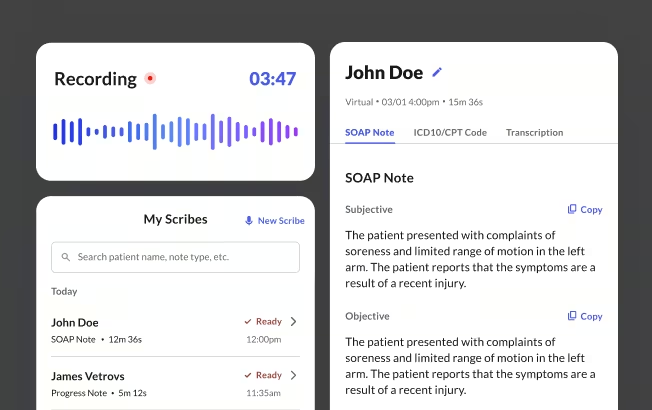
The workflow is Capture → Edit → Finalize. Within seconds of ending the recording, Commure Scribe shows a structured SOAP note. It also suggests ICD-10 and CPT codes. You review the history, exam, risk discussion and medication plan before you finalize. While the patient walks you through their history and medicines, you can stay present in the room.
You copy the findings the requester needs from the finished note into the clearance form. Independent practices and small groups move the note into the EHR by copy and paste from an overlay that sits over the EHR.
Turn the preoperative visit into a draft note
If you would rather not type up every clearance visit yourself, Commure Scribe drafts the note from the conversation. You review the draft before you finalize. Try it on your clearance visits within your 7-day trial, then compare Commure Scribe pricing and plans.
Medical Clearance Form Template Download
Download a copy of this template
Thanks! Your medical clearance form template is ready.
Click below to download.

Frequently Asked Questions
A medical clearance form is the request a surgeon, dentist, school or gym sends before a procedure or activity. The clinician who does the evaluation fills it in and sends it back. Get the patient's or parent's consent before you send it to a school or gym. The 2024 AHA/ACC guideline frames the work as assessing and reducing the patient's immediate surgical risk. The form you send back should show that evaluation along with the decision.
For surgery, the surgeon or the patient's primary care clinician may do the evaluation. According to the AAP, state law decides whether an MD, DO, NP or PA can do the sports physical. Check the requester's form and your state's scope of practice rules before you sign.
MedlinePlus says the checkup usually needs to be done within the month before surgery. Check the date on the request, since surgeons and facilities can set shorter windows. When the evaluation serves as the history and physical for an admission or registration, Medicare rules require it within the prior 30 days. The admitting team then documents an update within 24 hours after admission or registration and before surgery. Repeat the evaluation if the patient's health changes before surgery.
Order tests based on the history, exam and surgical risk. According to American Family Physician, patients having low-risk surgery need no ECG if they have no signs or symptoms of cardiovascular disease. The same review says patients in their usual health having cataract surgery need no tests before surgery. The 2024 guideline found little evidence for broad testing before low-risk surgery.
Use the dental add-on for blood thinners, recent heart events, antibiotic prophylaxis, drugs that affect the jawbone and head and neck radiation. For sports, complete the medical eligibility form from the sports physical. Send only that form to the school, with the patient's or parent's consent. Remove any section the requester does not need.
Sources
- MedlinePlus, U.S. National Library of Medicine. "Tests and visits before surgery." 2026. https://medlineplus.gov/ency/patientinstructions/000479.htm
- Thompson A, et al. "2024 AHA/ACC/ACS/ASNC/HRS/SCA/SCCT/SCMR/SVM Guideline for Perioperative Cardiovascular Management for Noncardiac Surgery." Circulation. 2024;150(19):e351-e442. https://pubmed.ncbi.nlm.nih.gov/39316661/
- Cohn SL. "Updated guidelines on cardiovascular evaluation before noncardiac surgery: A view from the trenches." Cleveland Clinic Journal of Medicine. 2014;81(12):742-751. https://www.ccjm.org/content/ccjom/81/12/742.full.pdf
- Hendrix JM, Garmon EH. "American Society of Anesthesiologists Physical Status Classification System." StatPearls. 2025. https://www.ncbi.nlm.nih.gov/books/NBK441940/
- Lee TH, et al. "Derivation and prospective validation of a simple index for prediction of cardiac risk of major noncardiac surgery." Circulation. 1999;100(10):1043-1049. https://pubmed.ncbi.nlm.nih.gov/10477528/
- Feely MA, Collins CS, Daniels PR, Kebede EB, Jatoi A, Mauck KF. "Preoperative Testing Before Noncardiac Surgery: Guidelines and Recommendations." American Family Physician. 2013;87(6):414-418. https://www.aafp.org/pubs/afp/issues/2013/0315/p414.html
- Herrick KR, Terrio JM, Herrick C. "Medical Clearance for Common Dental Procedures." American Family Physician. 2021;104(5):476-483. https://www.aafp.org/pubs/afp/issues/2021/1100/p476.html
- American Dental Association. "Antibiotic Prophylaxis Prior to Dental Procedures." 2026. https://www.ada.org/resources/ada-library/oral-health-topics/antibiotic-prophylaxis
- American Academy of Pediatrics. "Preparticipation Physical Evaluation." 2026. https://www.aap.org/en/patient-care/preparticipation-physical-evaluation/
- Riebe D, Franklin BA, Thompson PD, et al. "Updating ACSM's recommendations for exercise preparticipation health screening." Medicine and Science in Sports and Exercise. 2015;47(11):2473-2479. https://digitalcommons.uri.edu/kinesiology_facpubs/180
- Electronic Code of Federal Regulations. "42 CFR 482.22: Condition of participation: Medical staff." 2026. https://www.ecfr.gov/current/title-42/chapter-IV/subchapter-G/part-482/subpart-C/section-482.22