



ATI System Disorder Template: Free Editable Download
Field-by-field guidance for using a system disorder template in independent and group practices, plus a free editable download.
Written by the Commure Scribe Team
Published: June 3, 2026
•
8 min read
Updated June 3, 2026
What You Need to Know About ATI System Disorder Templates
- An ATI system disorder template organizes one disease by pathophysiology, risk factors, findings, diagnostics, care, and patient education.
- Outpatient physicians spend 49.2% of office time on EHR and desk work, more than they spend on patient face time¹.
- Download the editable template, then adapt the fields to your specialty and EHR before clinical use.
Download the ATI System Disorder Template
Note: This template is for informational purposes only and does not constitute legal or medical advice. Have your compliance officer review it before clinical use.
- Download the ATI System Disorder Template. Editable structured assessment scaffold.
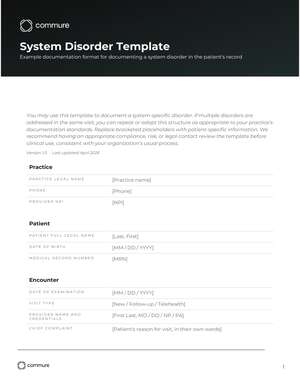
Edit the field names, cut sections you do not need, and align the template with your specialty before clinical use.
What is an ATI system disorder template?
The ATI system disorder template comes from Assessment Technologies Institute, known as ATI. Nursing programs first used it to teach students how to map a body system and the disorder affecting it. Some independent and group practices now adapt the same structure to organize visit notes. The format covers pathophysiology, risk factors, expected findings, labs, diagnostics, care, medications, and patient education.
The template is a clinical scaffold. It is a checklist for one disorder. It does not score a patient or replace clinical judgment.
The sections below cover what each field captures, how to fill it out, and which compliance rules apply. The last section shows how practices adapt the format for outpatient EHR workflows.
Why use a system disorder template in clinical documentation?
Clinicians use system disorder templates to make their clinical thinking visible. The format encourages a complete pass through pathophysiology, risk factors, findings, labs, care, medications, and patient education. Without it, busy outpatient visits can leave gaps. With it, the note can be aligned with the elements of medical decision-making that 2021 Centers for Medicare & Medicaid Services (CMS) E/M rules use to set visit level².
Documentation burden is real. A time and motion study tracked 57 outpatient physicians. They spent 49.2% of office time on EHR and desk work, and 27.0% on face time with patients¹. Templates can cut that load when they save typing. They can add to it when they force fields the encounter does not need. Federal research has flagged documentation burden as a driver of cognitive load and after-hours charting³.
The system disorder format also supports complete coding. CMS bases E/M level on the number and complexity of problems, the data reviewed, and risk². A complete template captures each element during the visit. A blank-page note often misses one or two.
What sections should an ATI system disorder template include?
A complete ati system disorder template covers two layers of fields. The first layer holds standard documentation elements aligned with CMS evaluation and management practice. The second layer holds the clinical fields that follow the ATI structure for the disorder.
The standard documentation fields appear at the top of the form:
- Patient identifier fields. Name, date of birth, and medical record number (MRN). They link the note to a specific person and prevent record mix-ups.
- Date of examination. The day the encounter happened. CMS ties the bill to the date of service.
- Chief complaint. Why the patient came in, in their own words. It anchors the visit in the patient's reason for coming in.
- Review of systems and exam findings. What was checked and what was found, organized by body system. Together they document the medically appropriate exam.
- Clinical impression and plan. The diagnosis or working diagnosis, plus next steps. CMS E/M coding draws on the complexity captured here.
- Provider signature and credentials. Who saw the patient and signed the note. Required for the note to support the billed visit.
These fields align the note with CMS evaluation and management documentation expectations². For exam findings, a 9-system physical examination format lists each body system in order, from general appearance through psychiatric.
The clinical fields follow the ATI structure. Each one captures a specific layer of the disorder:
- Alterations in health. The diagnosis or working diagnosis.
- Pathophysiology. What the disease does at the cell, tissue, and system level.
- Health promotion and disease prevention. Steps that reduce the chance of getting the disorder.
- Risk factors. What raises a patient's chance of having the disorder.
- Expected findings. What signs and symptoms the disorder typically shows.
- Laboratory tests. Bloodwork, urine tests, and other labs that confirm or rule out the diagnosis.
- Diagnostic procedures. Imaging, scopes, and other studies tied to the workup.
- Complications. What can go wrong if the disorder progresses or treatment fails.
- Therapeutic procedures. Surgeries, infusions, or other procedures tied to the treatment plan.
- Interprofessional care. What other roles, like physical therapy or pharmacy, contribute to the plan.
- Nursing care. The day-to-day steps the bedside or clinic team handles.
- Client education. What the patient needs to know about the diagnosis, drugs, and warning signs.
- Medications. The drug list, dose, route, and reason for each.
Use [Patient Name], [Date of Birth], and similar bracket placeholders in the blank ati system disorder template. Real patient data does not belong in a blank form.
How do you fill out an ATI system disorder template?
Filling out an ati system disorder template starts with the patient and the encounter, not the form. The clinician should answer four questions before typing anything:
- What disorder are we documenting in this note?
- What did the patient say in their own words?
- What did the exam show?
- What is the plan, and who needs to know it?
With those four answers in hand, the template fills out in a single pass:
- Header fields. Fill in [Patient Name], [Date of Birth], and [MRN]. Add the date of examination. Skip pre-filled patient data in a blank training template.
- Chief complaint. Use the patient's own words. "My foot hurts when I walk" beats "patient presents with foot pain." Patient phrasing carries clinical context that the rest of the note builds on.
- Alterations in health and pathophysiology. Name the disorder, then write one or two sentences on what is happening at the cell or system level. Skip textbook depth. Stay focused on what drives this patient's signs and labs.
- Risk factors and expected findings. Pull from the chart and the encounter. List only what applies to this patient, not the full textbook list.
- Labs and diagnostic procedures. List the tests ordered or reviewed today. Note the date of any prior result the plan depends on.
- Therapeutic procedures, interprofessional care, and medications. Capture what was done in the visit and what was ordered after. List the drug name, dose, route, and reason for each medication.
- Client education. Write what the patient was told, in plain language. Include teach-back if used.
Sign and date the note before it enters the chart. The clinician's review is what turns a draft into a record.
What compliance rules apply to clinical assessment templates?
Three sets of rules govern a clinical assessment and examination template like the system disorder format.
HIPAA covers patient information. Any field that holds patient data is protected health information, or PHI. The minimum necessary rule says the practice should collect only the information needed for treatment, payment, or operations (45 CFR 164.502(b))⁴. A blank ati system disorder template should use [bracket placeholders], not real patient data.
CMS sets the documentation rules for billed visits. The 2021 office and outpatient E/M rules govern medically appropriate history and exam. The note should hold enough detail to support the billed level. Visit level is set by medical decision making or by time, not by exam bullet count². The template should track the diagnosis, the data reviewed, and the risk discussed during the visit.
Assessment tools sometimes need a license. The ATI template framework is used in many nursing programs. Some disease-specific layouts are publicly available from ATI or schools. The exact ATI Active Learning Template is published by Assessment Technologies Institute. A clinical practice should review ATI's license terms before copying the form. Building your own version of the structure is often safer. Patient Health Questionnaire-9 (PHQ-9) and Generalized Anxiety Disorder-7 (GAD-7) are copyrighted but free for clinical use under their publisher's terms. Other instruments, like the Beck Depression Inventory, need a paid license.
State law sometimes adds rules on top of HIPAA. State medical boards can set documentation timelines, retention periods, and signature rules. Requirements vary by state. We recommend having your compliance officer review any system disorder ati template before it goes into clinical use.
The template supports compliance. It does not stand in for a compliance review.
How can practices adapt the template for outpatient EHR workflows?
The same ati system disorder template can be adapted for an independent solo practice or a multi-site group. What changes is how it gets adapted.
Independent and small practices. Solo and small group practices may not have dedicated EHR build teams. The template usually starts as a Word document or PDF, then moves into the EHR as a custom note template. Keep the field names short. Cut clinical fields the practice does not need. A primary care visit may not need detailed surgical procedure fields, for example. Set up the template once, then tune it as the staff finds friction points.
Group practices. Group practices often run shared note templates across providers and sites. Standardization helps with consistency, audit, and quality measurement⁵. Local edits should still be allowed for visit type and specialty. A central template plus a few specialty-specific overlays often works better than a single one-size-fits-all version. Practices with EHR build resources can build the template as a SmartPhrase, dot-phrase, or structured note shell.
AI scribe pairing. Ambient AI medical scribes can draft structured notes that fit many templates. The AI works from the encounter audio. The clinician reviews the draft before finalizing.
A randomized study of 238 outpatient physicians found ambient scribes cut time-in-note by up to 9.5%⁶. The same study showed lower burnout and lower cognitive task load⁶. A separate study of 6 health systems tracked 30 days with an ambient AI scribe. Self-reported burnout dropped from 51.9% to 38.8%, and after-hours charting fell too⁷.
Templates do not replace the scribe, and the scribe does not replace the template. They cover different parts of the same task.
The clinician should always review and sign the note before it enters the chart. Payer and legal norms expect this step for any template, scribe, or workflow.
How Commure Scribe helps you use a system disorder template
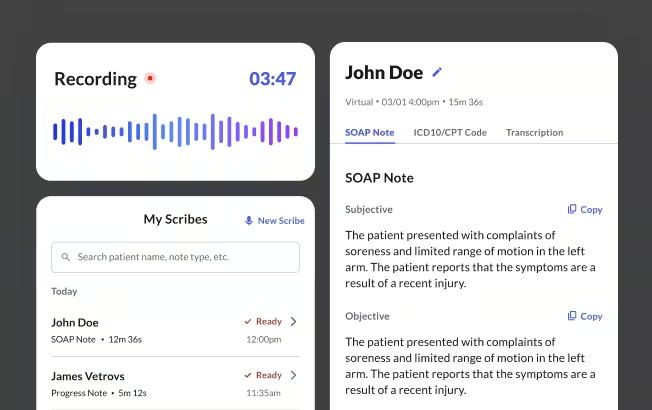
Commure Scribe is an ambient AI medical scribe that drafts a structured note from the encounter. The custom template builder lets a practice mirror the system disorder layout, covering pathophysiology, findings, diagnostics, care, and patient education. The clinician reviews and signs the draft before it enters the chart.
After End Recording, the draft appears in seconds. The disorder, exam findings, and plan land in the right fields, and suggested ICD-10 and CPT codes show up in a separate tab. Transcripts hit 99.4% accuracy across 90 languages, and the tool integrates with 60+ EHRs.
In Commure's user survey, 90%+ of providers said Commure Scribe cut their documentation time and digital fatigue, and 91% reported feeling less fatigued. Audio is encrypted in transit and at rest, stored onshore, and used only to generate the clinical note. Capture → Edit → Finalize stays in the clinician's hands at every step.
This article is for informational and educational purposes only, does not constitute legal, medical, or professional advice, and does not guarantee compliance with any regulation.
ATI System Disorder Template Download
Download a copy of this template
Thanks! Your ATI system disorder template is ready.
Click below to download.

Frequently Asked Questions
The ATI system disorder template is a structured form that organizes one disease into its core parts. Sections cover pathophysiology, risk factors, expected findings, labs, diagnostics, care, complications, medications, and patient education. Nursing programs first used it to teach students. Some independent and group practices now adapt the same structure for visit notes.
Start with the disorder, the patient's chief complaint, exam findings, and the plan. Fill in the patient identifier fields, then move section by section through the ATI structure. Use [bracket placeholders] in any blank or training copy. Sign and date the note before it enters the chart.
The template includes patient identifier fields and clinical sections. Clinical sections cover the disorder, its pathophysiology, risk factors, expected findings, labs, diagnostics, care, medications, and patient education. Each section captures one layer of the disorder so the note stays complete and easy to read.
Yes. Ambient AI medical scribes capture the encounter audio and generate a structured draft note. The clinician reviews the draft note before signing. Studies show ambient scribes can cut time-in-note and after-hours documentation work.⁷ The template provides the structure; the scribe drafts the note that fits it.
HIPAA's minimum necessary rule limits how much patient data the template should hold (45 CFR 164.502(b)).⁴ CMS 2021 E/M rules govern documentation for billed office visits.² State medical boards add documentation timelines and signature rules. We recommend having your compliance officer review the ati system disorder template before clinical use.
Sources
- Sinsky CA, Colligan L, Li L, et al. 2016. "Allocation of Physician Time in Ambulatory Practice: A Time and Motion Study in 4 Specialties." Annals of Internal Medicine 165(11):753-760. https://pubmed.ncbi.nlm.nih.gov/27595430/
- Centers for Medicare & Medicaid Services. "Office/Outpatient Evaluation and Management Visits Fact Sheet." 2021. https://www.cms.gov/files/document/physician-fee-schedule-pfs-payment-officeoutpatient-evaluation-and-management-em-visits-fact-sheet.pdf
- Agency for Healthcare Research and Quality. 2024. "Measuring Documentation Burden in Healthcare." Technical Brief No. 47. https://effectivehealthcare.ahrq.gov/srdrplus/measuring-documentation-burden-healthcare
- U.S. Department of Health and Human Services. "Minimum Necessary Requirement." 45 CFR 164.502(b), 164.514(d). https://www.hhs.gov/hipaa/for-professionals/privacy/guidance/minimum-necessary-requirement/index.html
- Office of the National Coordinator for Health Information Technology (HealthIT.gov). "Clinical Quality and Safety." https://healthit.gov/clinical-quality-and-safety/
- "Ambient AI Scribes in Clinical Practice: A Randomized Trial." 2024. PubMed Central. https://pmc.ncbi.nlm.nih.gov/articles/PMC12768499/
- Tierney AA et al. 2024. "Ambient Artificial Intelligence Scribes to Alleviate the Burden of Clinical Documentation." NEJM Catalyst. https://catalyst.nejm.org/doi/full/10.1056/CAT.23.0404