



Dental Notes Template: Free Editable SOAP Format
A free editable SOAP-format template covering every recommended field, plus documentation rules for HIPAA, CMS, and ADA compliance.
Written by the Commure Scribe Team
Published: June 13, 2026
•
6 min read
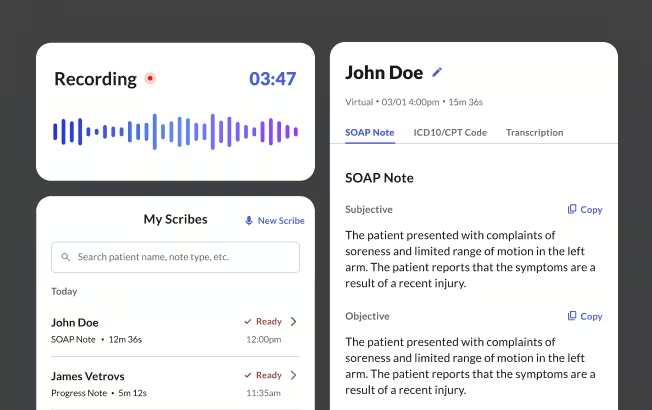
A dental notes template is a structured form for recording each visit in the Subjective, Objective, Assessment, Plan (SOAP) format. Dentists, hygienists and dental specialists use this free editable template. Its nine recommended fields start with patient IDs, date and time of service, and the provider name and signature. Clinical fields cover the chief complaint, subjective and objective findings, and assessment. The plan carries Current Dental Terminology (CDT) codes, and an amendment and addendum section comes last.
What You Need to Know About Dental Notes Templates
- 58% of oral health providers report experiencing burnout due to work a few times per week or more, and administrative documentation is a leading driver.⁵ A well-built dental notes template cuts charting time and removes one of the biggest sources of end-of-day fatigue.
- A dental notes template structures how you record patient exams, diagnoses, and treatment plans across every visit.
- A complete dental notes template should include nine recommended fields that align with ADA documentation guidance and support HIPAA and Centers for Medicare & Medicaid Services (CMS) requirements.
- Download the free template below, fill in all nine sections, and have your compliance officer review it before clinical use.
Download the Free Dental Notes Template
Note: This template is for informational purposes only and does not constitute legal or medical advice. Have your compliance officer review it before clinical use.
- Download the Dental Notes Template: editable DOCX, all nine recommended fields included
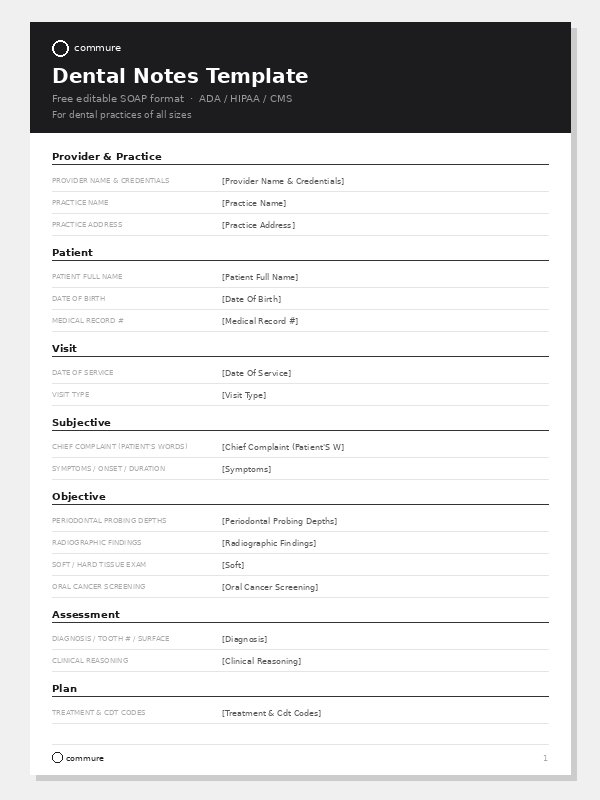
Use the sections below to see what goes in each field and how to adapt the template for your specialty.
What Is a Dental Notes Template?
Every patient visit in a dental practice creates a clinical record. A dental notes template gives that record a consistent structure. The record has to do three things: hold up to audit, support billing, and make sense to the next provider who reads the chart.
The SOAP notes format (Subjective, Objective, Assessment, Plan) is a widely used structure for dental chart notes.² Each section has a job. Subjective holds what the patient reports. Objective holds what you find during the exam. Assessment states the diagnosis. Plan records the treatment and follow-up.
Federal and professional rules apply to most dental practices. HIPAA applies to dental practices that submit electronic claims or other covered transactions, known as covered entities.¹ The ADA sets professional documentation standards for all practices. CMS requirements apply when a practice bills Medicare or Medicaid for covered services. The recommended fields stay consistent across practice sizes. What changes is the visit type. A new patient exam, a hygiene recall, a restoration, and a scaling each call for different content within that structure.
The sections below cover what a dental notes template must include, how to fill it in, the most common note types, and the documentation rules that apply. For a broader look at how clinical notes work across specialties, see clinical notes.
What Does a Dental Notes Template Include?
A dental notes template built for clinical use should include nine recommended sections. Each one captures something a missing note cannot recover after the fact.¹
Patient identifier fieldsRecord the patient's name, date of birth, and medical record number (MRN) or account number. This ties the note to the right person in your system. Use bracket placeholders when building your template: [Patient Name], [Date of Birth], [MRN].
Date of service and timeInclude the exact date and, for time-based billing codes, the start and end time of the visit. Time records protect the procedure code you submit.
Provider name, credentials, and signature lineThe note must show who gave the care. Include the provider's full name, license type and number, and a dated signature line. A note without a provider signature is not complete.¹
Chief complaintWrite the patient's reason for the visit in their own words. "Pain when biting on the upper left" is better than "patient reports discomfort." Their phrasing goes here, not your interpretation.
Subjective findingsRecord the patient's description of symptoms. Include onset, duration, pain level (1-10 scale), and anything that makes the symptoms better or worse.
Objective findingsThis is what you observe and measure during the exam. Include:
- Periodontal probing depths
- Radiographic findings with the image date noted
- Soft tissue and hard tissue exam results
- Vitality, percussion, or palpation test results
- Oral cancer screening result (positive or negative; document both)
AssessmentState the diagnosis. Include the tooth number and surface when applicable. Record your clinical reasoning: what you found, what you ruled in, and why.
PlanList the treatment completed or recommended, with CDT codes. Note any medications given or prescribed. Include patient education provided and the follow-up timeline.
Amendment and addendum sectionEvery template needs a space for corrections and late entries. The right way to fix an error is to add a dated, initialed addendum. Do not change the original note.¹
How to Fill Out a Dental Notes Template
Fill in the dental notes template during the visit or right after. Memory fades fast. A note written an hour later carries more risk than one written at chairside.¹
Step 1: Confirm patient informationCheck the name, date of birth, and record number against your system before you start. This step takes seconds and prevents misfiled records.
Step 2: Write the chief complaint in the patient's wordsUse their language, not yours. If they said "my tooth is throbbing," write that. Put their exact words in quotes when you transcribe them.
Step 3: Complete objective findings as you examineWrite findings as you go. Don't wait until after the appointment. Include negative findings too. "Oral cancer screening negative" and "no caries detected" belong in the note. A record that only logs positive findings looks incomplete to a reviewer.¹
Step 4: State the assessment in plain termsName the diagnosis. Include the tooth number and surface. If you found more than one issue, list each one with its location.
Step 5: Write the plan with specificsList the treatment done or recommended. Use plain descriptions alongside CDT codes. If the patient declined care, document it along with the reason they gave.
Step 6: Sign and date before the note closesThe provider who gave the care signs the note. A note without a signature is not complete.¹
Step 7: Use addenda for correctionsIf you need to fix an error, draw a line through it, add your initials and the date, and write the correct information below. Never use white-out. Never delete a digital entry without an audit trail.¹
Use objective clinical language throughout. "Patient required repeated repositioning during the exam" is a clinical observation. "Patient was uncooperative" is an opinion. Leave it out.
Types of Dental Notes Templates
A dental notes template uses the same SOAP structure for all visit types. What changes is the clinical focus of each section and how much detail each visit type needs.
New patient comprehensive examThis is the most detailed note type. It captures a full medical history form and dental history, extraoral and intraoral exam results, and full-mouth periodontal charting.¹ It also includes a radiographic survey and an initial treatment plan. Providers seeing this patient for the first time rely on this note to understand their full history.
Hygiene and recall visitThe hygiene note centers on periodontal status. It records probing depths, bleeding on probing, recession, calculus distribution, and any changes from the prior visit. The note should also capture oral hygiene instruction given and the patient's response. Record any fluoride or preventive agents applied.¹
Treatment and procedure visitA procedure note documents what was done. It includes the tooth number and surface, anesthesia type and amount, materials used, and the patient's condition at the end of the visit. Post-operative instructions given to the patient belong here.
Periodontal therapy (SRP) noteScaling and root planing notes get extra attention from payers. Document the quadrant treated, anesthesia used, instruments used, and the re-evaluation timeline, typically 4-6 weeks.¹ Thin SRP notes are a common audit trigger.
Emergency visit noteRecord the presenting complaint, clinical findings, any immediate treatment given, and the referral or follow-up plan. A complete emergency note protects the practice if the patient does not return for follow-up care.
For a general-purpose note that works across specialties and visit types, see the progress note template.
Dental Notes Template: Worked Examples
The sections above describe what each field requires. The examples below show what filled-in notes actually look like across three common visit types.
Example 1: Hygiene Recall Visit
Date of service: 06/15/2026. Visit type: Hygiene recall, 6-month. Provider: Jane R. Kim, RDH, License #DH-44821.
Chief complaint: "No pain. Just here for my cleaning."
Subjective: Patient reports no pain, sensitivity, or swelling since last visit. No changes to medications or medical history. Last dental radiographs taken 12 months ago.
Objective: Full-mouth probing completed. Generalized 2–3 mm depths; localized 4 mm readings at #14 MB and #15 DB. Bleeding on probing at #14, #15, #30. No recession. Calculus: light supragingival, buccal surfaces #6–11. Radiographic findings: no interproximal caries on BW series dated 06/15/2026. Oral cancer screening: negative.
Assessment: Generalized mild gingivitis; localized 4 mm pocketing upper left and lower right. No caries detected radiographically.
Plan: Prophylaxis completed. Oral hygiene instruction: modified Bass technique, interdental brushes for posterior contacts. Fluoride varnish applied (D1206). Re-evaluation at next recall in 6 months. Patient declined sealants on #18 and #19; refusal documented.
Signature: Jane R. Kim, RDH, 06/15/2026
Example 2: Emergency Toothache
Date of service: 06/15/2026. Visit type: Emergency, acute pain. Provider: Marcus D. Obi, DDS, License #DN-29114.
Chief complaint: "My bottom right tooth has been throbbing for three days. Keeps me up at night."
Subjective: Patient reports spontaneous, throbbing pain 8/10 at tooth #30 for approximately 72 hours. Pain lingers 10+ minutes after cold stimulus. No relief from ibuprofen 400 mg. No swelling or fever reported. No prior treatment at this tooth.
Objective: #30: significant response to cold (EPT 60, prolonged); percussion positive; palpation positive at the apical area. No visible sinus tract. Periapical radiograph: widened PDL space, early periapical radiolucency noted. No fracture visible. Soft tissue exam: no facial swelling; no lymphadenopathy.
Assessment: #30: irreversible pulpitis with symptomatic apical periodontitis. Endodontic treatment indicated.
Plan: Root canal therapy initiated: access, pulp extirpation, irrigation (NaOCl/EDTA), WL established at 20.5 mm with #15 file. Calcium hydroxide interim dressing placed; access sealed with IRM. Rx: amoxicillin 500 mg TID × 7 days (no known allergies). Ibuprofen 600 mg q6h PRN. Post-op instructions given verbally and in writing. Patient to return in 2 weeks for obturation.
Signature: Marcus D. Obi, DDS, 06/15/2026
Example 3: Periodontal Follow-Up (Post-SRP Re-evaluation)
Date of service: 06/15/2026. Visit type: Periodontal re-evaluation, post-SRP. Provider: Andrew A. Barlow, DDS, License #DN-55302.
Chief complaint: "My gums feel a lot better. A little sore still near the back on the right."
Subjective: Patient reports improved comfort since SRP completed 04/28/2026 (full mouth, 4 quadrants). Mild residual soreness at posterior right. Compliance with home care: using electric toothbrush and flossing daily per patient report.
Objective: Full-mouth probing at re-evaluation. Generalized improvement: most sites 2–4 mm (down from 4–7 mm at baseline). Residual 5 mm pockets at #2 DB, #3 DB, #15 MB. Bleeding on probing: 10% of sites (down from 44% at baseline). No suppuration. Oral cancer screening: negative.
Assessment: Stage II, Grade B periodontitis (AAP/EFP 2017 classification), improving response to SRP. Localized residual pocketing upper right quadrant.
Plan: Patient advances to periodontal maintenance (D4910) every 3 months. Sites at #2, #3, #15 to be monitored at next maintenance visit; consider site-specific re-treatment if no further improvement in 3 months. Reinforced flossing technique. Next appointment: 09/15/2026.
Signature: Andrew A. Barlow, DDS, 06/15/2026
Documentation Requirements for Dental Practices
A complete dental notes template satisfies three sets of rules at once. Each framework looks at the record differently. HIPAA covers data protection, CMS covers billing support, and the ADA covers professional standards.
HIPAA Privacy Rule (45 CFR 164.502, 164.524)Dental records are PHI (protected health information, meaning any data that could identify a patient).³ For a full compliance walkthrough, see the HIPAA compliance checklist. HIPAA's minimum necessary standard limits how PHI is shared outside of treatment. Practices should disclose only the information needed when sharing records with insurers or other third parties. The standard does not apply to treatment communications between providers.³ Patients have the right to access their records. You must give them a copy within 30 days of a written request under 45 CFR 164.524.³
CMS Medicare and Medicaid billing documentationFor practices that bill Medicare or Medicaid for covered services, the dental notes template must support the level of service billed.⁴ Each CDT code needs documentation that justifies it. A code billed without a matching note is a claim at risk. CMS requires notes to be completed and signed close to the time of service.⁴
ADA documentation standardsThe ADA needs notes to be complete, legible, and written close to the time of service.¹ Late entries are allowed but must be marked as such, with the date they were added.
Record retentionRetention periods for adult records vary by state, typically ranging from 6 to 10 years after the last visit.¹ For minor patients, keep records until the patient reaches the age of majority in your state (typically 18), plus an additional period set by state law. Requirements vary. Check your state dental board's rules before setting a retention policy.
Cloning and copy-forward riskCopying a previous note into a new visit without changes is called cloning. Payers flag it. CMS treats it as a compliance risk that can rise to fraud and abuse.⁴ Templates help prevent this by requiring providers to fill in each field for each visit.
Tips for Customizing Your Dental Notes Template
The base dental notes template in this article covers general dentistry. Most practices need a few adjustments for their specialty or workflow.
Add specialty-specific fields
- Orthodontics: Add bracket placement, wire gauge, and treatment stage.
- Pediatric dentistry: Add behavior rating, guardian name, and whether fluoride varnish was applied.
- Oral surgery: Add incision type, suture material, estimated blood loss, and post-op instructions.
- Endodontics: Add working length, file size, and obturation details.
- Periodontics: Add AAP disease staging and grading fields alongside probing charts.
Adapt for your practice sizeSolo and small practices (1-5 providers) can manage templates directly in their practice management software. Group practices benefit from a shared master template. Shared templates make cross-coverage and peer review faster. All providers document the same fields in the same order.
Build the template into your EHRMost practice management systems allow custom note templates. Build your dental notes template into the system so notes generate in a structured format. Free-text notes are harder to audit and harder for coders to work from.
Use AI to fill in the template automaticallySome practices use an AI medical scribe to generate structured notes from the patient encounter. The provider reviews and approves the note before it enters the chart. The template fields fill from what was said in the room.
How Commure Scribe Works With Dental Notes
Filling in a dental notes template by hand takes time away from the patient in the chair. Commure Scribe for dentistry captures the clinical encounter as it happens and drafts a structured dental notes template. The note is organized into subjective, objective, assessment, and plan sections for the provider to review and finalize.
The workflow runs in three steps. The software records the visit. Within seconds of clicking End Recording, a structured note appears: accurate, complete, and already organized into the template fields. The provider reviews, adjusts if needed, and approves. The note enters the chart only after the provider signs off.
For dental practices, Commure Scribe includes specialty-specific templates and a custom template builder. Providers can adapt the note structure to their visit types (new patient exams, hygiene recalls, SRP appointments) without building from scratch for every case. 90%+ of providers reduce clinical documentation time and digital fatigue after starting with Commure Scribe.
Commure Scribe works across a wide range of specialties, including Dentistry, with proven documentation time reduction across 25 specialties. Solo and small practices (1-5 providers) can get started with a 7-day trial, no credit card required. Group practices can access one-click EHR sync and custom AI workflows.
Commure Scribe integrates with the practice management systems dental teams already use, including Dentrix, Eaglesoft, OpenDental, and Curve Dental, so notes transfer directly without copy-paste.
Note: This template is for informational purposes only and does not constitute legal or medical advice. Have your compliance officer review it before clinical use.
Dental notes Template Download
Download a copy of this template
Thanks! Your dental notes template is ready.
Click below to download.

Sources
- American Dental Association. "What and How to Write, or Change, in the Dental Record." ada.org/resources/practice/practice-management/writing-in-the-dental-record. (See also: ADA Record Retention, ada.org/resources/practice/practice-management/record-retention.)
- American Dental Association. "Templates, Smart Phrases and SOAP." ada.org/resources/practice/practice-management/templates-smart-phrases-and-soap.
- U.S. Department of Health and Human Services. "Summary of the HIPAA Privacy Rule." hhs.gov/hipaa/for-professionals/privacy/laws-regulations/index.html.
- Centers for Medicare and Medicaid Services. "Medicare Dental Coverage." cms.gov/medicare/coverage/dental. See also: CMS Medicaid Compliance for the Dental Professional, cms.gov/medicare/medicaid-coordination/states/compliances-for-dental-professional.