





Nuance Dragon Medical One Review (2026)
How to Evaluate AI Scribes for Your Practice

Medically Reviewed by Donald Lazure
Written by the Commure Scribe Team
Published: March 11, 2026
•
6 min read
What You Need to Know
- Dragon Medical One is a dictation platform, not an ambient AI scribe. The clinician speaks the note; the software transcribes it verbatim. ICD-10/CPT coding is not included in the base product. Native integration is strongest in Epic, Cerner, and the Microsoft health ecosystem. Pricing starts at $99/month per user on a one-year term, plus a $525 per-user setup fee. No self-serve free trial is available.
- Where it works best: Dragon Medical One fits large health systems already on Epic or Cerner with an existing Microsoft relationship that want reliable, high-accuracy transcription without changing their dictation workflow.
- Where clinicians are switching: Dictation moves documentation from typing to speaking. Clinicians who want the encounter itself to generate the note are looking at a different category of tool.
Dragon Medical One is Microsoft's cloud-based speech recognition platform for healthcare. It has been in clinical use for decades. The clinician speaks, the software transcribes. For health systems built around Epic or Cerner with an existing Microsoft relationship, it fills a well-defined role.
This review covers what Dragon Medical One actually does, where it performs well, and where its design creates friction for clinicians whose documentation needs have changed.
What Dragon Medical One Is (and Is Not)
Dragon Medical One is a dictation tool. The clinician speaks the note, section by section, including structure, punctuation, and clinical reasoning. The software captures every word as text.
It does not generate notes on its own. There is no passive ambient capture during the encounter. The output reflects exactly what the clinician says.
Nuance also offers Dragon Copilot, which adds ambient and generative AI capabilities as a separate product. Dragon Medical One remains available as the dictation baseline. This review focuses on Dragon Medical One.
Note Quality
Dragon Medical One produces what you say. Note quality depends entirely on the clinician's dictation. Structure, completeness, and clinical reasoning come from the clinician, not the software. After the visit, the clinician constructs the full encounter in dictation form: subjective findings, assessment, plan, differentials.
Reusable auto-text templates are available. The clinician calls them by voice command to insert preset text blocks. This speeds repetitive documentation. It does not generate content from the encounter.
A 2025 systematic review found that medical transcription accuracy varies across platforms and that workflow integration affects how much time is actually recovered.¹
EHR Integration
Dragon Medical One's integration is strongest in Epic, Cerner, and the broader Microsoft health ecosystem. For practices on those systems, it works inside the EHR workflow without copy-paste steps.
Outside that stack, integration varies. Confirm fit and setup requirements directly with Nuance or your reseller. The native application is Windows-only. Mac use requires Parallels or a virtual machine.
Coding and Documentation
Dragon Medical One does not output ICD-10 or CPT codes. Coding follows the clinician's standard workflow: manual review, billing staff, or a separate coding platform.
Coding assistance is available through Dragon Medical Advisor, a separate enterprise-only add-on. No public pricing is listed. Contact Nuance or your reseller for details.
Document generation is voice-driven: auto-text templates called by voice command insert preset text blocks. This is not generative AI output from the encounter.
Multilingual Support
Dragon Medical One is primarily an English-language platform. Additional language support includes Dutch, French, German, Italian, Spanish, and Swedish. Availability varies by region and reseller. Confirm current options directly with Nuance.
Pricing
Pricing is term-based and per-user. The Nuance Store lists:
- 1-year term: $99/month per user
- 2-year term: $89/month per user
- 3-year term: $79/month per user
A one-time setup fee, cited by resellers at $525 per user, applies to each new license. The eCommerce store supports up to 5 licenses. Practices with 6 or more must contact Nuance directly. Confirm current pricing with Microsoft or your reseller before purchasing.
No self-serve free trial is available. A demo is available through Nuance or a reseller.
Support and Compliance
Phone support is available via enterprise contract or reseller. There is no direct end-user support line.
Dragon Medical One is HIPAA compliant and operates within Microsoft's healthcare compliance framework. Audio is streamed in real time to Nuance's cloud for processing. It is not retained on the client device. BAA terms and security details vary by deployment. Confirm specifics with your Nuance or Microsoft representative.
Where Dragon Medical One Falls Short
Based on first-party product documentation, Dragon Medical One has the following limitations:
No ambient capture. The clinician must actively dictate. There is no passive background listening during the encounter. The note does not build from the conversation itself.
No coding in the base product. ICD-10/CPT coding requires Dragon Medical Advisor, a separate enterprise-only add-on with no public pricing.
Limited multilingual support. Seven languages are supported. Availability varies by region and reseller.
No self-serve trial. Clinicians cannot test the product without engaging a reseller or sales team.
Windows-only native application. Mac use requires Parallels or a virtual machine.
Support via reseller, not direct. There is no direct end-user phone line. Support access depends on the enterprise contract or reseller arrangement.
Integration outside Epic and Cerner requires confirmation. Practices not on the Microsoft health ecosystem need to verify compatibility directly with Nuance.
How Commure Scribe Addresses Each Gap
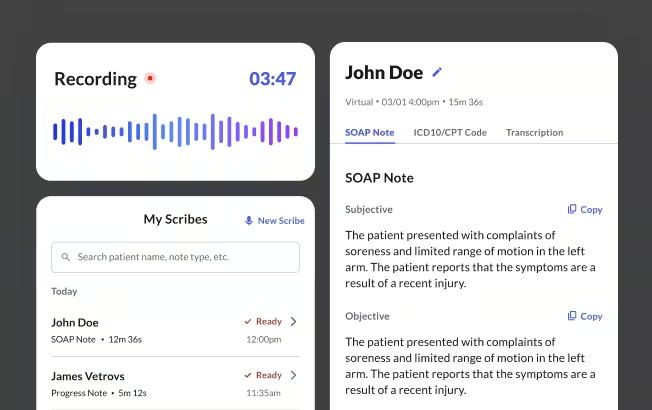
On ambient capture. Commure Scribe listens to the clinical encounter in the background. The clinician conducts the visit normally. When the recording ends, a structured SOAP note appears within seconds. The clinician reviews it and finalizes. The workflow is always Capture, Edit, Finalize. No dictation required.
A 2025 NEJM AI randomized trial of 238 physicians across 14 specialties at UCLA found that ambient AI scribes improved clinician experience and, for at least one of the two tools tested, reduced documentation time.² The trial noted occasional inaccuracies, most commonly omissions and pronoun errors, which is why the review step exists.
Commure Scribe has 99.4% transcription accuracy. 90% or more of providers report a reduction in documentation time. 91% report feeling less fatigued.³ Average chart close time is 43 seconds.³
On coding. Suggested ICD-10 and CPT codes are generated with the note, at no separate cost. Codes appear in a separate tab for review. For practices with existing coding staff, coders review and confirm rather than generate codes from scratch. Context-rich, AI-generated notes may support more accurate coding. Commure Scribe users have seen an average 25% reduction in denials where documentation gaps were a contributing factor.³
On multilingual support. Commure Scribe supports 90 languages with automatic detection. No manual language selection is required. The clinician and patient speak in their preferred language.
On trial access. A 7-day free trial is available at commure.com with no credit card required. The first note is available the same day.
On device compatibility. Commure Scribe works on any device: mobile, tablet, or desktop. No hardware requirements. No operating system restrictions.
On support. US-based live phone support is included. Not a chatbot or ticket queue.
On EHR integration. Commure Scribe integrates with 60+ EHRs, including AdvancedMD, eClinicalWorks, Athenahealth, Elation, SimplePractice, Practice Fusion, Cerbo, WebPT, Tebra, and Kipu. Copy/paste delivery is available for all tiers.
On admin tasks. Commure Scribe generates patient emails, work excuse letters, and prior authorization requests directly from the encounter.
Who Should Switch and Who Should Stay
Stay with Dragon Medical One if:
Your practice is on Epic or Cerner with an existing Microsoft relationship. Your dictation workflow is established and your notes are accurate. You prefer to construct and control every element of the note yourself. You have IT support for setup and maintenance, and budget is anchored to a multi-year Microsoft enterprise contract.
Consider Commure Scribe if:
You want the encounter to generate the note, not your dictation. You need coding suggestions without a separate enterprise add-on. You see patients who speak languages outside Dragon's supported list. You need a direct support line, not a reseller chain. You use a Mac or prefer mobile-first documentation. You want to evaluate a tool in 7 days before committing to anything.
Independent and small practices (1–5 clinicians)
The 7-day free trial is the lowest-risk way to compare. Record a visit the first day. Review the generated note against what you would have dictated. Check the suggested ICD-10 and CPT codes against your coding workflow. Most clinicians reach a clear decision within the first few visits. See the complete guide to AI medical scribes for a full evaluation framework.
Solo and small practice pricing: $89/month, or $59/month billed annually.
Medium and large practices (6–100+ clinicians)
Have a champion clinician complete the 7-day trial first. Present findings to an administrator or clinical director. The first value moment is more persuasive as a demonstration than as a description.
A 2025 JAMA Network Open study across six health systems found ambient AI scribes reduced documentation burden and improved clinician experience at the group level.⁴
Frequently Asked Questions
Medical dictation software and ambient AI scribes differ in where documentation work happens. Dragon Medical One transcribes spoken words; the clinician still constructs the note. Commure Scribe captures the encounter and generates a structured SOAP note automatically. The clinician reviews before submitting. Dictation moves the burden from typing to speaking. Ambient AI removes it from the workflow entirely.
Microsoft introduced Dragon Copilot in March 2025, combining Dragon Medical One's speech recognition with ambient AI and generative AI in one platform. Dragon Medical One remains available as a standalone dictation product. Dragon Copilot is the current direction of the Microsoft clinical documentation platform. Confirm the current product roadmap and pricing with Microsoft or your reseller before purchasing.
HIPAA compliance is a baseline requirement, not a differentiator on its own. Verify that any vendor offers a signed BAA, specifies how audio and note data are stored, confirms no third-party data sharing, and uses onshore infrastructure. Commure Scribe is HIPAA compliant and SOC 2 certified, stores notes onshore, does not store audio, and shares no data with third parties.
EHR integration ranges from copy-paste to native one-click sync depending on the tool and pricing tier. Verify whether a tool supports your EHR natively or via a browser extension, and whether setup requires IT. Commure Scribe works has one-click integrations with 60+ EHRS, including AdvancedMD, eClinicalWorks, Athenahealth, Elation, SimplePractice, WebPT, Tebra, and others.
Practices can run both tools in parallel before switching. Dragon Medical One licenses are term-based; check your contract for cancellation terms before committing. Commure Scribe's 7-day trial lets you test the ambient workflow against your existing Dragon workflow with no financial commitment. Most clinicians reach the first value moment on day one, which makes the comparison concrete and fast.
Sources
- Alboksmaty, A., Aldakhil, R., et al. (2025). The impact of using AI-powered voice-to-text technology for clinical documentation on quality of care in primary care and outpatient settings: A systematic review. eBioMedicine, 118, 105861. https://doi.org/10.1016/j.ebiom.2025.105861
- Lukac, P. J., Turner, W., et al. (2025). Ambient AI scribes in clinical practice: A randomized trial. NEJM AI, 2(12), Article AIoa2501000. https://doi.org/10.1056/AIoa2501000
- Olson, K. D., Meeker, D., et al. (2025). Use of ambient AI scribes to reduce administrative burden and professional burnout. JAMA Network Open, 8(10), e2534976. https://doi.org/10.1001/jamanetworkopen.2025.34976
- Microsoft. Dragon Medical One. https://www.microsoft.com/en-us/health-solutions/clinical-workflow/dragon-medical-one
- Microsoft Support. Introduction to Dragon Medical One. https://support.microsoft.com/en-us/dragon-medical-one/introduction-to-dragon-medical-one
- Microsoft News. Microsoft Dragon Copilot provides the healthcare industry's first unified voice AI assistant that enables clinicians to streamline clinical documentation, surface information, and automate tasks. March 3, 2025. https://news.microsoft.com/source/2025/03/03/microsoft-dragon-copilot-provides-the-healthcare-industrys-first-unified-voice-ai-assistant-that-enables-clinicians-to-streamline-clinical-documentation-surface-information-and-automate-task/
- Microsoft Service Trust Portal. HIPAA. https://servicetrust.microsoft.com/ViewPage/HIPAA
Try the #1 AI Scribe for Free
No Credit Card Required. Join 20,000 Clinicians.