




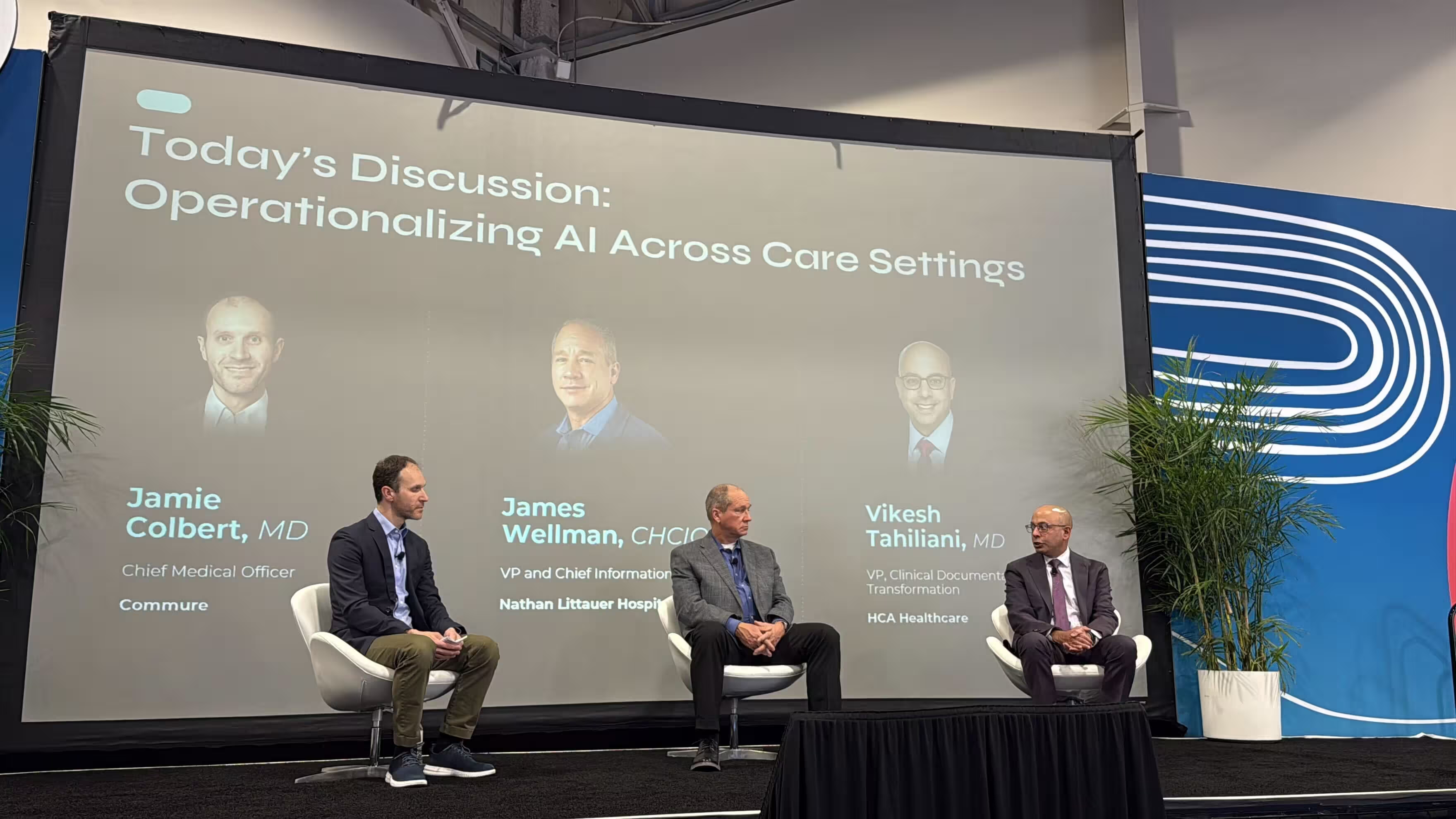
At HIMSS, healthcare leaders from a broad range of organizations shared how they are evaluating Ambient AI as a promising new component of care delivery operations.
To dive deep into practical strategies, Commure hosted a panel session, “The Ambient AI Playbook: From Rural Care to Enterprise Scale,” featuring:
- Vikesh Tahiliani, MD, MBA, VP of Clinical Documentation Transformation at HCA Healthcare Digital Transformation & Innovation
- James Wellman, CHCIO, VP and CIO at Nathan Littauer Hospital and Nursing Home
- Jamie Colbert, MD, MBA, Chief Medical Officer for Provider and Patient Experience at Commure
Both HCA Healthcare and Nathan Littauer discussed ambient AI in the context of clinical documentation workflows, offering an important perspective for health systems evaluating how AI can integrate into existing environments.
Despite their scale differences—HCA Healthcare operates 190 hospitals across 19 states and the United Kingdom while Nathan Littauer is a rural community hospital in upstate New York—both organizations are focused on the same industry-wide challenge: returning time to clinicians while ensuring accurate, timely documentation within their workflows.
Building an AI Strategy at Enterprise Scale: HCA Healthcare
HCA Healthcare has taken a deliberate approach to AI adoption through its Digital Transformation & Innovation (DT&I) organization, which identifies priority areas for care transformation, including clinical documentation.
After considering many potential partners, the organization selected Commure based on three defining strengths: confidence in its leadership, the demonstrated performance of its ambient technology, and its willingness to engage in a true co-development partnership.
For HCA Healthcare, that partnership model was essential. Ambient AI cannot simply be installed and expected to scale uniformly across a large health system. Each clinical environment operates with its own workflows, demands, and documentation patterns. Success depends on shaping the technology around the realities of patient care, not asking clinicians to conform to the technology.
Working closely with DT&I leadership and frontline care teams, Commure used direct provider feedback to iteratively refine its product and align it with real-world documentation workflows across the enterprise. That work also guided the necessary integration within HCA Healthcare’s existing EHR landscape.
This effort represents an important step in HCA Healthcare’s clinical documentation transformation. More broadly, it advances the organization’s vision for an intelligent documentation ecosystem that reduces administrative and cognitive burden, captures the full complexity of patient care and helps identify and close documentation gaps.
A Focused AI Roadmap for Community Healthcare: Nathan Littauer
Nathan Littauer approached AI adoption through a focused four-pillar strategy aligned with the full patient journey:
- AI call center agents
- Ambient clinical documentation
- AI assistants for searching and summarizing medical records
- Revenue cycle optimization
The goal is to deploy AI in areas where it can support measurable improvements to clinician workflows and operational efficiency. As these initiatives roll out, the organization is establishing clear metrics to evaluate impact across each focus area.
Within the AI call center, leadership is measuring improvements in patient access, including response times, reliability during peak demand, and the ability to provide consistent 24/7 coverage despite staffing constraints.
For ambient documentation, the focus is on reductions in physician documentation time, improvements in provider satisfaction, and the potential to support clinician recruitment and retention.
AI assistants are designed to help clinicians efficiently interpret large volumes of external records without overwhelming the EHR workflow.
Finally, within revenue cycle operations, the organization will track documentation completeness and coding accuracy, using AI to identify gaps earlier and support more reliable reimbursement.
Measurable Impact on Documentation and Clinician Time
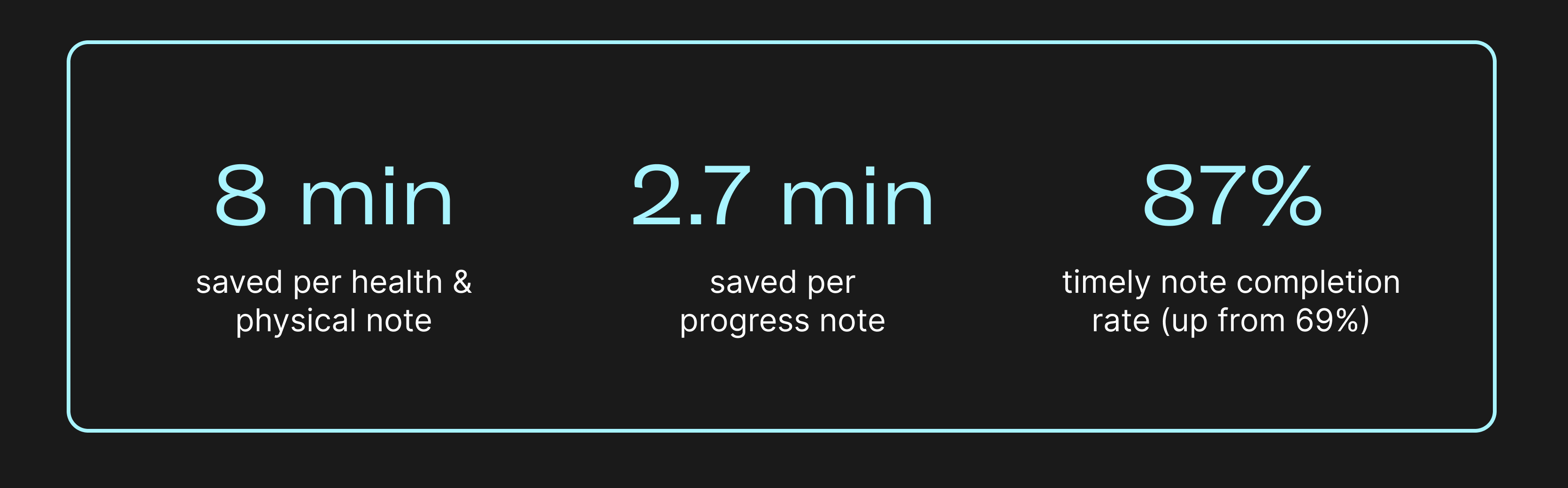
HCA Healthcare is testing Commure Ambient AI with 1,400+ physicians across 50+ hospitals and three care settings, and early results show measurable improvement in clinical documentation quality while delivering time savings to providers. Clinical documentation accuracy, measured using the F1 score where 0.0 is low and 1.0 is best, has surpassed 0.8 and is approaching 0.9, exceeding typical industry benchmarks.
Efficiency gains are equally significant:
- ~8 minutes saved per history and physical note
- ~2.7 minutes saved per progress note
- 87% timely note completion rate, up from 69%
“Some of our data is showing us there is substantial time savings for the physicians. Anecdotally we’ve heard 2-3 hours per day per hospitalist,” shared Dr. Vikesh Tahiliani, VP, Clinical Documentation Transformation, HCA Healthcare Digital Transformation & Innovation
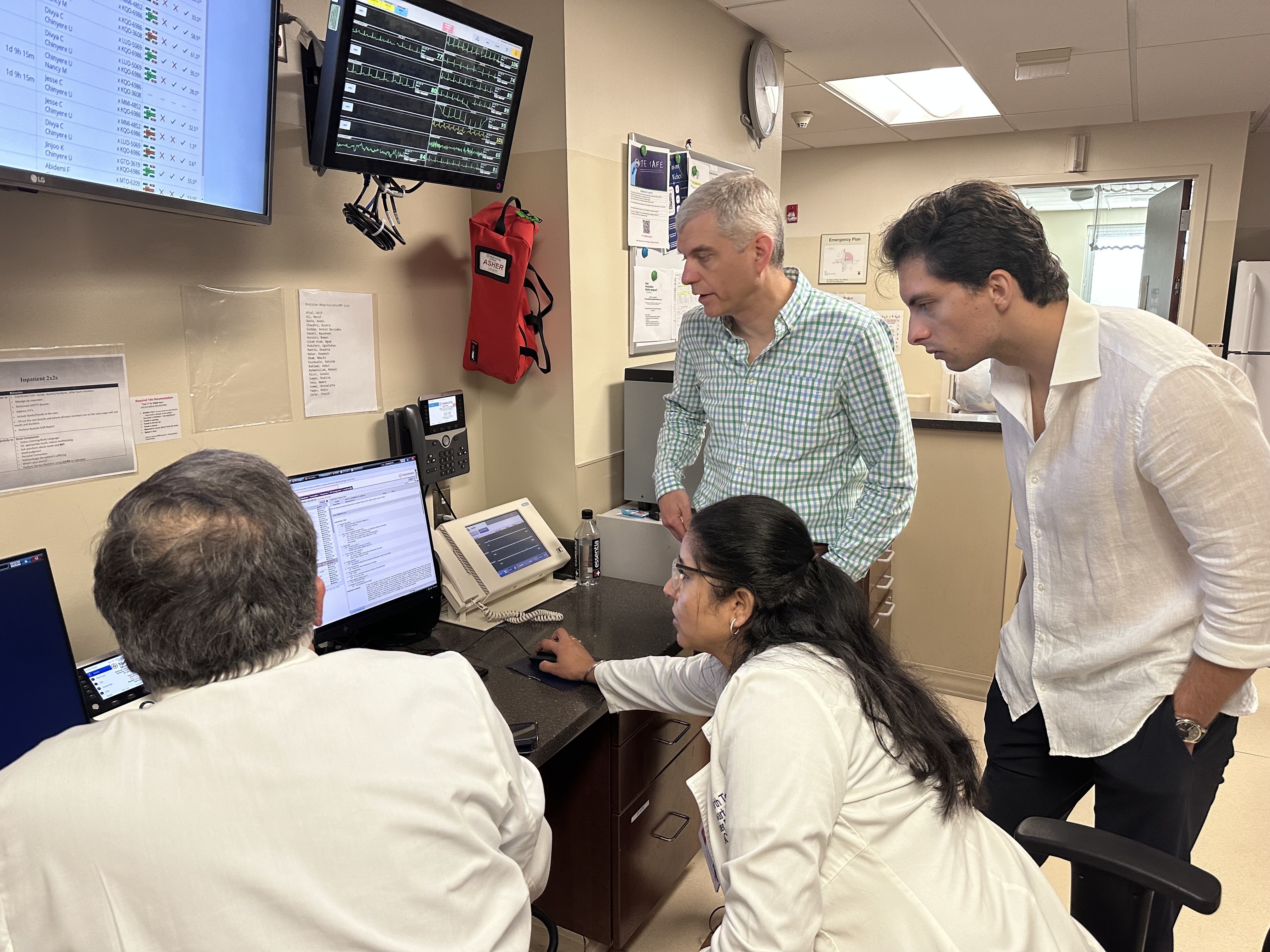
Nathan Littauer is earlier in its ambient AI deployment journey but is already seeing strong feedback from Emergency Department physicians participating in early pilots within its clinical documentation environment.
Providers report that ambient documentation is simplifying note creation, often requiring only minor edits after the AI-generated draft.
“It’s truly giving time back to our providers. That improves satisfaction and I believe it will become a powerful recruiting tool in the future,” said James Wellman.
The Key to Successful AI Adoption
One clear lesson from both organizations is that technology alone does not drive adoption.
Successful deployments require strong leadership commitment, thoughtful change management, and close collaboration between clinicians and technology teams. For health systems, integrating ambient AI into existing documentation workflows—rather than requiring clinicians to adopt new processes—has been an important factor in adoption.
Most importantly, ambient AI should deliver a clear benefit to providers. When clinicians see that the technology reduces documentation burden and supports their daily workflow, adoption follows naturally.
For health systems navigating AI transformation, that principle remains an important measure of success, because it may directly translate to better care and experiences for patients and physicians.
.png)
*These results are specific to HCA Healthcare’s implementation and based on internal data and methodology, and are not necessarily indicative of results other organizations should expect. Outcomes will vary depending on a range of factors, including workflow design, specialty, user adoption, and technology environment.
Share this story




.png)









.jpeg)
.png)