





The U.S. healthcare industry could save $20 billion a year by replacing manual administrative workflows with electronic ones, according to the latest CAQH Index. The same shift saves 70 minutes per patient visit.
That's the cost of the clipboard era. And for the first time, the technology to end it actually exists.
For two decades, "patient intake software" meant the same thing: take the paper forms, put them on a tablet. The clipboard got a screen, but patients still answered the same questions. Staff still re-keyed the same data, but eligibility still got checked somewhere downstream, usually by phone.
The clipboard didn't go away. It just got a software wrapper.
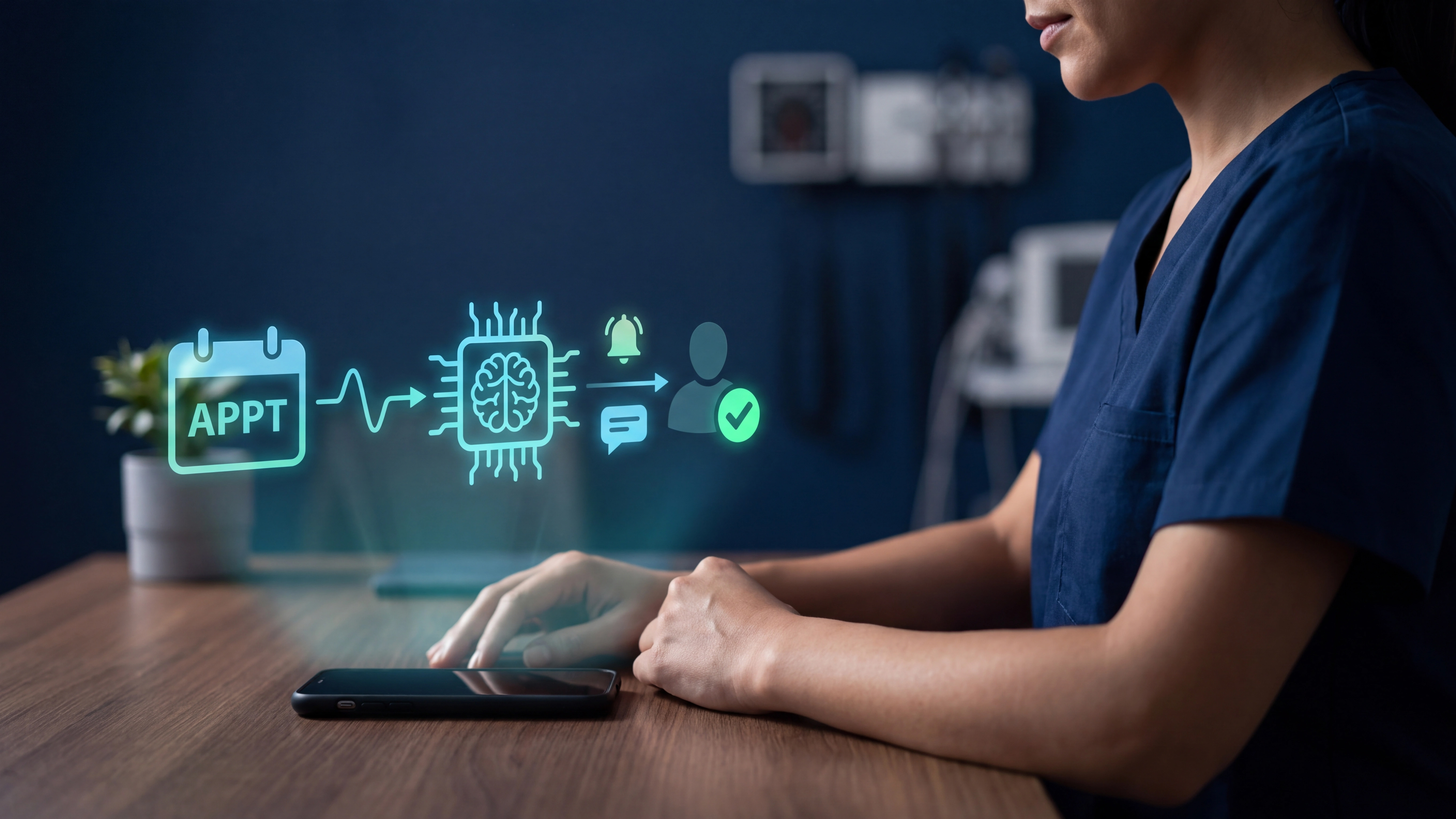
AI changes the assumption underneath all of it by replacing the workflows the form was built to support.
The clipboard era costs more than most health systems realize
Patient intake is one of the most measured workflows in healthcare and one of the least scrutinized. Most enterprise health systems track no-show rates, registration time, and front-end denials as separate metrics, but they rarely add them up.
When they do, the picture is consistent. The manual pre-visit experience bleeds revenue, staff hours, and patient trust at every step.
CAQH's 70-minutes-per-visit figure is the cumulative cost of staff calling patients to confirm appointments, re-verifying insurance by phone, fielding follow-up questions about pre-visit prep, and re-entering the same data into multiple systems. Multiply that across a health system's daily patient volume, and those minutes turn into a full-time staffing burden that grows with every new clinic and every new payer contract.
The patient side is worse. Patients show up to fill out the same forms they already completed online. They wait while staff verifies what should have been verified the week before. They leave with the impression that the most technologically advanced industry in the world can't remember their address from one visit to the next.
This is the gap modern patient intake software has to close.
What AI patient intake actually does
The shift is a redefinition of what patient intake software is responsible for.
In the clipboard era, intake software's job was to collect information at the front desk. In the AI era, the job is to manage the entire pre-visit experience. From the moment an appointment is scheduled to when the patient walks in already verified, prepared, and registered.
That broader definition matters because it changes what health systems are actually buying. A traditional intake product replaces the form. An AI-powered patient engagement platform replaces the workflow. The first reduces clicks. The second reduces phone calls, no-shows, denied claims, and the staff hours required to chase each one of them down.
In practice, AI-driven patient intake covers four overlapping capabilities:
- Automated, conversational outreach that confirms the appointment, gathers pre-visit information, and answers patient questions in plain language over SMS or voice. No portal, no app, no login.
- Intelligent referral intake that captures and tracks incoming referrals so patients don't fall through the cracks between schedule and visit.
- Personalized pre-procedure preparation that delivers the right instructions at the right time and flags patients who haven't completed them.
- Bi-directional messaging with intelligent triage that escalates urgent issues to a human and resolves the routine ones automatically.
Each of these used to be a separate vendor conversation. Now they're table stakes for a single platform.
Why the AI layer changes the economics
The most underappreciated thing about AI-driven patient intake is that in addition to reducing manual work, it changes which work is worth doing at all.
When pre-visit confirmation, prep, and information capture happen automatically through conversational AI, the marginal cost of engaging each patient drops close to zero. That unlocks workflows that health systems couldn't justify before. Multi-touchpoint reminders for complex procedures. Proactive outreach that meaningfully reduces no-shows. Bowel prep follow-ups for colonoscopies. Pre-op education for orthopedic patients. Behavioral health check-ins before the first visit.
The AI layer also reaches places the clipboard never could. Voice-based agents can capture patient information during inbound and outbound calls (which is still the channel where most patients engage with their health system). The same AI that confirms an appointment can spot a patient who needs to reschedule, triage a clinical question, or hand off to a human when escalation is warranted. Modern call center automation extends intake into a 24/7 capability.
The financial picture changes with it. The clipboard era measured intake as a cost center. The AI era measures it as a lever for access, throughput, denial prevention, and retention. The systems already operating this way are seeing the math play out. At Yale New Haven Health, pre-appointment AI texting drove a 54% reduction in no-show and cancellation rates for breast cancer screening alone.
What enterprise buyers should look for in 2026
The patient intake software market is in the middle of a category shift. The products that win the next decade won't be the products that won the last one.
A few principles separate the AI-era platforms from the legacy ones.
- Platform breadth over form depth. The right question is no longer how good the digital forms are. It's how much of the pre-visit experience the platform actually owns. A vendor that handles intake but not referral management, or messaging but not scheduling coordination, is selling only a piece of the workflow when health systems need the whole thing.
- Retrieval-based AI, not generative guessing. In healthcare, an AI that hallucinates a medication or a pre-op instruction is a safety event. Enterprise-grade patient intake AI has to be grounded in clinically validated content and deterministic logic.
- Deep EHR integration as table stakes. Patient data that enters the platform should land in the EHR in the right fields, without staff re-keying. Bi-directional integration with the major EHRs separates platforms that look modern from platforms that actually reduce work.
- Omnichannel by patient preference. SMS, RCS, voice, and email. Meeting patients on the channel they actually use, not the channel the vendor built first.
Health systems making this transition are replacing the entire pre-visit stack with one platform built for the AI era.
How Commure Engage approaches patient intake
Commure Engage is built for the shift from clipboard to AI. It combines automated patient outreach, conversational AI, referral and intake management, and personalized care pathways into one platform that owns the pre-visit experience end to end.
Engage uses retrieval-based AI grounded in over 500 clinically validated care pathways, integrates bi-directionally with all major EHRs, and reaches patients through SMS, RCS, voice, and email without requiring an app or portal login. Health systems using Engage resolve 80%+ of patient inquiries automatically through conversational workflows, increase outreach capacity by 6.5x, and cut no-shows by 54%.
The clipboard era is ending. The platforms replacing it are already in production.
See how Commure Engage is rebuilding patient intake for the AI era
Share this story



.png)








.jpeg)
.png)