



DBT Diary Card Template: Free Printable 7-Day Card and Guide
An original weekly card therapists can hand to clients, with field-by-field guidance, a session review order, and filing steps for the completed card.
Written by the Commure Scribe Team
Published: September 25, 2026
•
8 min read
Updated September 25, 2026
What You Need to Know About DBT Diary Card Templates
- A DBT diary card template is a one-week form for rating daily urges, emotions, behaviors, and skills in therapy.¹
- In one comprehensive DBT program, adults completed an average of 19.1 diary cards over about 25 weeks.¹
- Download the free DBT diary card template, give clients the fill-out steps, and review each card at session start.
Download the Free DBT Diary Card Template
This DBT diary card template comes with a skills reference, and both are editable Word (DOCX) files you can print.
Note: This template is for informational purposes only and does not constitute legal or medical advice. Have your compliance officer review it before clinical use.
- Download the DBT Diary Card Template (DOCX): weekly card with a clinician review page
- Download the DBT Skills Tracking Reference (DOCX): editable skills guide
Both files are original Commure designs that you can edit and share with clients.
What Is a DBT Diary Card Template, and When Should You Use One?
Use a DBT diary card template when a client in individual dialectical behavior therapy (DBT) needs a weekly record for session planning. According to Cleveland Clinic, clients bring the diary to sessions "so you and your therapist can decide what to work on for each session."²
The card belongs to individual therapy, one of four parts of comprehensive DBT.³
- Individual therapy
- Between-session telephone coaching
- Therapist consultation team meetings
- Group skills training
A therapist in independent practice who uses the card without the other three parts offers DBT-informed care. The card has no scoring key, so when you need a score, pair it with a validated mental health questionnaire.
What Does a DBT Diary Card Track?
A DBT diary card groups daily ratings into six areas, from safety to completion. This DBT diary card template tracks the same areas as the University of Washington Behavioral Research and Therapy Clinics (UW BRTC) card.⁴ Its wording and layout are original, and the top lists client name, ID, week, and therapist.
- Safety urges and actions. Clients rate urges to self-harm and to end their life from 0 to 5 and mark self-harm actions yes or no.⁴ On this template, the risk rows come first.
- Target behaviors. Client and therapist set target behaviors "to increase or decrease" in individual therapy.³ Each of three editable targets gets an urge row and an action row.
- Substances and medication. The UW card rates urges to use drugs, including alcohol, from 0 to 5 and tracks medications taken as prescribed.⁴ In a federally conducted, regulated, or assisted substance use disorder (SUD) program, these rows can carry added privacy rules.
- Emotions. Clients rate each feeling, including joy, from 0 to 5 at its most intense point that day.¹ In one DBT program, monthly gains in joy predicted lower borderline personality disorder (BPD) severity at month's end, a correlational finding.¹
- Skills. The UW card rates skill use from 0 to 7, and this template uses Used and Helped boxes instead.⁴ Cleveland Clinic names four modules: mindfulness, distress tolerance, emotion regulation, and interpersonal effectiveness.²
- Completion. The UW card asks how often the client filled it out and whether it was "Filled out in session?"⁴
- Clinician review page. The clinician section records session date, length, and service type, plus consent, diagnosis, risk review, safety plan, and targets. It ends with a record-handling note and your signature and license, and diagnosis codes should be current-year ICD-10-CM.
How Should Clients Fill Out a DBT Diary Card?
Clients fill out the card once a day and bring it to each session. You can hand them these steps as written.
- Fill out your card once a day, at about the same time each day.
- Rate each urge and feeling from 0 for none to 5 for the strongest you felt that day.
- Mark Y for yes or N for no for each action, such as self-harm or taking your medicine as prescribed.
- Check Used for each skill you tried. Check Helped if the skill made things better.
- If you missed a day, fill in what you remember. Then mark how many days you filled out.
- Write down what you want to talk about, and bring your card to each session even if it is not finished.
- If your urges are high, follow your safety plan. You can call or text 988 to reach the 988 Suicide & Crisis Lifeline, which is open 24/7.⁵
How Do You Review a Diary Card at the Start of Session?
Review the card in the first few minutes of session and let it set the agenda in priority order. Cleveland Clinic lists the goals of individual DBT. Safety comes first, then limiting behaviors that block therapy, then quality of life.²
In DBT terms, these are life-threatening, therapy-interfering, and quality-of-life behaviors, so scan the card in that order.
- Safety rows. Check suicide and self-harm urges and any self-harm action. A high rating or a yes goes to the top of the agenda.
- Therapy-interfering behavior. Look at blank days and when the card was filled out. A blank or last-minute card can be a behavior to discuss.
- Targets. Compare urges and actions with last week's card, and pick one target to work on in depth.
- Emotions and skills. Find days when strong feelings met a skill marked Helped to see which skills to coach.
In a 6-month comprehensive DBT program, adults with BPD completed an average of 19.1 diary cards over about 25 weeks.¹ That figure comes from one program, so use it as a rough benchmark.
If a client arrives without a card, fill it out together and mark the in-session box. Then ask what got in the way this week.
How Can You Adapt a DBT Diary Card for Apps, Teens, or Substance Use?
Adapt a DBT diary card template by changing its format, its reader, or its rows. One trial compared app and paper diary cards at 5 Danish psychiatric outpatient facilities, with 78 participants analyzed.⁶ App users averaged 37.1 more treatment days and 3.16 more logged skills per week, with wide standard errors.⁶
The paper group had larger gains in quality-adjusted life years (QALYs) and larger drops in depression severity.⁶ Both groups improved, and the authors reported "both positive and negative consequences" of the app.⁶
Other changes affect who reads the card or what it tracks.
- Teens. A trial of youth ages 12 to 18 at risk for suicide used a DBT package with multi-family skills groups and youth and parent phone coaching.⁷ Rules on parent access to a minor's records vary by state, so check yours before sharing the card.
- Substance use. The Linehan Institute distributes a National Institute on Drug Abuse (NIDA) diary card alongside its standard card.⁸ Add rows for specific substances, amounts, and urges to use.
- Client targets. Rename the three target rows to match the client's mental health treatment plan.
How Should You Document and Store Completed Diary Cards?
File the completed card in the client's record and summarize the review in your progress note. HHS says the HIPAA Privacy Rule "applies uniformly to all protected health information," with psychotherapy notes as the exception.⁹
A card the client fills out is most likely ordinary protected health information (PHI). HHS has not addressed these forms directly, so confirm that reading with counsel.
- Psychotherapy notes. HIPAA gives extra protection to a mental health professional's notes documenting or analyzing a counseling session, kept apart from the rest of the record (45 CFR 164.501).⁹ Disclosing these notes generally needs the client's authorization (45 CFR 164.508(a)(2)), so keep them in a separate psychotherapy notes template.
- Substance use records. In a federally conducted, regulated, or assisted SUD program, a card that tracks drug or alcohol use can be a record under 42 CFR Part 2. Part 2 adds its own consent and redisclosure rules, and compliance with its 2024 final rule was required by February 16, 2026.¹⁰
- State law. State mental health privacy laws can be stricter than HIPAA, and requirements vary by state.
- Progress note. Summarize the risk review, targets addressed, and skills coached in the record, using a structured progress note template. In a DAP note format (Data, Assessment, Plan), log the card's ratings and skills coached under Data, then progress on targets under Assessment.
Review your filing and release steps with your compliance officer or legal counsel before you adopt the card.
How Does Commure Scribe Fit Into the Diary Card Review?
To document the card review, use Commure Scribe. The client still fills out the card, and Commure Scribe drafts the note from your conversation.
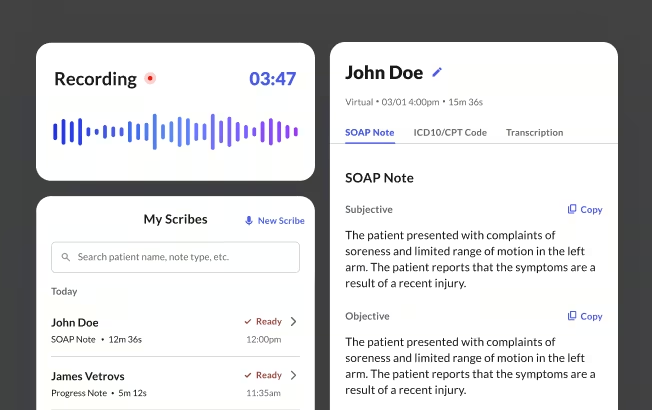
- Capture. Record in person or by telehealth on any device, for up to 2 hours per session. You can stay present in the room while the client walks you through the card.
- Edit. Within seconds of clicking End Recording, a structured SOAP note appears with suggested ICD-10 and CPT codes. Adjust the risk review, targets, and skills coached, or build a custom template for card reviews.
- Finalize. You review and approve the note before it enters the chart. Solo and small practices (1 to 5 providers) move it into the EHR by copy/paste through a Chrome extension overlay.
Commure Scribe is HIPAA compliant and SOC 2 certified, and session audio is not used for AI training. According to Commure, 90%+ of providers reduce clinical documentation time and digital fatigue. Keep any separate psychotherapy notes outside the drafted progress note.
Turn the card review into a signed note
Commure Scribe drafts the progress note from your diary card review for you to check and sign. Independent practices can start with a 7-day trial, no credit card required, and check Commure Scribe pricing.
This article is for informational and educational purposes only, does not constitute legal, medical, or professional advice, and does not guarantee regulatory compliance.
DBT Diary Card Template Download
Download a copy of this template
Thanks! Your DBT diary card template is ready.
Click below to download.
Thanks! Your DBT skills tracking reference template is ready.
Click below to download.

Frequently Asked Questions
Clients should fill out the card once a day. In standard DBT, clients and therapists monitor progress through daily diary card entries about the past day's emotions and behaviors.
A therapist in independent practice can use the card as part of DBT-informed care. Call it DBT-informed unless you also offer phone coaching, a consultation team, and skills groups. DBT trial results describe the full treatment package, not the card alone.
According to the Linehan Institute, its assessments are free for "research, clinical, and educational purposes." Commercial use needs "prior permission" from the Institute. Guilford Press states that buyers of its DBT skills handouts get "Permission to photocopy for personal use or use with clients." Check each source's terms before you reuse a published card.
A completed card filed in the chart most likely counts as ordinary PHI rather than a psychotherapy note. HIPAA psychotherapy notes exclude summaries of "symptoms, prognosis, and progress to date." HHS guidance does not name client-completed cards. Confirm your approach with your compliance officer or legal counsel.
You can rename the target rows in this DBT diary card template for each client in the editable DOCX. Targets set in individual therapy can include increasing self-respect or decreasing substance use. Keep the 0 to 5 rating scales the same so weeks stay comparable.
Sources
- Bitran AM, Hughes CD, Bist J, Krall HR, Yin Q, Rizvi SL. "The Effects of Dialectical Behavior Therapy on Joy: A Diary Card Study." Cognitive Therapy and Research, 2026;50(2):315–325. https://link.springer.com/article/10.1007/s10608-025-10704-z (2026)
- Cleveland Clinic. "Dialectical Behavior Therapy (DBT): What It Is & Purpose." https://my.clevelandclinic.org/health/treatments/22838-dialectical-behavior-therapy-dbt (2022)
- Title IV-E Prevention Services Clearinghouse, Administration for Children and Families, U.S. Department of Health and Human Services. "Dialectical Behavior Therapy®." https://preventionservices.acf.hhs.gov/programs/470/show (2024)
- University of Washington Behavioral Research and Therapy Clinics. "How to Complete the Diary Card: Instructions for Therapists" (NIMH4 S-DBT Diary Card). https://depts.washington.edu/uwbrtc/wp-content/uploads/NIMH4-S-DBT-Diary-Cards-with-Instructions.pdf
- Substance Abuse and Mental Health Services Administration (SAMHSA). "Crisis Help: Suicide, Mental Health, Drug, and Alcohol Issues." https://www.samhsa.gov/find-support/in-crisis (2026)
- Laursen SL, Helweg-Jørgensen S, Langergaard A, Søndergaard J, Sørensen SS, Mathiasen K, Lichtenstein MB, Ehlers LH. "Mobile Diary App Versus Paper-Based Diary Cards for Patients With Borderline Personality Disorder: Economic Evaluation." Journal of Medical Internet Research, 2021;23(11):e28874. https://doi.org/10.2196/28874 (2021)
- National Institute of Mental Health. "Therapy Reduces Risk in Suicidal Youth." https://www.nimh.nih.gov/news/science-updates/2018/therapy-reduces-risk-in-suicidal-youth (2018)
- Linehan Institute. "DBT Research, Assessment & Scales." https://www.linehaninstitute.org/dbt-assessments (accessed 2026)
- U.S. Department of Health and Human Services, Office for Civil Rights. "Does HIPAA provide extra protections for mental health information compared with other health information?" HIPAA FAQ 2088. https://www.hhs.gov/hipaa/for-professionals/faq/2088/does-hipaa-provide-extra-protections-mental-health-information-compared-other-health.html (2017)
- U.S. Department of Health and Human Services. "Fact Sheet 42 CFR Part 2 Final Rule." https://www.hhs.gov/hipaa/for-professionals/regulatory-initiatives/fact-sheet-42-cfr-part-2-final-rule/index.html (2026)
- The Guilford Press. "Supplementary Materials for DBT Skills Training Handouts and Worksheets, Second Edition." https://www.guilford.com/companion-site/DBT-Skills-Training-Handouts-and-Worksheets-Second-Edition/9781572307810