



Telehealth Consent Form Template: Free Editable Download
An editable form with plain guidance on what to include, how to chart verbal consent, and where state and federal telehealth rules stand in 2026.
Written by the Commure Scribe Team
Published: September 25, 2026
•
7 min read
Updated September 25, 2026
What You Need to Know About Telehealth Consent Form Templates
- A telehealth consent form template records a patient's agreement to video or phone care and its added terms.
- The Center for Connected Health Policy (CCHP) reports that the majority of states have telehealth-specific consent rules.¹
- Download the form, add your state and practice details, and have legal counsel review it before use.
How Is a Telehealth Consent Form Different From a General Consent Form?
A telehealth consent form adds four terms a general consent form skips. You may also see it called a telemedicine consent form.
- What the video or phone technology can and cannot do
- Where the patient is during each visit
- What happens if the connection drops
- Whether the visit is recorded
Use it as a standalone form or as an add-on to your current consent packet. For general treatment consent, such as procedure risks, use a medical consent form template. Sharing health records takes a separate HIPAA authorization form.
State law and the payer decide whether your practice needs one.
What Should a Telehealth Consent Form Template Include?
A telehealth consent form template should include the standard parts of informed consent for telehealth. It should also add six terms unique to virtual care.
- Standard informed consent elements. These cover the service, its risks and benefits, and other options. They also cover questions and voluntary consent. Signature lines go to the patient or guardian, the provider, and a witness if your state needs one.
- Technology and its limits. This part names the platform and the visit type, video or audio-only. It explains the limits of an exam without physical contact. Patients can then weigh a virtual visit against an in-person one.
- Privacy and security. This part lists how the practice protects the session. It also asks the patient to join from a private place. HHS lists private settings and no speakerphone among its safeguards for audio-only telehealth.²
- Right to decline. This line tells patients they can refuse telehealth and ask for an in-person visit. It makes clear that telehealth is a choice.
- Backup plan. This part gives a callback number and how long the provider waits before calling. Patients know what to do if the video freezes.
- State disclosures and location. This part lists the provider's licensing states and where the provider works during visits. It also records where the patient is. HHS notes that care across state lines depends on state rules.³
- Recording and AI documentation. This part gives two separate yes-or-no choices. One covers recording the visit. The other covers AI tools that help draft the visit note. Separate lines let a patient agree to one and decline the other.
The template also adds five fields as practice design choices.
- Emergency plan. The patient's emergency contact and nearest emergency facility for their location.
- Anyone else present. HHS advises telling the patient about anyone observing the visit and getting their consent at the start.⁴
- Minors and guardians. The guardian's name, relationship and how staff checked their identity.
- Renewal date. The date consent was given and the date to review it.
- Staff verbal consent record. Fields for staff to log consent the patient gave out loud.
How Do You Fill Out and Chart a Telehealth Consent Form?
Fill out the telehealth consent form template with the patient before or at the first telehealth visit. Send it ahead of time with your patient intake forms.
- Confirm identity. HHS guidance says to check the identity of a patient you do not know, out loud or in writing.²
- Confirm and write down the patient's location. HHS advises providers to check patient location before an appointment.³
- Fill in emergency details. Add the emergency contact and the nearest emergency facility for that location.
- Mark the recording and AI choices. Check yes or no on each line, and update the form if the patient changes a choice.
- Complete the guardian block for minors. Write down how staff checked the guardian's identity. A scoping review warns that holding an ID up to a webcam "may prove insufficient."⁵
- Collect signatures. Get dated signatures from the patient or guardian, the provider, and a witness if required.
Medicare lets staff under the billing practitioner's general supervision get consent for non-face-to-face services.⁶ Staff can get it when those services start, without direct supervision.⁶
Some Medicaid programs set chart rules too. Michigan Medicaid says consent "must be properly documented in the beneficiary's medical record."¹ For verbal consent, log these details in the staff record on the form.
- Date and time
- Video or phone
- Staff name and credentials
- The patient's confirmed location
Add the same details to the visit note built from your progress note template.
Is a Telehealth Consent Form Required?
Telehealth consent can be required by state law, a state Medicaid program or Medicare. Some of these rules accept verbal consent instead of a signed form. Each layer can set different terms for the same visit.
- State law. Consent rules can sit in state statute or administrative code, and the details differ by state.¹
- State Medicaid. Each program sets its own rules. Alaska Medicaid accepts written or verbal consent.¹ Georgia Medicaid requires the referring practitioner to get written consent from the member before the service.¹
- Medicare. CMS requires patient consent for non-face-to-face services.⁶ These include communication technology-based services (CTBS), e-visits, remote patient monitoring (RPM) and chronic care management (CCM).⁶ For virtual check-ins, Medicare.gov says the patient consents out loud and the provider notes it in the record.⁷
As of September 2026, federal coverage and prescribing rules carry these end dates.
- Medicare telehealth at home. Medicare patients can get non-behavioral telehealth at home through December 31, 2027, including audio-only visits.⁸
- Medicare in-person visit rule. The in-person visit rule for Medicare behavioral and mental telehealth does not apply through December 31, 2027.⁸
- HIPAA. HIPAA enforcement discretion from the COVID-19 public health emergency has ended. Its transition period closed on August 9, 2023.⁹
- Controlled substances. For controlled substance prescribers, Drug Enforcement Administration (DEA) telemedicine flexibilities run through December 31, 2026.¹⁰
Requirements vary by state and keep changing. Check CCHP's state consent summary for your state.
Have your legal counsel review your telehealth consent form template before use. For wider privacy tasks, use a HIPAA compliance checklist.
How Does Commure Scribe Help Document Telehealth Consent?
The signed form stays in your records. The visit note still needs to show what the patient confirmed on camera.
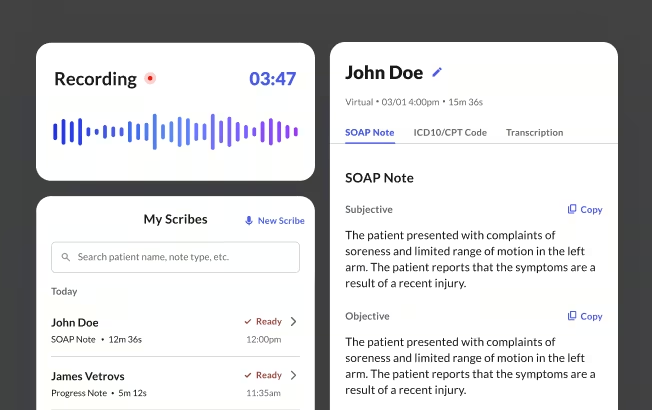
Both in-person and telehealth visits are supported in Commure Scribe. The software recognizes multiple speakers, such as a guardian on the call.
Within seconds of ending the recording, a structured SOAP note appears and suggested ICD-10 and CPT codes are generated.
The clinician adds or corrects the consent line, patient location and emergency details. Then the clinician approves the note before it enters the chart.
A custom template can keep a fixed spot for those details in each note. While the note drafts, the clinician can stay present with the patient on screen.
For the AI documentation line on the form, you can tell patients that audio is stored and encrypted. The audio is not used for AI training or any purpose other than generating the clinical note.
Put the consent conversation in the chart
If you would rather not type up what a patient said on camera, Commure Scribe drafts the visit note for you to review and finalize. Start with a 7-day trial, no credit card required, or see Commure Scribe pricing.
This article is for informational and educational purposes only, does not constitute legal, medical, or professional advice, and does not guarantee compliance with telehealth consent rules.
Telehealth Consent Form Template Download
Download a copy of this template
Thanks! Your telehealth consent form template is ready.
Click below to download.

Frequently Asked Questions
HHS HIPAA guidance does not say you need a telehealth consent form. The HIPAA Privacy Rule still applies to telehealth, including audio-only visits. The Security Rule does not apply to audio-only visits on a standard phone line. Apps and internet-based calls can bring Security Rule and business associate agreement (BAA) duties.
Renewal timing depends on your state and payer. For Medicare virtual check-ins, a provider may get one consent for a year's worth of services. CCHP's summary of CMS rules says patients give chronic care management consent once, unless they switch practitioners. For other visits, set a review date in your practice policy.
A parent or legal guardian generally gives consent for a child. Alabama requires a parent or guardian to attend telemedicine visits for minors under the age of medical consent. Arizona requires an identity check when a parent gives consent by telehealth. Requirements vary by state, so check yours before telehealth visits with minors.
The template asks about recording and AI documentation on separate lines. Patients can change either choice at any time. Rules for recording and AI tools can differ by state. Ask your legal counsel which consent your practice needs before you record or use AI tools.
Yes, consent can be collected during check-in. HHS guidance says to make sure consent is received or charted during check-in, including verbal consent. Staff can log verbal consent in the staff record on the form before the visit begins.
Sources
- Center for Connected Health Policy. "States with Telehealth Consent Requirements." CCHP (National Telehealth Policy Resource Center). 2026. https://www.cchpca.org/topic/consent-requirements-medicaid-medicare/
- U.S. Department of Health and Human Services, Office for Civil Rights. "Guidance on How the HIPAA Rules Permit Covered Health Care Providers and Health Plans to Use Remote Communication Technologies for Audio-Only Telehealth." HHS.gov. 2022; content last reviewed June 23, 2026. https://www.hhs.gov/hipaa/for-professionals/privacy/guidance/hipaa-audio-telehealth/index.html
- U.S. Department of Health and Human Services, Health Resources and Services Administration. "Licensing across state lines." Telehealth.HHS.gov. Last updated April 30, 2025. https://telehealth.hhs.gov/licensure/licensing-across-state-lines
- U.S. Department of Health and Human Services, Health Resources and Services Administration. "Obtaining informed consent." Telehealth.HHS.gov. Last updated August 18, 2023. https://telehealth.hhs.gov/providers/preparing-patients-for-telehealth/obtaining-informed-consent
- Ricci G, Gibelli F, Bailo P, Caraffa AM, Nittari G, Sirignano A. "Informed Consent in Paediatric Telemedicine: Challenge or Opportunity? A Scoping Review." Healthcare (Basel). 2023;11(10):1430. https://pmc.ncbi.nlm.nih.gov/articles/PMC10218595/
- Centers for Medicare & Medicaid Services, Medicare Learning Network. "Telehealth & Remote Monitoring" (MLN901705). December 2025. https://www.cms.gov/files/document/mln901705-telehealth-remote-monitoring.pdf
- Medicare.gov. "Virtual check-in coverage." Accessed September 16, 2026. https://www.medicare.gov/coverage/virtual-check-ins
- U.S. Department of Health and Human Services, Health Resources and Services Administration. "Telehealth policy updates." Telehealth.HHS.gov. Last updated February 5, 2026. https://telehealth.hhs.gov/providers/telehealth-policy/telehealth-policy-updates
- U.S. Department of Health and Human Services, Office for Civil Rights. "HIPAA and Telehealth." HHS.gov. Content last reviewed October 18, 2023. https://www.hhs.gov/hipaa/for-professionals/special-topics/telehealth/index.html
- U.S. Department of Health and Human Services. "HHS & DEA Extend Telemedicine Flexibilities for Prescribing Controlled Medications Through 2026." HHS.gov press release. January 2, 2026. https://www.hhs.gov/press-room/dea-telemedicine-extension-2026.html
- Agency for Healthcare Research and Quality. "AHRQ's Easy-to-Understand Telehealth Consent Form." AHRQ.gov. 2020. https://www.ahrq.gov/health-literacy/improve/informed-consent/index.html
- U.S. Department of Health and Human Services, Office for Civil Rights, and U.S. Department of Justice, Civil Rights Division. "Guidance on Nondiscrimination in Telehealth: Federal Protections to Ensure Accessibility to People with Disabilities and Limited English Proficient Persons." HHS.gov. July 26, 2022; last reviewed July 31, 2026. https://www.hhs.gov/civil-rights/for-individuals/disability/guidance-on-nondiscrimination-in-telehealth/index.html