



ADHD Assessment for Adults PDF: Free Editable Evaluation Form
A 15-section adult ADHD evaluation form, with the screener licensing, accuracy data, and privacy rules behind each section. Time to Read 7 minutes
Written by the Commure Scribe Team
Published: September 18, 2026
•
min read
Updated September 25, 2026
What You Need to Know About the ADHD Assessment for Adults PDF
- An ADHD assessment for adults PDF is a printable form for a full attention-deficit/hyperactivity disorder (ADHD) evaluation.
- More than half of US adults with ADHD, 55.9%, received their diagnosis at age 18 or older.¹
- Pair the form with a free or licensed screener, and let the full workup guide the diagnosis.
Download the ADHD Assessment for Adults PDF
The form comes as an editable DOCX and a printable PDF with the same 15 sections.
Note: This template is for informational purposes only and does not constitute legal or medical advice. Have your compliance officer review it before clinical use.
What Should an Adult ADHD Assessment Cover Beyond a Screener?
An adult ADHD assessment should check a positive screen against childhood history, daily life, and other conditions. The screen shows who needs a closer look. The rest of the workup shows whether symptoms began early and still cause problems. When the workup points to other conditions, a full psychiatric evaluation template covers psychiatric, medical, social, and family history in the sections American Psychiatric Association guidelines define.
A 2024 National Academies workshop report states there were "no United States guidelines for diagnosing and treating adults with ADHD."²
The form puts the workup in a set order and holds no licensed test items. The evaluating clinician records the findings and makes the diagnosis.
What Does This ADHD Assessment for Adults PDF Include?
The ADHD assessment for adults PDF has 15 sections in the order of a full evaluation. Fields use bracket placeholders, such as [Patient Name], in place of patient data.
- Patient and visit. Fill in [Patient Name], [Date of Birth], and [Medical Record Number]. Add the date of service, session length, service type, and clinician license number.
- Reason for assessment. Write the concern in the patient's own words next to the referral question.
- Consent and privacy. Check that treatment consent is on file. A printed notice keeps psychotherapy notes out of this record.
- Screening results. Record the date, scoring method, and result of the Adult ADHD Self-Report Scale (ASRS) screener.
- Current symptoms. Enter counts from the Diagnostic and Statistical Manual of Mental Disorders, Fifth Edition (DSM-5). According to the American Psychiatric Association (APA), adults over age 17 need five from either symptom group.³
- Childhood onset. Mark whether several symptoms began before age 12, and name the source.
- Impairment by setting. Describe problems at work, at home, and with others. The APA describes a pattern "present in multiple settings."³
- Collateral informant. Record input from someone who knows the patient well and note whether a release is on file.
- Other conditions. Review depression, anxiety, substance use, bipolar disorder, and autism. The APA notes that DSM-5 has no autism exclusion.³
- Substance use. Record use history and flag substance use disorder (SUD) records covered by federal Part 2 rules.
- Risk and safety. Check for suicidal thoughts, homicidal thoughts, and self-harm, and note any safety plan.
- Impression and plan. Enter the DSM-5 diagnosis and a current-year ICD-10-CM code. Set measurable goals with a review date for the mental health treatment plan.
- Addendum and signature. Date any late entry with a reason, then sign with credentials and date.
Which Adult ADHD Screening Tools Are Free to Use, and Which Need Permission?
Of the ASRS scales, the ASRS v1.1 six-question screener is free to use without formal permission.⁴ The owner asks users to cite the 2005 paper on the scale and to include its copyright notice.⁴ The longer checklist and the newer ASRS-5 each need a permission request.⁴
For a licensed tool, use the validated instrument with appropriate licensing. Depression and anxiety screens, such as the Patient Health Questionnaire-9 (PHQ-9) and Generalized Anxiety Disorder-7 (GAD-7), can support rule-outs. Both appear in this guide to the mental health questionnaire.
How Accurate Is the ASRS Screener, and What Does a Positive Screen Mean?
The ASRS v1.1 screener closely matched clinician diagnoses in a study of 668 US health plan members.⁷ Its accuracy score, the area under the curve (AUC), was 0.90 on a scale where 1.0 is perfect.⁷
The owner's 2024 scoring update lists two scoring rules.⁸
- Original rule. One point per item above a set threshold gives a 0 to 6 total, and 4 or more screens positive.⁸
- Alternative rule. Answers score 0 for "never" up to 4 for "very often," and a 0 to 24 total of 14 or more screens positive.⁸
The owner reports that the 0 to 6 rule gave high or uneven prevalence estimates.⁸
The ASRS-5 is a separate screener built for DSM-5.⁹ In general population data, it caught 91.4% of true cases.⁹ It also cleared 96.0% of people without ADHD.⁹
In a clinical sample where 57.7% met criteria, that second figure fell to 74.0%.⁹ More people without ADHD screen positive in that setting.
A positive screen starts the evaluation. CAMH, a Canadian mental health center, states, "The tool does not make the diagnosis."¹⁰
How Do You Complete an Adult ADHD Evaluation Step by Step?
Follow the order of the form, from the screen to a plan.
- Log the screen. Enter the screener date, scoring method, and result.
- Interview the patient. A 2024 National Academies workshop summary says the interview "should inquire about symptoms, impairments, and comorbid conditions."²
- Confirm childhood onset. Check early examples against school records or family reports.
- Map daily impact. Give one concrete example per setting.
- Get outside history. CAMH suggests having the patient's partner complete the screening tool too.¹⁰ Get a signed release first.
- Rule out other causes. Review mood, anxiety, substance use, and bipolar symptoms.
- Record the impression and plan. List pending items, goals, and the follow-up date.
The same workshop reported that more than 70% of adults with ADHD have at least one other psychiatric disorder.² Its figures put depression near 55% and anxiety near 47%.² Workshop figures also list substance use disorders at 41% and bipolar disorder at 35%.²
How Should You Document and Protect an Adult ADHD Assessment?
File the completed form in the medical record and protect it as PHI under the HIPAA Privacy Rule. Psychotherapy notes kept apart from that record generally need a separate patient authorization before you share them (45 CFR 164.508(a)(2)). Keep this form out of any file you hold for psychotherapy notes.
- 42 CFR Part 2. These federal rules apply to "any federally assisted program that provides SUD diagnosis, treatment, or referral for treatment."¹¹ Compliance with the 2024 final rule "was required by February 16, 2026."¹¹
- State law. Mental health privacy requirements vary by state and can be stricter than HIPAA. Ask your compliance officer to review the form.
- Telehealth prescribing. A temporary Drug Enforcement Administration (DEA) extension lets practitioners "remotely prescribe Schedule II-V controlled medications via audio-video telemedicine encounters."¹² The extension runs "through December 31, 2026," so check the DEA site before you prescribe.¹²
- Instrument copyright. Keep the owner's notice with any ASRS v1.1 screener you use: "Copyright © New York University and President and Fellows of Harvard College. All rights reserved."⁴
A full adult evaluation produces a long interview record for the clinician to turn into these fields. Practices that plan to audio-record the interview can compare AI scribes for psychiatry on mental status exam (MSE) structure, risk documentation, and 42 CFR Part 2 handling.
How Can Commure Scribe Help Document an Adult ADHD Evaluation?
Record the adult ADHD interview with Commure Scribe, and the evaluating clinician can stay present in the room. Commure Scribe supports in-person and telehealth visits and recognizes multiple speakers, including a partner giving collateral history.
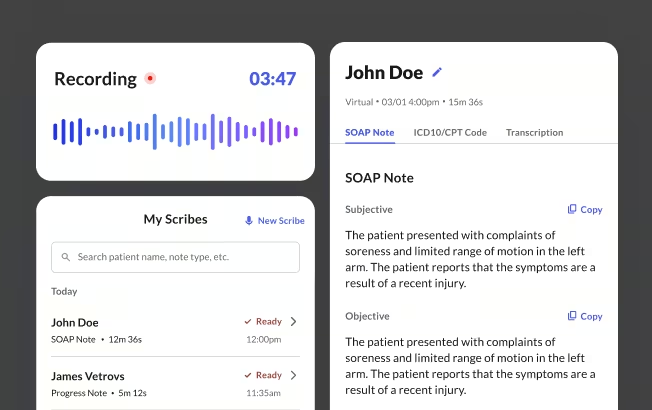
Within seconds of ending the recording, a structured SOAP note appears with suggested ICD-10 and CPT codes. The clinician reviews and edits the note, then carries the history and impression details into this form. Specialty templates and a custom template builder help match the note to the form's sections.
Commure Scribe is HIPAA compliant and SOC 2 certified, with onshore data storage. Before committing, review how AI medical scribes work and what to evaluate, then run a one-week trial on real evaluations.
Keep your focus on the ADHD interview
A full ADHD evaluation leaves a long interview to write up, and Commure Scribe can draft that note for your review. Start a 7-day trial, no credit card required, or see current Commure Scribe plans.
This article is for informational and educational purposes only, does not constitute legal, medical, or professional advice, and does not guarantee regulatory compliance or diagnostic accuracy.
ADHD Assessment for Adults Template Download
Download a copy of this template
Thanks! Your download, ADHD Assessment for Adults PDF, is ready
Click below
Thanks! Your ADHD Assessment for Adults DOCX download is ready
Click below

Frequently Asked Questions
A screener can flag possible ADHD, and a clinician makes the diagnosis. The clinician confirms symptoms, childhood onset, and impairment in more than one setting. Other causes, such as depression, anxiety, or substance use, still need review.
The ASRS v1.1 screener was tested against DSM-IV clinical interviews.⁷ It is free with a citation and the owner's copyright notice.⁴ The ASRS-5 was built for DSM-5 and needs a permission request.⁴
Yes, the six-question screener is free and needs no formal permission, according to its owner.⁴ The owner asks you to cite the 2005 paper on the scale and include the copyright notice when you use it.⁴
Part 2 applies to federally assisted programs that provide substance use disorder diagnosis, treatment, or referral.¹¹ Records your practice receives from such a program keep some Part 2 protections, such as limits on use in legal proceedings against the patient. Ask your compliance officer how to store and share them.
Yes, if you hold the right license or permission from the publisher. Record the scale name, version, score, and license status in the screening section of the ADHD assessment for adults PDF. Keep licensed test items out of the form itself.
Sources
- Staley BS, Robinson LR, Claussen AH, Katz SM, Danielson ML, Summers AD, Farr SL, Blumberg SJ, Tinker SC. "Attention-Deficit/Hyperactivity Disorder Diagnosis, Treatment, and Telehealth Use in Adults: National Center for Health Statistics Rapid Surveys System, United States, October–November 2023." MMWR Morbidity and Mortality Weekly Report, Centers for Disease Control and Prevention, 2024;73(40):890–895. https://www.cdc.gov/mmwr/volumes/73/wr/mm7340a1.htm (2024)
- National Academies of Sciences, Engineering, and Medicine. "ADHD Diagnosis and Treatment in the United States." In: Adult Attention-Deficit/Hyperactivity Disorder: Diagnosis, Treatment, and Implications for Drug Development: Proceedings of a Workshop. National Academies Press. https://www.ncbi.nlm.nih.gov/books/NBK606341/ (2024)
- American Psychiatric Association. "Attention Deficit/Hyperactivity Disorder" (DSM-5 Fact Sheet). https://www.psychiatry.org/File%20Library/Psychiatrists/Practice/DSM/APA_DSM-5-ADHD.pdf (2013)
- National Comorbidity Survey, Harvard Medical School. "Adult ADHD Self-Report Scales (ASRS)." https://www.hcp.med.harvard.edu/ncs/asrs.php (accessed September 2026)
- Kessler RC, Adler L, Ames M, Demler O, Faraone S, Hiripi E, Howes MJ, Jin R, Secnik K, Spencer T, Ustun TB, Walters EE. "The World Health Organization Adult ADHD Self-Report Scale (ASRS): a short screening scale for use in the general population." Psychological Medicine, 2005;35(2):245–256. https://pubmed.ncbi.nlm.nih.gov/15841682/ (2005)
- NYU Langone Health, Technology Opportunities & Ventures. "ASRS DSM-5." https://license.tov.med.nyu.edu/product/asrs-dsm-5 (accessed September 2026)
- Kessler RC, Adler LA, Gruber MJ, Sarawate CA, Spencer T, Van Brunt DL. "Validity of the World Health Organization Adult ADHD Self-Report Scale (ASRS) Screener in a representative sample of health plan members." International Journal of Methods in Psychiatric Research, 2007;16(2):52–65. https://pmc.ncbi.nlm.nih.gov/articles/PMC2044504 (2007)
- National Comorbidity Survey, Harvard Medical School. "ASRS v1.1 screener (6Q) Scoring update." https://www.hcp.med.harvard.edu/ncs/ftpdir/adhd/ASRS_v1.1_screener(6Q)_scoring_update.pdf (2024)
- "The World Health Organization Adult Attention-Deficit/Hyperactivity Disorder Self-Report Screening Scale for DSM-5." JAMA Psychiatry, 2017;74(5):520–527. https://pubmed.ncbi.nlm.nih.gov/28384801/ (2017)
- Centre for Addiction and Mental Health (CAMH). "Adult ADHD: Screening and Assessment." https://www.camh.ca/en/professionals/treating-conditions-and-disorders/adult-adhd/adult-adhd---screening-and-assessment (accessed September 2026)
- U.S. Department of Health and Human Services. "Understanding Confidentiality of Substance Use Disorder (SUD) Patient Records or 'Part 2'." https://www.hhs.gov/hipaa/part-2/index.html (accessed September 2026)
- U.S. Drug Enforcement Administration. "DEA Extends Telemedicine Flexibilities to Ensure Continued Access to Care." December 31, 2025. https://www.dea.gov/press-releases/2025/12/31/dea-extends-telemedicine-flexibilities-ensure-continued-access-care (2025)