



SOAP Note Example for Nurse Practitioners (Free Template)
Five outpatient NP visits in SOAP format, with MDM considerations and billing and signature checks.
Written by the Commure Scribe Team
Published: October 15, 2026
•
11 min read
What You Need to Know About SOAP Note Examples for Nurse Practitioners
- A SOAP note example for a nurse practitioner (NP) shows how to organize an illustrative visit into Subjective, Objective, Assessment and Plan sections.
- A 2024 meta-analysis reports a study of 333 advanced practice registered nurses in which too little charting time was associated with higher odds of burnout (odds ratio 3.72).¹
- Use the free template and five examples below to write notes that support your visit level and billing path.
Download the Nurse Practitioner SOAP Note Template
The template is an editable form with fields for your NP credential, billing path and supervising physician. It also covers time and addenda: download the NP SOAP note template (DOCX).
Fill in the bracketed fields and keep the signature and addendum sections in place. For DAP, BIRP and other formats, start from a progress note template.
What Goes Into a Nurse Practitioner SOAP Note?
An NP SOAP note has four sections, and an NP template can add a short header. The sections match those in standard SOAP notes. The header names the NP who performed the visit, your credentials and the billing path.
- Subjective: what the patient tells you, starting with the chief complaint in their own words.
- Objective: what you observe and measure, such as vitals, exam findings and results.
- Assessment: your differential and the diagnoses you are treating today.
- Plan: tests, treatment, patient education and follow-up.
Keep what the patient reports apart from what you observe and measure. One NP course puts the Objective rule plainly: "This section should not contain anything the patient has told you."² The Assessment can include "the differential diagnosis and a list of billable medical diagnoses that you're seeing the patient for today."²
These examples illustrate outpatient visits in family, adult, pediatric and psychiatric NP practice. Each one ends with the medical decision making (MDM) considerations for its visit level.
What Does a SOAP Note Example for a Nurse Practitioner Look Like?
A strong SOAP note example for a nurse practitioner shows the shape and logic of a visit. It has a focused history, a targeted exam, an assessment for each problem and a specific plan. The five examples below follow that pattern. Each one closes with the MDM elements that count toward its visit level, which point the way without settling the code.
Patient details are placeholders. Drug choices and doses are examples only, so check them against current guidelines. ICD-10 codes change every year, so use the current code set for the date of service.
Example 1: Hypertension follow-up with a medication change
- Subjective: A 58-year-old established patient returns for blood pressure follow-up. Home readings average 152/94 over two weeks. The patient takes lisinopril 20 mg daily and reports no missed doses. They deny chest pain, shortness of breath, headache and vision changes.
- Objective: BP 154/96, repeat 150/94. HR 76. BMI 31. Heart regular with no murmur. Lungs clear. No edema. Prior BMP on [date] within normal limits.
- Assessment: Essential hypertension, not at goal on current dose [ICD-10 code]. Obesity [ICD-10 code].
- Plan: Increase lisinopril to 40 mg daily. Repeat BMP in 2 weeks. Continue home log. Review sodium intake and DASH-style eating. Follow up in 4 weeks.
- MDM considerations: One chronic illness that is poorly controlled (not at goal) and prescription drug management. Together they can meet two of the three MDM elements at the moderate level.
- Time statement (required if you choose the level by time): "I personally spent [__] minutes on this patient's care on the date of the visit, including record review, exam, counseling and charting. This excludes clinical staff time and time on separately reported services."
Example 2: Uncomplicated cystitis
- Subjective: A 31-year-old woman reports 2 days of burning with urination, frequency and urgency. She denies fever, flank pain and vaginal discharge. No antibiotics in the past 3 months. Last menstrual period [date].
- Objective: Temp 98.4°F. BP 118/72. Mild suprapubic tenderness. No CVA tenderness. Urine dipstick positive for leukocyte esterase and nitrite. Urine pregnancy test negative.
- Assessment: Acute cystitis without hematuria [ICD-10 code].
- Plan: [Antibiotic, dose and duration per current guideline]. Increase fluids. Return for fever, flank pain or no better in 48 hours. Send a urine culture if symptoms persist.
- MDM considerations: One acute, uncomplicated problem and two unique tests reviewed. The prescription counts toward the risk element and does not raise the level on its own.
Example 3: Type 2 diabetes above goal
- Subjective: A 62-year-old established patient returns to review labs. They take metformin 1,000 mg twice daily with no GI upset. No low blood sugar episodes. They have cut back on sweet drinks.
- Objective: BP 128/78. BMI 33. Monofilament sensation intact in both feet. Pedal pulses 2+. A1c 8.4% on [date]. eGFR [value] on [date].
- Assessment: Type 2 diabetes with hyperglycemia, not at goal [ICD-10 code].
- Plan: Add a second agent chosen with the patient: [drug and dose]. Refer for a diabetic eye exam. Recheck A1c in 3 months. Follow up in 3 months.
- MDM considerations: One chronic illness not at goal and prescription drug management for the new agent. The A1c and eGFR count as data at this visit only if they were not already counted when ordered.³
Example 4: Child with an ear infection
- Subjective: A 3-year-old has had right ear pain for about [__] hours, rated [mild, moderate or severe] by the parent, and a home temp of 102.1°F. A parent gives the history because the child can't give a reliable one. The parent reports a runny nose for 4 days. No amoxicillin in the past 30 days. No drug allergies.
- Objective: Weight [__] kg. Temp 101.4°F. Right TM bulging and red with poor mobility. Left TM normal. No purulent conjunctivitis. Lungs clear.
- Assessment: Acute otitis media, right ear [ICD-10 code].
- Plan: Amoxicillin [weight-based dose and duration]. Acetaminophen or ibuprofen for pain, dosed by weight. Return if not better in 48 to 72 hours.
- MDM considerations: One acute, uncomplicated illness, an assessment requiring an independent historian and prescription drug management. Under AMA rules, fever in a minor illness does not on its own make it an acute illness with systemic symptoms.³
Example 5: Psychiatric NP medication follow-up
- Subjective: A 34-year-old returns 6 weeks after starting sertraline 50 mg for depression and anxiety. Mood is "a little better." Sleep has improved. Worry is still present most days. Mild nausea in week one has resolved. Denies suicidal and homicidal ideation. Patient-completed PHQ-9 [score] (prior [score]) and GAD-7 [score] (prior [score]).
- Objective: Alert and cooperative. Affect mildly anxious. Thought process linear. Insight and judgment intact.
- Assessment: Major depressive disorder, single episode, moderate, improving [ICD-10 code]. Generalized anxiety disorder, partly controlled [ICD-10 code].
- Plan: Increase sertraline to 100 mg daily. Continue weekly therapy. Crisis line information given. Follow up in 4 weeks.
- MDM considerations: Two chronic problems, one improving and one not at goal, and prescription drug management for the dose change. AMA doesn't count a test as MDM data when you bill your own reading of it separately.³ Check how your payer treats screeners you bill on their own.
Use the same signature block with each example. It shows your name, credentials and signing time: "[NP Name], [credentials, such as FNP-C], electronically signed [date and time]."
How Is a Practicing NP's SOAP Note Different From a Student Note?
A practicing NP writes a focused note that supports the visit level and the billing path. Student notes can run longer because they show your reasoning to a preceptor.
Practice notes can be shorter because CMS asks for a history and exam that are "medically appropriate."⁴ CMS also states, "You don't use the volume of documentation to decide the specific level of service to bill."⁴
The shift shows up in three places:
- History: Record what matters for today's problems, starting with the history of present illness.
- Exam: Examine the systems tied to the complaint and chronic problems, using a focused physical examination format.
- Assessment and plan: Write one entry per problem, with its status and next step.
How Should an NP Note Support the Visit Level?
For office and outpatient visits, an NP note supports the visit level through either MDM or total time. CMS lets you "choose the visit level based on the level of MDM or the amount of time you spend with the patient."⁴ Document the care you gave. Then choose the evaluation and management (E/M) level that the note's MDM or total time supports.
- If you level by MDM: Let the assessment and plan carry the weight. MDM has three elements: the problems addressed, the data reviewed and analyzed, and the risk of patient management. Under AMA guidelines, a level needs "two of the three elements for that level of MDM" met or exceeded.³ A prescription change alone does not set it. For the detailed elements, CMS directs you to "review the AMA's E/M Services Guidelines for a detailed breakdown of the elements of MDM."⁴
- If you level by time: Record the total minutes you personally spent on the patient's care on the date of the visit, leaving out clinical staff time and separately reported services.³ List what filled those minutes, such as record review, the exam, counseling and charting.
- Either way: The note has to back up the code. CMS puts it simply: "The medical record documentation supports the level of service you report to a payer."⁴
CMS also sets a timing expectation: "Document services during the encounter or as soon as possible after the encounter to keep the medical record accurate."⁴
What Changes When an NP Bills Under Their Own NPI or Incident-To?
Your billing path changes what the note has to show. Medicare payment to an NP who bills under their own national provider identifier (NPI) can't exceed 85% of the physician fee schedule amount.⁵
Incident-to billing asks more of the note. When a physician supervises and every incident-to condition is met, the physician bills the visit.⁶ Payment is then based on 100% of the physician fee schedule.⁶ Incident-to services that an NP or other listed practitioner supervises are paid at 85%.⁶ Document three facts tied to CMS's incident-to rules. They are not a full checklist:
- Direct supervision: Name the supervising physician. That physician must be in the office suite, or present by real-time audio and video, and immediately available to give assistance and direction.⁷ Audio-only contact does not count, and services with a 010 or 090 global surgery indicator are excluded from virtual supervision.⁸
- Initial service: Point to the visit where the physician personally performed the initial service for this course of treatment.⁶ A new problem that only you have seen does not meet this condition.
- Ongoing role: Show that the physician who set the plan is still actively involved in the course of treatment.⁶ The supervising physician who bills need not be the physician treating the patient more broadly.⁸
CMS sets more conditions.⁶ The service must be furnished outside a hospital or skilled nursing facility, to a noninstitutional patient.⁸ CMS also requires the service to be an integral part of the patient's normal treatment and commonly provided in the physician's office or clinic.⁶ The service has to be commonly provided without charge or included in the physician's bill.⁶ It must also be an expense to the physician and comply with state law.⁶ Confirm that each service qualifies before you bill it incident-to. Behavioral health services that auxiliary personnel provide incident-to can be done under general supervision.⁶ Auxiliary personnel can include an NP acting under a physician's supervision.⁶ The other conditions still apply.
State law adds a second layer. According to the American Association of Nurse Practitioners (AANP), states fall into full, reduced and restricted practice.⁹ Reduced practice states require a career-long collaborative agreement with another provider, or they limit the setting of at least one part of NP practice.⁹ Restricted practice states need supervision, delegation or team management by another provider for that same span.⁹
Rules vary by state and by payer. If your state requires collaboration or supervision, ask your state board of nursing what the note needs to show.
What Signature and Copy-Forward Mistakes Make an NP Note Harder to Defend?
A payer review looks at who signed the note and whether its text fits the visit. Medicare is direct about the signature: "If the entries don't meet the signature requirements, we may deny the associated claims."¹⁰ Run these five checks before you sign.
- A stamped signature: CMS states, "We don't usually accept stamped signatures."¹⁰ Sign by hand or with a protected electronic signature.
- A missing signature fixed the wrong way: Only the note's author can sign an attestation for an unsigned entry. CMS doesn't accept attestations for orders that require a signature, and an attestation can't backdate a plan of care.¹⁰
- Credentials: CMS encourages credentials in signature logs and says reviewers won't deny a claim because the log lacks them.¹⁰ Adding them shows who performed the visit at a glance.
- Copied text that no longer fits: A 2014 federal review found that EHR features "may be used to mask true authorship of the medical record."¹¹ Check any carried-forward exam or history against today's visit.
- An undated addendum: Clearly mark an addendum, correction or late entry. Date it the day you write it and name its author. Keep the original text in place instead of overwriting it.¹²
The same signature rule applies when an AI scribe drafts the note. CMS guidance tells clinicians who use a scribe, "including artificial intelligence technology," to sign the entry themselves.¹⁰
How Does Commure Scribe Draft a Nurse Practitioner SOAP Note?
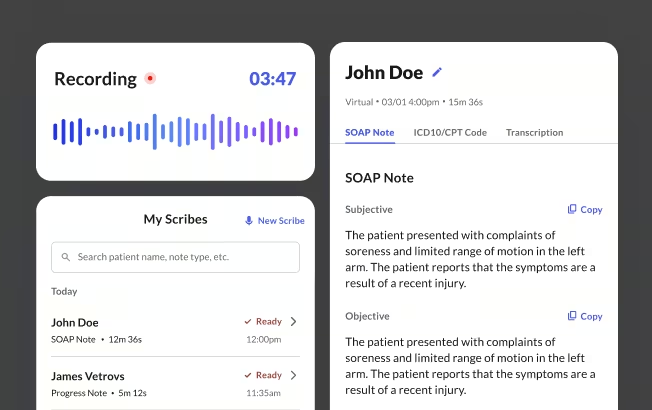
The SOAP note can be drafted from the visit itself by Commure Scribe. It works as an AI medical scribe, so you can stay present in the room instead of typing. The draft is ready to review before you leave rather than written after hours. The note captures the full clinical context of the encounter.
Within seconds of ending the recording, a structured SOAP note appears with suggested ICD-10 and CPT codes. You review and edit the draft, and you always have the choice to finalize it before it enters the chart. The NP header fields from this template can live in a custom template you build once and reuse. These include credentials, billing path and supervising physician.
Independent practices and small groups copy and paste the note into the EHR through a Chrome extension overlay. Larger groups can get EHR integrations by contacting Commure's sales team. Commure Scribe works across a wide range of specialties, including family medicine, internal medicine, pediatrics and psychiatry, among others.
Close the visit with the note drafted
If you'd rather not write each NP SOAP note by hand, Commure Scribe drafts it from the visit for you to review and sign. You can start with a 7-day trial and compare Commure Scribe pricing.
This article and template are for informational and educational purposes only, do not constitute legal, medical, or professional advice, and do not guarantee payment, coding accuracy or regulatory compliance. Have your compliance officer review the template before clinical use.
Nurse Practitioner SOAP Note Template Download
Download a copy of this template
Thanks! Your nurse practitioner SOAP note template is ready.
Click below to download.

Frequently Asked Questions
The four parts are Subjective, Objective, Assessment and Plan. Subjective holds what the patient reports, and Objective holds what you observe and measure. Assessment lists the diagnoses you are treating, and Plan lists next steps. An NP template can add a header with your credentials and billing path.
Watch for a stamped signature, which Medicare does not usually accept. Also watch for copied history or exam text that no longer fits the visit, and for addenda without a date or author. Keep what the patient tells you in Subjective, apart from what you saw and measured.
Not automatically. According to AANP, reduced practice states require a career-long collaborative agreement or limit the setting of NP practice. Restricted practice states require supervision, delegation or team management. Neither is a co-sign rule. Medicare's incident-to rules cover supervision and the physician's ongoing role, not a co-sign. A co-sign rule can come from state law, payer policy or your employer.
Yes. The DOCX version is editable, so you can add fields such as weight for pediatric visits or screener scores for psychiatric visits. You can also copy the section headings into your EHR's template builder. Keep the patient identifiers, date of service, signature block and addendum section in every version.
A nurse practitioner SOAP note should be as long as the visit needs and no longer. CMS asks for a history and exam that are medically appropriate, and it does not use note length to set the visit level. Write an assessment and plan entry for each problem you addressed, plus anything else the visit needs.
Sources
- Wu Y, Wu M, Wang C, Lin J, Liu J, Liu S. Evaluating the Prevalence of Burnout Among Health Care Professionals Related to Electronic Health Record Use: Systematic Review and Meta-Analysis. JMIR Medical Informatics. 2024. https://medinform.jmir.org/2024/1/e54811
- Bradley University. SOAP Notes (NUR676 course transcript). https://ldt.bradley.edu/ldt/onlinecourse/NUR/NUR676/Transcripts/SOAP_Notes.html
- American Medical Association. CPT Evaluation and Management (E/M) Services Guidelines. 2023. https://www.ama-assn.org/system/files/2023-e-m-descriptors-guidelines.pdf
- Centers for Medicare & Medicaid Services, Medicare Learning Network. Evaluation and Management Services (MLN006764). 2026. https://www.cms.gov/files/document/mln006764-evaluation-management-services.pdf
- Electronic Code of Federal Regulations. 42 CFR 414.56, Payment for nurse practitioners' and clinical nurse specialists' services. 2026. https://www.ecfr.gov/current/title-42/chapter-IV/subchapter-B/part-414/subpart-B/section-414.56
- Centers for Medicare & Medicaid Services. Incident To Services & Supplies. 2026. https://www.cms.gov/medicare/payment/fee-schedules/physician-fee-schedule/advanced-practice-non-physician-practitioners/incident-services-supplies
- Electronic Code of Federal Regulations. 42 CFR 410.32, Diagnostic x-ray tests, diagnostic laboratory tests, and other diagnostic tests: Conditions. 2026. https://www.ecfr.gov/current/title-42/chapter-IV/subchapter-B/part-410/subpart-B/section-410.32
- Electronic Code of Federal Regulations. 42 CFR 410.26, Limitations on coverage of certain services furnished incident to a physician's professional service. 2026. https://www.ecfr.gov/current/title-42/chapter-IV/subchapter-B/part-410/subpart-B/section-410.26
- American Association of Nurse Practitioners. State Practice Environment. 2026. https://www.aanp.org/advocacy/state/state-practice-environment
- Centers for Medicare & Medicaid Services, Medicare Learning Network. Complying with Medicare Signature Requirements (MLN905364). 2025. https://www.cms.gov/files/document/mln905364-complying-medicare-signature-requirements.pdf
- U.S. Department of Health and Human Services, Office of Inspector General. CMS and Its Contractors Have Adopted Few Program Integrity Practices To Address Vulnerabilities in EHRs (OEI-01-11-00571). 2014. https://oig.hhs.gov/reports/all/2014/cms-and-its-contractors-have-adopted-few-program-integrity-practices-to-address-vulnerabilities-in-ehrs/
- Centers for Medicare & Medicaid Services. Medicare Program Integrity Manual, Chapter 3, section 3.3.2.5: Amendments, Corrections and Delayed Entries in Medical Documentation. 2026. https://www.cms.gov/regulations-and-guidance/guidance/manuals/downloads/pim83c03.pdf