



AI Scribe for Behavioral Health: 7 Tools Scored for 2026
Seven AI scribes scored for therapists, psychiatric prescribers and group practices on note formats, where the note lands and what happens to session audio.
Written by the Commure Scribe Team
Published: October 2, 2026
•
18 min read
Updated October 2, 2026
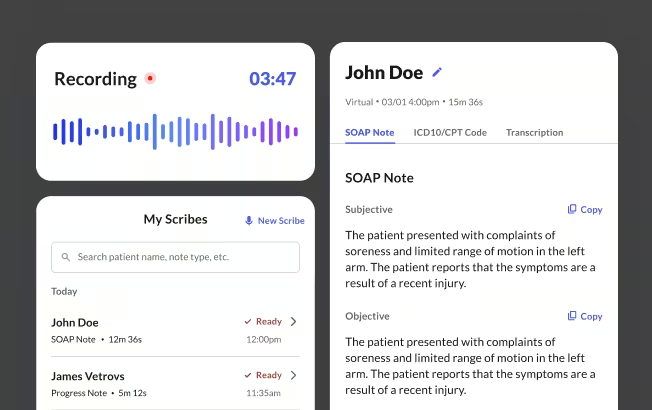
Mentalyc is the best AI scribe for behavioral health, with every common format and supervision notes. Upheal ties it, adding per-session pricing and a free plan. JotPsych is third for add-on code suggestions.
Commure publishes this page and sells Commure Scribe. It is scored on the same criteria and weights as the other six entries, and the result is published either way.
What You Need to Know About an AI Scribe for Behavioral Health
- An AI scribe for behavioral health drafts data, assessment and plan (DAP), behavior, intervention, response and plan (BIRP) or SOAP notes while you stay with the client.
- Mentalyc and Upheal tie for first at 7.05 and 6.95 of 10, ahead of JotPsych at 6.25.
- Check what happens to session audio first, since retention ranges from minutes to six years or more.
What Is the Best AI Scribe for Behavioral Health?
The best AI scribe for behavioral health lets you keep your eyes on the client and still leave with a finished progress note. Each behavioral health AI scribe below is scored on the same eight criteria, with a cited source behind every score.
The Health Resources and Services Administration (HRSA) projects a 2038 shortage of 99,780 mental health counselors and 43,810 psychiatrists.¹ Behavioral health notes also carry mental status findings, risk language and a format your payer expects.
The ranking covers each AI scribe for therapists that a solo clinician or group practice can buy on its own. Eleos Health, which sells to community agencies, is described separately. For scribes across all specialties, see the ranking of the best AI medical scribes.
Which Behavioral Health AI Scribe Fits Your Practice?
Mentalyc fits therapy practices that want every format, a mental status exam (MSE) and supervision notes, and Upheal fits solo therapists who pay per session. JotPsych suits psychiatric prescribers who bill add-on codes. Find your situation in the first column.
The comparison table shows what each behavioral health AI scribe costs and how it handles the note and the audio. Prices for each AI scribe for therapists are the vendor's published figures.
The scorecard ranks all seven on the weighted total. Tied entries share a rank, shown as T-1 for a tie at first. A dagger (†) marks a cell based on company confirmation rather than a public page.
The total counts a not-assessable cell (n/a) as zero. The renormalized total leaves those cells out and rescales the rest. On that basis Blueprint (5.81) joins the tie for fourth, and Freed rises to 5.67. The top three stay the same.
Which Behavioral Health AI Scribes Should You Shortlist?
Seven behavioral health AI scribes are ranked here. Mentalyc and Upheal tie for first, JotPsych is third, Twofold ties for fourth, and Blueprint and Freed tie for sixth. Each profile covers what the tool costs, what it changes in your sessions and the one thing to test before you commit.
Mentalyc
Best for: therapy practices and groups that want every common format, a mental status exam and a note for each group member.
Rank: Tied for 1st
Mentalyc drafts SOAP, DAP, BIRP, goals, intervention, response and plan (GIRP), PIE, SIRP and intake notes, plus treatment plans.² Its mental status exam "covers appearance, behavior, mood, affect, thought process, cognition, insight, and judgment." You can run it as a standalone assessment or as a section inside a progress note.
For group therapy, Mentalyc writes a note for the session and a progress note for every participant.² Supervision notes come with Pro and above. Supervisees get free access to supervision sessions.³ A browser extension pushes each note into SimplePractice, TherapyNotes, Jane App or TheraNest without copy and paste.⁴
Solo plans are priced by monthly note volume:³
- Mini at $19.99 a month, or $14.99 billed annually, for 40 notes
- Basic at $39.99, or $29.99 billed annually, for 100 notes
- Pro at $69.99, or $59.99 billed annually, for 160 notes
- Super at $119.99, or $99.99 billed annually, for 330 notes with group notes
Groups can move to the Team plan, priced per seat with unlimited notes. The 14-day trial gives full Pro access for 15 notes, with no credit card.³ Recordings are deleted once the note is generated, and session data never trains AI models.⁵ Mentalyc lists "auto-computed CPT codes" without naming psychotherapy codes, so run a 90837 session through it during the trial.³
Upheal
Best for: solo therapists who want to pay per session, keep a free plan to fall back on and control how long transcripts stay.
Rank: Tied for 1st
Upheal charges $1 per session, billed monthly by usage with no minimum spend.⁶ Its homepage caps that charge at $69 a month, though the pricing page does not repeat the cap.⁷ The trial runs 30 days with full access and no card, and you can stay on the free plan afterward. Upheal's group-practice page applies the same per-session price to each provider, while enterprise plans are quoted.⁸
The note library covers SOAP, DAP, BIRP, GIRP, PIRP, SIRP, PIE and eye movement desensitization and reprocessing (EMDR) notes.⁹ Its mental status exam template covers nine domains, from appearance and speech to insight and judgment.¹⁰ A browser extension called Smart Fill enters notes into SimplePractice, TherapyNotes, Owl Practice, Jane App and Healthie.¹¹ For group sessions, Upheal "writes notes for each member present."¹²
You set how long session data stays. Audio is deleted by default once notes are generated, and transcripts can be deleted by hand or on a timer.¹³ Session data trains Upheal's AI only when both you and your client opt in. The company says it has completed a System and Organization Controls (SOC) 2 Type II audit. It also reports security testing in a public trust center.¹⁴ Notes carry ICD-10 codes but no documented CPT or psychotherapy code suggestions, so plan to code sessions yourself.¹⁵
JotPsych
Best for: psychiatrists and psychiatric nurse practitioners who bill E/M visits with psychotherapy add-ons.
Rank: 3
JotPsych is built around the prescriber's visit, with more than 60 behavioral health templates, including psychiatric intake, follow-up, medication management and EMDR.¹⁶ The homepage example pairs an E/M code with the 90833 psychotherapy add-on, and JotPsych says it checks codes "against 150+ payer rules."¹⁷ When documentation supports a higher code, it flags that too.¹⁶
Plans are published:¹⁸
- Moonlighting at $53 a month for 15 notes
- Basic at $135 a month with unlimited notes
- Everything at $269 a month
Groups of seven or more clinicians get 10% off, and the free trial needs no credit card. Its JotTransfer browser extension moves notes section by section into SimplePractice, TherapyNotes, Practice Fusion, DrChrono and Jane.¹⁹ Audio is "permanently and irreversibly deleted the moment the transcript is completed and verified," and you can set auto-deletion windows for notes.²⁰ JotPsych documents no per-member group notes, so group therapists should test that workflow first.
Commure Scribe
Best for: practices that mix behavioral health with other specialties, or medium and large groups that want one-click sync on a quoted plan.
Rank: Tied for 4th
Commure Scribe records sessions on any device, in person or by telehealth, and recognizes multiple speakers. Its therapy setup is described on the specialty page for AI scribe for behavioral health. Behavioral health templates and a custom template builder come with it, and the AI learns your phrasing over time. Within seconds of the recording ending, a structured note appears with suggested ICD-10 and CPT codes in a separate tab. You review and finalize the note before it enters the chart.
How much pasting you do depends on practice size. A practice of one to five providers pastes each note through a Chrome extension overlay. Quoted plans for medium and large groups add one-click sync, advanced integrations and admin controls. The named EHR list includes SimplePractice, plus Kipu.
Commure Scribe keeps audio longer than most tools here: one year active by default, then an archive of at least six years. The audio is encrypted and used only to generate the note, never for AI training. You can permanently delete transcripts and notes at any time.
The 7-day trial needs no credit card. Test the templates against your DAP or BIRP structure, and check the retention schedule against your consent form.
Twofold
Best for: solo therapists who want psychotherapy CPT codes named and one flat monthly price.
Rank: Tied for 4th
Twofold costs $69 a month, or $49 a month billed annually, with unlimited notes.²¹ You can try it for 7 days without a credit card, and an introductory offer cuts the first month to $19. Its behavioral health page names the CPT codes therapists bill: 90791, 90832, 90834, 90837, 90846, 90847 and 90853.²² Notes come in DAP, SOAP, BIRP, GIRP and PIRP, with a mental status exam for intake.
Every note reaches your EHR by copy and paste.²³ Session recordings "are never stored on our servers," according to Twofold's security page.²⁴ The same page lists a SOC 2 Type II audit as "currently undergoing." The homepage mentions an opt-in retention setting, so check your account settings. If you see clients with substance use disorders, ask what sits behind the "42 CFR Part 2 compatible" label on the behavioral health page.²²
Blueprint
Best for: therapists who want per-session pricing and the option to move onto an all-in-one EHR later.
Rank: Tied for 6th
Blueprint works alongside your EHR for $0.99 per session, or $69 per seat for unlimited sessions, with no subscription or contract.²⁵ Its all-in-one EHR costs $1.49 per session. You start the alongside option with five free sessions, and the all-in-one EHR comes with a 30-day free trial. The note list is wide, from SOAP, DAP, BIRP and GIRP to couples and psychiatric evaluation notes.²⁶
Blueprint's browser extension lets you copy the full note or each section into your EHR.²⁷ "No recordings, copies, or backups are retained," and client data never trains AI models.²⁸ It supports group, family and couples sessions. Per-member group notes and code suggestions are not documented, so check both if you bill group therapy.
Freed
Best for: clinicians who want one general scribe that pushes into SimplePractice or TherapyNotes and also handles medical visits.
Rank: Tied for 6th
Freed pushes notes into SimplePractice and TherapyNotes through its Chrome extension.²⁹ Unlimited push comes only with Premier and Groups, while Starter and Core get five transfers in total. Plans are published:³⁰
- Starter at $39 a month for 40 notes
- Core at $79 a month with unlimited notes
- Premier at $119 a month, or $1,248 a year, with EHR push and ICD-10 and CPT codes
The 7-day trial needs no billing information. Freed is a general medical scribe rather than a behavioral health scribe, though it says it generates DAP notes.³¹ Its template library lists psychiatry and behavioral health templates but no BIRP or mental status exam template, so plan to build your own.³² Audio is deleted after the note. Notes stay until you delete them unless you turn on 30-day auto-delete. Freed trains its AI on de-identified notes, so mention that in your consent form.³³
Eleos Health: sold to organizations (not ranked)
Eleos Health sells to community behavioral health, substance use and other community care organizations by demo.³⁴ No price or self-serve trial is published. A solo therapist or small group has no way to buy it, so it is described here rather than ranked.
Eleos runs as a browser extension over agency EHRs, including Credible, SmartCare, myEvolv, CareLogic and Kipu.³⁵ For group sessions it writes one group note and a summary for each member.³⁶ Audio is deleted within one to two minutes. Eleos keeps AI suggestions and usage data "for refining models."³⁵
Eleos is the only behavioral health AI scribe here with a randomized trial of its own platform. In that 2023 study of 47 adults at one community clinic, the authors included Eleos employees.³⁷
What Should a Behavioral Health AI Scribe Document?
A behavioral health note carries a mental status exam, precise risk language and a format built for therapy billing. An AI scribe for behavioral health hears what the client says, which covers mood statements, speech and thought content. It cannot see affect, psychomotor changes or grooming, so you still dictate or enter those observed findings. Which domains to cover is laid out in the mental status exam template.
Risk language needs the closest review. Suicidal and homicidal ideation, intent, plan, means and protective factors should appear in exact terms. A 2026 study of 20,302 primary care notes found AI-scribed notes documented more psychiatric symptoms but less psychiatric management.³⁸ Read the assessment and plan sections of every draft before you sign.
The progress note an AI drafts is part of the medical record. Under HIPAA, "psychotherapy notes" are a mental health professional's notes on the session conversation that are "separated from the rest of the individual's medical record."³⁹ They exclude symptoms, progress and treatment plans. A DAP or BIRP note filed in the chart does not get that extra protection. The format itself is covered in the guide to BIRP notes.
Keep process notes you want protected separate from the behavioral health scribe's draft. The difference is explained in the psychotherapy notes template.
What Privacy and Consent Rules Apply to Behavioral Health AI Scribes?
HIPAA, the Part 2 rule on substance use disorder records, state AI laws and recording-consent laws shape how you use an AI scribe for behavioral health. The last three add duties on top of HIPAA for substance use records, AI use and recording.
- HIPAA and the business associate agreement (BAA). If your practice is a HIPAA covered entity, a scribe vendor that handles client information is your business associate and needs a BAA.⁴⁰ Get the vendor's BAA before the first recorded session.
- 42 CFR Part 2. This Code of Federal Regulations (CFR) rule protects substance use disorder (SUD) records. Federally assisted SUD programs, and practices that receive their records, had to comply with the 2024 final rule by February 16, 2026.⁴¹ It allows a single client consent for treatment, payment and operations. SUD counseling notes need their own consent.⁴²
- State AI laws. Illinois lets licensed professionals use AI for records and therapy notes. When a session is recorded or transcribed, the client must be told in writing and consent.⁴³ Nevada allows AI for managing session notes and requires the provider to review what it produces.⁴⁴
- Recording consent. California and several other states require consent from all parties to a confidential conversation.⁴⁵ Get written consent that names the AI tool and its purpose before the first recorded session.
The U.S. Department of Health and Human Services (HHS) proposed updates to the HIPAA Security Rule in a rule published January 6, 2025. The proposal includes required encryption and multi-factor authentication. The current rule stays in effect while that proposal is pending.⁴⁶ Ask any vendor for its BAA and retention policy in writing. What a BAA should say is covered in the guide to HIPAA-compliant AI note-taking.
What Does Research Say About AI Scribes in Behavioral Health?
Three studies found lower burnout, about 16 fewer documentation minutes per 8 patient hours, and less psychiatric management in AI-scribed notes. All three come from primary care or mixed specialties rather than behavioral health practices alone.
The burnout study compared the same clinicians before and after, so other causes can't be ruled out. In the multisite study, gains were largest among clinicians who used a scribe in at least half their visits.⁴⁸ A mental health AI scribe returns time only on the sessions where you turn it on. How to build review into each session is covered in the guide to AI therapy notes.
How Were These Behavioral Health AI Scribes Scored?
Each behavioral health AI scribe was scored 0 to 10, in half-point steps, on eight criteria weighted for a therapy or psychiatry practice. Scores come from vendor pages and peer-reviewed research. Three marked cells come from company confirmation instead.
Retention rewards less storage, because a stored session transcript can be requested in legal discovery. The same rules apply to all seven entries. A feature behind a plan a practice can't reach earns nothing, and a missing fact makes a cell not assessable (n/a). Vendor-reported figures, such as time saved, score zero.
A 10 means an outside top standard, such as a peer-reviewed study of the product. An 8 means documented with one gap, and 6 to 7 means documented with real limits. Partial documentation earns 4 to 5, a feature named only earns 2 to 3, and 0 means absent. Totals within 0.20 of the highest total in a group share a rank.
Where does Commure Scribe land?
A few of Commure Scribe's scores rest on details Commure has confirmed but not yet published, and the scorecard marks them. Each of those scores is higher than the published pages alone support. The documented-only total rescores them on published pages, at 5.0 for formats, 2.0 for group notes and 4.0 for coding.
Commure publishes this page and sells Commure Scribe. It is scored on the same criteria and weights, and the result is published either way. On the main total, Commure Scribe ties Twofold for fourth at 5.80, 1.25 behind Mentalyc. Retention and group notes account for most of that gap, at 0.60 and 0.45. JotPsych, Mentalyc and Upheal delete audio after the note. Commure Scribe keeps it for a year by default and then archives it for at least six years.
Mentalyc and Upheal both publish a mental status exam template, which Commure Scribe does not publish. Both also name more therapy EHRs for their browser extensions, and supervision notes are documented by Mentalyc.
More Behavioral Health Documentation Guides
These guides cover the formats, EHRs and reviews that come up when choosing a behavioral health scribe.
- Psychiatric note structure, risk documentation and psychotherapy coding are compared in the guide to choosing an AI scribe for psychiatry.
- Pricing, formats and HIPAA handling are covered in the review of Mentalyc.
- SimplePractice's built-in scribe and standalone alternatives are compared in the guide to the SimplePractice AI scribe.
- Data, assessment and plan structure, with examples, is laid out in the guide to DAP notes.
- Goal-focused group and individual note structure is covered in the guide to GIRP notes.
- EHRs built for therapy practices are compared in the guide to the best EHR for mental health.
- Billing and compliance features are compared in the guide to choosing an EHR for behavioral health.
- How notes move from a scribe into a therapy EHR is covered in the guide to EHR integrations.
- How ambient scribes draft a note and what the clinician reviews is covered in the explainer on the AI medical scribe.
Test it on a group session first
Commure Scribe is one of the seven tools scored above. A group or family session is a fair test for any behavioral health scribe, because it shows how the draft handles several voices. The 7-day trial needs no credit card, and practice plans are listed under Commure Scribe pricing.
Vendor details on this page were checked against each vendor's own pages on September 30, 2026. Prices and features change, so confirm current terms with each vendor before you buy.
This article is for informational and educational purposes only, does not constitute legal, medical, or professional advice, and does not guarantee compliance with HIPAA, 42 CFR Part 2 or any state law.
Frequently Asked Questions
Commure Scribe ties Twofold for fourth on this page, behind Mentalyc and Upheal, which tie for first at 7.05 and 6.95. Per-member group notes and the widest format list set Mentalyc apart, while Upheal has per-session pricing and a free plan. JotPsych, third, suits psychiatric prescribers who bill psychotherapy add-ons. Commure Scribe fits practices that mix behavioral health with other specialties.
Yes, and four of the ranked tools publish all three formats. Commure Scribe ships behavioral health templates and a custom template builder. Mentalyc, Upheal, Blueprint and Twofold each publish DAP, SOAP and BIRP among their formats. Freed says it generates DAP notes but names no BIRP template, and relies on templates you build. Test your own format on real sessions during the trial.
In practice, yes. Illinois requires written notice and client consent when AI is used on a recorded or transcribed session. California requires all-party consent to record a confidential conversation. JotPsych and Mentalyc supply consent templates. Get written consent that names the tool and its purpose before the first recorded session.
Commure Scribe is HIPAA compliant and SOC 2 certified, with data stored onshore, and the other vendors here describe themselves as HIPAA compliant. Mentalyc, Blueprint and Upheal say they hold SOC 2 Type II, while Twofold's audit is still in progress. Ask each vendor for a signed business associate agreement, and compare audio policies before you choose.
Commure Scribe publishes its plan for one to five providers and quotes group plans. Upheal and Blueprint charge about $1 per session, and Upheal caps it at $69 a month. Mentalyc runs $19.99 to $119.99 a month by note volume, Twofold $49 to $69, and JotPsych $53 to $269. Eleos publishes no price.
Sources
- Health Resources and Services Administration, Bureau of Health Workforce. "Behavioral Health Workforce Projections." https://bhw.hrsa.gov/data-research/projecting-health-workforce-supply-demand/behavioral-health 2025.
- Mentalyc. "AI Note Taker." https://www.mentalyc.com/ai-note-taker 2026.
- Mentalyc. "Pricing." https://www.mentalyc.com/pricing 2026.
- Mentalyc. "EHR Integration." https://www.mentalyc.com/ehr-integration 2026.
- Mentalyc. "Security." https://www.mentalyc.com/security 2026.
- Upheal. "Pricing." https://www.upheal.io/pricing 2026.
- Upheal. Homepage. https://www.upheal.io/ 2026.
- Upheal. "Group Practices." https://www.upheal.io/who-we-serve/group-practices 2026.
- Upheal. "AI Clinical Notes." https://www.upheal.io/ai-clinical-notes 2026.
- Upheal. "AI Mental Status Exam." https://www.upheal.io/ai-clinical-notes/ai-mental-status-exam 2026.
- Upheal. Upheal browser extension, Chrome Web Store listing. https://chromewebstore.google.com/detail/upheal/bdmobenofdjpipjmkjckldjipjhmmpgh 2026.
- Upheal. "Group Therapy Notes." https://www.upheal.io/blog/group-therapy-notes 2026.
- Upheal. "AI Scribe Data Retention." https://www.upheal.io/blog/ai-scribe-data-retention 2026.
- Upheal. "Privacy and Compliance." https://www.upheal.io/privacy-and-compliance 2026.
- Upheal. "Upheal vs Freed." https://www.upheal.io/comparisons/upheal-vs-freed 2026.
- JotPsych. "Features." https://jotpsych.com/features 2026.
- JotPsych. Homepage. https://jotpsych.com/ 2026.
- JotPsych. "Pricing." https://jotpsych.com/pricing 2026.
- JotPsych. JotTransfer, Chrome Web Store listing. https://chromewebstore.google.com/detail/jottransfer/jooogmdiklogejmlncnknjembkilajdb 2026.
- JotPsych. "Security." https://jotpsych.com/security 2026.
- Twofold Health. "Pricing." https://www.trytwofold.com/pricing 2026.
- Twofold Health. "AI Scribe for Behavioral Health." https://www.trytwofold.com/specialties/behavioral-health 2026.
- Twofold Health. Homepage. https://www.trytwofold.com/ 2026.
- Twofold Health. "Security." https://www.trytwofold.com/security 2026.
- Blueprint. "Pricing." https://www.blueprint.ai/pricing 2026.
- Blueprint. "AI Documentation." https://www.blueprint.ai/documentation 2026.
- Blueprint. Blueprint AI Notetaker, Chrome Web Store listing. https://chromewebstore.google.com/detail/blueprint-ai-notetaker/fmjbhmhmfanpmdhpjjemafjlgomdccnm 2026.
- Blueprint. "Privacy and Security." https://www.blueprint.ai/privacy-security 2026.
- Freed. "EHR Push." Freed Help Center. https://help.getfreed.ai/en/articles/11328264-ehr-push 2026.
- Freed. "Freed Pricing, Discounts and Referral Program." Freed Help Center. https://help.getfreed.ai/en/articles/9242518-freed-pricing-discounts-and-referral-program 2026.
- Freed. "DAP Notes." https://www.getfreed.ai/resources/dap-notes 2026.
- Freed. "Freed Template Library." https://www.getfreed.ai/blog/freed-template-library 2026.
- Freed. "Security." https://www.getfreed.ai/security 2026.
- Eleos Health. Homepage. https://eleos.health/ 2026.
- Eleos Health. "AI Frequently Asked Questions." https://eleos.health/ai-frequently-asked-questions/ 2026.
- Eleos Health. "Group Therapy." https://eleos.health/group-therapy/ 2026.
- Sadeh-Sharvit S, et al. "Effects of an Artificial Intelligence Platform for Behavioral Interventions on Depression and Anxiety Symptoms: Randomized Clinical Trial." Journal of Medical Internet Research. https://www.jmir.org/2023/1/e46781 2023.
- Castro VM, McCoy TH, Verhaak P, Ramachandiran A, Perlis RH. "Psychiatric Documentation and Management in Primary Care With Artificial Intelligence Scribe Use." JAMA Psychiatry. https://jamanetwork.com/journals/jamapsychiatry/fullarticle/2843978 2026.
- Electronic Code of Federal Regulations. 45 CFR 164.501, Definitions. https://www.ecfr.gov/current/title-45/subtitle-A/subchapter-C/part-164/subpart-E/section-164.501 2026.
- U.S. Department of Health and Human Services. "Business Associates." https://www.hhs.gov/hipaa/for-professionals/privacy/guidance/business-associates/index.html 2026.
- Federal Register. "Confidentiality of Substance Use Disorder (SUD) Patient Records." Final rule. https://www.federalregister.gov/documents/2024/02/16/2024-02544/confidentiality-of-substance-use-disorder-sud-patient-records 2024.
- U.S. Department of Health and Human Services. "Fact Sheet: 42 CFR Part 2 Final Rule." https://www.hhs.gov/hipaa/for-professionals/regulatory-initiatives/fact-sheet-42-cfr-part-2-final-rule/index.html 2024.
- Illinois Compiled Statutes, 225 ILCS 155, Wellness and Oversight for Psychological Resources Act. Justia. https://law.justia.com/codes/illinois/chapter-225/act-225-ilcs-155/ 2025.
- Nevada Legislature. Assembly Bill 406 (2025), enrolled. https://archive.leg.state.nv.us/Session/83rd2025/Bills/AB/AB406_EN.pdf 2025.
- California Penal Code § 632. Public.Law. https://california.public.law/codes/penal_code_section_632 2024.
- U.S. Department of Health and Human Services, Office for Civil Rights. "HIPAA Security Rule Notice of Proposed Rulemaking Fact Sheet." https://www.hhs.gov/hipaa/for-professionals/security/hipaa-security-rule-nprm/factsheet/index.html 2025.
- Olson KD, Meeker D, Troup M, Barker TD, Nguyen VH, Manders JB, Stults CD, Jones VG, Shah SD, Shah T, Schwamm LH. "Use of Ambient AI Scribes to Reduce Administrative Burden and Professional Burnout." JAMA Network Open. https://jamanetwork.com/journals/jamanetworkopen/fullarticle/2839542 2025.
- Rotenstein LS, Holmgren AJ, Thombley R, et al. "Changes in Clinician Time Expenditure and Visit Quantity With Adoption of Artificial Intelligence–Powered Scribes: A Multisite Study." JAMA. https://jamanetwork.com/journals/jama/article-abstract/2847319 2026.
.jpeg)