



Therapy Notes: What to Include, How to Write Them, and Examples
What every therapy note needs, how progress notes differ from psychotherapy notes, and four worked examples by session type.
Written by the Commure Scribe Team
Published: September 28, 2026
•
14 min read
Updated September 28, 2026
What You Need to Know About Therapy Notes
- A therapy note is the progress record of a behavioral health session: what the client reported, what the clinician observed and did, and what comes next.
- Outpatient notes at one academic medical center grew 60% longer over a decade. Notes with more copied or templated text were longer and more redundant.¹
- Keep private process reflections out of the therapy note in the chart. HIPAA requires the client's authorization before psychotherapy notes are disclosed for almost any reason.²
What is a therapy note?
A therapy note is the clinical record of one behavioral health session. It documents what happened, what the clinician did, how the client responded, and the plan. The note lives in the chart and supports billing, continuity of care, and audit.
A billable therapy note has to meet three standards at once. It needs to be clinically useful to the next reader, meet legal and payer requirements, and match what happened in the room. Solo therapists and group practices carry the same obligations, though a group also has to keep notes consistent across clinicians who share one EHR. A shared case notes template with nine required sections aligned with HIPAA and CMS rules helps a group keep those notes consistent.
What should a therapy note include?
A therapy note should show who was seen, for how long, what was addressed, what the clinician did, and what happens next. These elements cover what payers and covering clinicians look for:
- Session date, start and end time or total time, session type, and who attended.
- The client's report in their own frame, with short quotes when the wording matters clinically.
- Your observations and mental status findings.
- The interventions you used and why.
- The client's response to those interventions.
- A risk statement, including when no risk was found.
- Progress toward a named treatment-plan goal, in numbers or observable behavior where possible.
- The plan: homework, referrals, coordination, and the next session date.
- Your signature, credentials, and the date signed.
Session time carries weight for billing. A Medicare billing article for psychotherapy services requires start and stop times or total time for codes 90832, 90834, and 90837.³ Record start and end times or total minutes in every therapy note.
How do progress notes and psychotherapy notes differ?
A progress note is part of the medical record, and a psychotherapy note is the clinician's separate analysis of the session conversation. HIPAA defines psychotherapy notes as notes that document or analyze a counseling session and are kept separate from the rest of the medical record.² The client must authorize their disclosure for almost any reason, including to another treating provider, with exceptions such as mandatory abuse reporting and duty-to-warn situations.²
HIPAA keeps some session details in the progress note. It excludes medication monitoring, session start and stop times, treatment modalities and frequencies, and test results from the definition of psychotherapy notes.² Clients have a right to access their progress notes, and that right excludes psychotherapy notes.⁴
In a group practice, the separation depends on how the shared EHR is set up. Access controls and a written policy on what goes where keep the two records apart. Reflections kept in the shared chart are part of the medical record, so they lose the extra protection that separately kept psychotherapy notes receive.² The psychotherapy notes template covers what a separate psychotherapy note holds and how to store it.
Which records and forms go with a therapy note?
A therapy note is one record in a chain that runs from intake to discharge, and each note draws on the records before it. These forms feed the progress note or depend on it:
- Biopsychosocial assessment: the intake history that sets the diagnosis and the problems treatment will address. The biopsychosocial assessment template includes a PHQ-9 screening form. For clients with trauma exposure, the trauma assessment template extends that history and includes a PTSD Checklist for DSM-5 (PCL-5) form.
- Mental status exam: the observation structure behind the objective part of each note. The mental status template covers all 10 domains.
- Treatment plan: the goals each therapy note should name and track. The mental health treatment plan template includes SMART goals with PHQ-9 and GAD-7 forms.
- Authorization to release psychotherapy notes: the signed form HIPAA requires before most disclosures. The HIPAA authorization form template lists the required elements.
- Discharge summary: the closing record of progress when treatment ends. The discharge summary template includes guidance for outpatient therapy closures.
Which format should a therapy note use?
Any consistent structure works when it captures what a therapy note needs. Choose a format by setting and by what your payer or program asks for. The common formats hold the same content in a different order:
- SOAP (Subjective, Objective, Assessment, Plan) separates what the client reports from what you observe, which suits integrated care settings.
- DAP (Data, Assessment, Plan) merges subjective and objective content into one Data section.
- BIRP (Behavior, Intervention, Response, Plan) centers the intervention and the client's response.
- GIRP and SIRP open with the treatment-plan goal or the presenting situation, a structure some programs and payer contracts ask for.
Each format has its own guide with templates and examples. See the SOAP notes guide, the DAP notes guide, and the BIRP notes template, which also covers GIRP and SIRP.
Length depends on how text enters the note. At one academic medical center, median outpatient note length rose from 401 words in 2009 to 642 words in 2018.¹ Each 1% increase in copied or templated text was associated with a 1.5% increase in note length.¹
What does a complete therapy note look like?
A complete therapy note for a routine session can fit on one screen. It names the treatment-plan goal the session addressed and records risk even when none was found. The four therapy note examples below cover common session types, and each lists the format it uses.
Routine individual session
This therapy note example documents an individual CBT session for a client whose worry is easing.
- Session: 53 minutes, individual, in person. Format: SOAP.
- S: "Work has been calmer this week." Reports sleep improved to six hours nightly with the sleep-hygiene plan. Denies caffeine after noon.
- O: Alert, cooperative, fully oriented. Speech normal rate and volume. Affect euthymic, range appropriate. Thought process linear. No perceptual disturbance. Insight and judgment intact.
- A: Generalized anxiety disorder, improving. Goal 2 (reduce daily worry from 7/10 to 4/10 or lower): client rates worry 4/10 this week. Denies SI and HI. Risk low. No change to diagnosis.
- P: Continue CBT with a cognitive restructuring focus. Assigned worry log and a two-week trial of scheduled worry time. Continue sleep-hygiene plan. Next session in one week.
Couples session
This therapy note example documents a conjoint couples session in which one partner is the identified client.
- Session: 50 minutes, conjoint, telehealth. Format: DAP.
- D: Both partners attended. Partner A reported fewer conflicts since using the softened startup technique. Partner B stated, "I still feel shut out when she gets stressed." Turn-taking improved: Partner B interrupted twice, compared with six times at intake. Both engaged. Both denied SI and HI.
- A: Adjustment disorder with mixed disturbance of emotions and conduct (Partner B, identified client). Goal 1 (reduce hostile escalation from 4 times a week to once a week or less): couple reports 2 this week. Communication patterns improving. Risk low.
- P: Continue Gottman method work on emotional bids and repair attempts. Assigned the stress-reducing conversation exercise twice a week. Next session in two weeks.
Adolescent session with risk screening
This therapy note example documents an individual session with a 16-year-old client seen in a group practice.
- Session: 45 minutes, individual, in person. Format: BIRP.
- B: Flat affect, minimal eye contact, and one-word answers for the first 15 minutes. Reported, "I stopped going to practice." Sleeping 4 to 5 hours a night. Denied SI, HI, and self-harm when asked directly.
- I: Used behavioral activation to identify a pattern of activity withdrawal. Mapped daily activities against mood on a 1 to 10 scale with the client. Explored the link between dropping soccer and the decline in mood.
- R: Engaged with activity mapping after initial resistance. Identified three previously enjoyable activities. Affect brightened when recalling a recent game. Stated, "I guess I do feel better when I actually go."
- P: Homework: schedule one previously enjoyable activity before next session. Continue sleep log. Coordinate with prescriber about sleep. Notify guardian of sleep disruption per practice protocol. Next session in one week.
High-risk session with a new safety plan
This therapy note example documents a session in which an adult client disclosed suicidal ideation after a job loss.
- Session: 60 minutes, individual, telehealth. Format: SOAP.
- S: "I keep thinking everyone would be better off without me." Reports suicidal thoughts most days since losing a job two weeks ago, including a thought of overdosing on medication stored at home. Denies intent to act and denies any preparatory steps. Denies HI.
- O: Tearful, slowed speech, restricted affect. Thought process linear. Oriented and engaged. Named two children as reasons for living.
- A: Major depressive disorder, recurrent, moderate, worsening since job loss. Risk moderate: ideation with a specific method and access to means, offset by no intent, no preparatory behavior, future orientation, and an engaged partner. Goal 1 (reduce depressive symptoms): not progressing this week.
- P: Completed a safety plan together, in the client's words, covering all six steps. Counseled on lethal means: client agreed to have their partner hold the stored medication tonight. With the client's consent, spoke with the partner, who agreed. Reviewed the 988 Suicide & Crisis Lifeline. Notified prescriber. Phone check-in tomorrow. Next session in three days.
The first three examples run under 150 words, and the high-risk note runs longer. Length grows with clinical complexity rather than with format.
Blank forms for each format are available to download. The progress note template includes fillable SOAP, DAP, BIRP, and GIRP versions for therapy sessions.
How do you write a therapy note that is short, compliant, and fast to finish?
Write the therapy note the same day, tie it to a treatment-plan goal, update anything carried forward, and structure it for scanning. A note written the same day relies less on memory, which matters most for mental status observations and direct quotes. Documentation burden is frequently cited as a contributor to clinician burnout, according to a 2024 systematic review of how that burden is measured.⁵
Name the goal the session addressed in the Assessment. State progress in numbers or observable behavior where you can. A therapy note that describes a session without linking it to a goal can be questioned in a retrospective payer review.
Update everything carried forward from the last note. Copied text that no longer matches the session makes a note longer and harder to scan. At one academic medical center, about 70% of the text in 2018 outpatient notes was templated or copied rather than typed.¹
Structure each section so a colleague can scan it in seconds:
- Write one clinical idea per sentence.
- Put one observation per line in the mental status exam.
- Use numbers where the assessment allows, such as a worry rating or a symptom scale score.
- Quote the client only when the exact words change the clinical picture.
Phrase stems speed up each section. The therapy progress notes cheat sheet lists wording for presenting concerns, interventions, client response, and plan.
What mistakes weaken a therapy note?
A therapy note is weakest when it is vague, disconnected from the treatment plan, or written long after the session. These patterns can weaken a note in a payer review or a records request:
- Vague summaries such as "client did well" in place of observable behavior or a rating.
- Interventions listed without the client's response to them.
- An Assessment that never names a treatment-plan goal.
- A risk section left blank, or one that says "no risk" without saying what was asked.
- Private reflections mixed into the progress note.
- Notes signed days after the session, when details have faded.
How should you document risk in a therapy note?
A risk note records what you asked, what the client said, what you concluded, and what you and the client agreed to do next. A thorough one includes these elements:
- The question about suicidal and homicidal ideation, with plan, intent, means, and timeframe when ideation is present. A structured screen such as the Columbia Suicide Severity Rating Scale (C-SSRS) asks about suicidal thoughts, preparatory actions, and attempts, and is free to use in healthcare settings.⁶
- A risk level (low, moderate, or high) with the reasoning behind it, drawn from the client's answers, presentation, and history.
- Named risk factors and protective factors, written out rather than checked off.
- Counseling on access to lethal means when indicated, with what was discussed and how the client responded.
- The safety plan, if one was made, and any collateral contact or coordination with psychiatry, emergency services, or a higher level of care.
Document negative findings in words. "Client denies current suicidal ideation or intent, reports no access to firearms, and reports no recent losses" shows the question was asked. A blank risk section after a session that touched on acute stressors leaves a reader unable to tell whether it was.
Build the safety plan with the client and record their part in it. The Stanley-Brown Safety Planning Intervention has six steps: warning signs, internal coping strategies, social contacts and settings for distraction, family or friends who can help, professionals and crisis services, and restricting access to lethal means.⁷ Its authors describe a plan built together with the client, in the client's own words.⁷ Note which elements the client chose and the date you will review the plan.
How long should you keep therapy notes?
State law sets how long you keep therapy notes, because the HIPAA Privacy Rule sets no retention period for medical records.⁸ HIPAA does require safeguards for as long as you keep the records, through disposal.⁸ Check your state's rule, your licensing board, and your payer contracts, and follow the longest period that applies.
Records for minors can need longer retention. Some states count the period from the client's age of majority rather than from the last session.⁹
How does Commure Scribe fit therapy note workflows?
An AI scribe drafts the therapy note from the session recording, and the clinician reviews every line before signing. Researchers writing in npj Digital Medicine describe how AI scribes can add content, such as examinations that never occurred.¹⁰ They can also omit findings that were discussed and attribute one speaker's words to another.¹⁰ Check risk language and mental status findings against the session, and use the AI therapy notes guide for the questions to ask a vendor.
Commure Scribe is an ambient AI scribe used by 75,000+ clinicians. It generates behavioral health notes in DAP, BIRP, SOAP, or narrative format and recognizes multiple speakers in couples, family, and group sessions. Because the session is captured ambiently, the clinician can stay present in the room instead of typing.
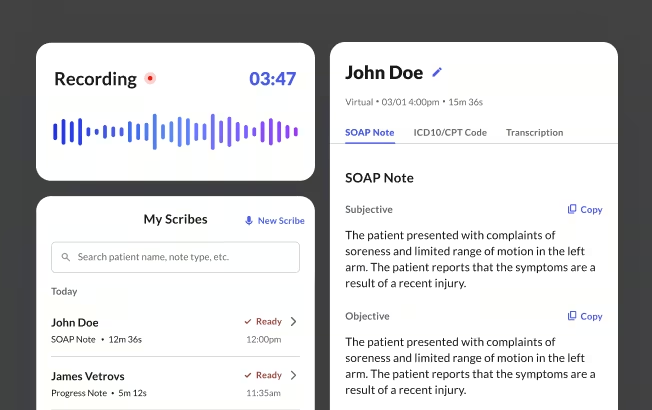
The draft appears within seconds of clicking End Recording. Suggested ICD-10 and CPT codes sit in a separate tab, and the clinician reviews, edits, and finalizes the note before anything posts to the chart. Recording runs up to two hours continuously, long enough for extended intakes and family sessions.
Commure reports that 90%+ of providers reduce clinical documentation time and digital fatigue, and 91% report feeling less fatigued. The product is HIPAA compliant and SOC 2 certified, with onshore data storage. Audio is encrypted and never used for AI training.
How the note reaches the chart depends on practice size. Solo and small practices copy and paste the finished note into the EHR. Medium and large group practices can use one-click sync with EHRs including SimplePractice and Kipu. The finished note is a progress note, so keep any private process reflections in your separate psychotherapy notes file.
Disclaimer
This article is for informational and educational purposes only. It does not constitute legal, medical, or professional advice and does not guarantee compliance with any specific federal, state, or payer requirement. Consult a qualified attorney or compliance professional for guidance on your practice's documentation obligations.
Frequently Asked Questions
In everyday use, "therapy notes" usually means the progress notes in the client's chart. HIPAA uses "psychotherapy notes" for a narrower record: the clinician's notes analyzing a session, kept separate from the medical record. Psychotherapy notes need the client's authorization before almost any disclosure, and progress notes follow standard HIPAA rules.
Common formats include SOAP (Subjective, Objective, Assessment, Plan), DAP (Data, Assessment, Plan), and BIRP (Behavior, Intervention, Response, Plan). GIRP and SIRP open with a goal or situation instead. Each holds the same clinical content in a different order, so choose by setting and by what your payer or program requires.
Keep private reflections, working hypotheses, and process observations out of the progress note, and store them separately as psychotherapy notes if you keep them. Limit details about other people in the client's life to what is clinically necessary. Update any text carried forward from the last session before you sign.
A routine session with no risk concerns can often be documented in under 150 words. Sessions with active risk, a new safety plan, or a change in diagnosis need more. A colleague reading the therapy note should be able to tell what you assessed, what you decided, and what comes next.
Clients have a HIPAA right to access their progress notes and the rest of their record. You generally have 30 days to act on a request, with one 30-day extension. That right excludes psychotherapy notes kept separately. State law can give clients broader access, so check your state's rules.
Yes, if the vendor signs a business associate agreement and its data handling fits your policies. Ask how long audio is kept, whether session data trains its models, and how notes move into your EHR. Review every AI-drafted note before you sign it, starting with risk language and mental status findings.
Sources
- Rule A, Bedrick S, Chiang MF, Hribar MR. Length and redundancy of outpatient progress notes across a decade at an academic medical center. JAMA Netw Open. 2021;4(7):e2115334. https://jamanetwork.com/journals/jamanetworkopen/fullarticle/2782054
- U.S. Department of Health and Human Services. Does HIPAA provide extra protections for mental health information compared with other health information? Last reviewed September 12, 2017. https://www.hhs.gov/hipaa/for-professionals/faq/2088/does-hipaa-provide-extra-protections-mental-health-information-compared-other-health.html
- Centers for Medicare & Medicaid Services. Billing and Coding: Psychiatric Diagnostic Evaluation and Psychotherapy Services (A57520). Medicare Coverage Database. https://www.cms.gov/medicare-coverage-database/view/article.aspx?articleId=57520
- 45 CFR 164.524, Access of individuals to protected health information. https://www.ecfr.gov/current/title-45/subtitle-A/subchapter-C/part-164/subpart-E/section-164.524
- Murad MH, Vaa Stelling BE, West CP, et al. Measuring documentation burden in healthcare. J Gen Intern Med. 2024;39(14):2837-2848. https://pmc.ncbi.nlm.nih.gov/articles/PMC11534919/
- Columbia Lighthouse Project. About the Protocol: Columbia-Suicide Severity Rating Scale (C-SSRS). https://cssrs.columbia.edu/the-columbia-scale-c-ssrs/about-the-scale/
- Stanley B, Brown GK. Safety planning intervention: a brief intervention to mitigate suicide risk. Cogn Behav Pract. 2012;19(2):256-264. https://www.sciencedirect.com/science/article/abs/pii/S1077722911000630
- U.S. Department of Health and Human Services. Does the HIPAA Privacy Rule require covered entities to keep patients' medical records for any period of time? Last reviewed July 26, 2013. https://www.hhs.gov/hipaa/for-professionals/faq/580/does-hipaa-require-covered-entities-to-keep-medical-records-for-any-period/index.html
- MIEC. How Long Should We Keep Medical Records? https://www.miec.com/knowledge-library/keeping-medical-records/
- Topaz M, Peltonen LM, Zhang Z. Beyond human ears: navigating the uncharted risks of AI scribes in clinical practice. NPJ Digit Med. 2025;8:569. https://www.nature.com/articles/s41746-025-01895-6
- U.S. Department of Health and Human Services. Business Associates. https://www.hhs.gov/hipaa/for-professionals/privacy/guidance/business-associates/index.html






.jpeg)