



Trauma Assessment in Mental Health: Free Template and Tool Guide
How to screen, measure, and interview for adult trauma, what PC-PTSD-5 and PCL-5 scores mean, and how to document the result with a free template.
Written by the Commure Scribe Team
Published: September 18, 2026
•
10 min read
Updated September 25, 2026
What You Need to Know About Trauma Assessment
- Trauma assessment in mental health gathers trauma history, symptoms, daily function, and risk to guide diagnosis and care.
- A national study found 89.7% of U.S. adults reported exposure to a traumatic event under DSM-5 criteria.¹
- Pair a validated self-report with a clinical interview, and record trauma history without asking for a detailed story.
What Is the Difference Between Trauma Screening and Trauma Assessment?
Trauma screening is a brief check for trauma history and current symptoms, mostly through yes or no questions.² A positive screen calls for a trauma assessment. That fuller step defines what the client struggles with now, so you can build a treatment plan.² Those findings then feed a mental health treatment plan template that sets SMART goals, measurable objectives, and a review schedule.
On this page, trauma means psychological trauma in adult clients of an independent behavioral health practice. Emergency teams use the same word for the survey of injured patients, which is a separate exam. Measures for children and teens are also out of scope.
In many surveys, more than half of respondents report a history of trauma.² Rates run even higher among clients with mental or substance use disorders.² National Institute of Mental Health (NIMH) survey data from 2001 to 2003 estimate that 3.6% of U.S. adults had post-traumatic stress disorder (PTSD) in the past year.³
A workable order for a trauma assessment starts with a screen, adds a symptom measure, and ends with a clinical interview. Trauma-focused therapy and timeline work come later, once the client feels safe with you. If that later work is eye movement desensitization and reprocessing (EMDR), an EMDR treatment plan template lays out the eight phases, measurable goals, and a risk and stabilization section.
Which Trauma Assessment Tools Should You Use?
Use one validated tool for each step: a screen, an exposure checklist, a symptom measure, and a clinical interview. The U.S. Department of Veterans Affairs (VA) National Center for PTSD publishes the first four tools in this table. Each is built for the Diagnostic and Statistical Manual of Mental Disorders, Fifth Edition (DSM-5).
A trauma screening tool such as the PC-PTSD-5 tells you who needs a full trauma assessment. VA intends the PCL-5 for qualified health professionals and researchers.⁶ Non-VA providers who request the CAPS-5 certify advanced graduate training in psychodiagnostic assessment, a clinical master's degree, or research credentials.⁷
In Centers for Disease Control and Prevention (CDC) survey data from 2011 to 2020, 63.9% of U.S. adults reported at least one ACE.⁸ About 17.3% reported four or more.⁸
Hand the client a written checklist when you can, since clients are more likely to report trauma on self-administered tools.² Pair that checklist with an interview for clearer context.²
Do not wait for abstinence or stable symptoms before you screen.² Skip screening and assessment while the client is under the influence of alcohol or drugs.²
For any tool without a public domain statement, use the validated version from its originator with appropriate permissions.
What Do PC-PTSD-5 and PCL-5 Scores Actually Tell You?
Both scores estimate how likely PTSD is, and neither score is a diagnosis on its own. Read each one against its cut-point, its study sample, and its known limits.
The PC-PTSD-5 score is the count of yes answers, from 0 to 5.⁴ In a large VA primary care sample, a cut-point of 4 gave the best balance of false negatives and false positives, overall and for men.⁴
For women, that cut-point missed many true cases.⁴ VA says practitioners may consider a lower cut-point for women when evaluation resources are available.⁴
The first validation study enrolled 398 veterans, and most were men in their 60s.⁹ In that group, a cut score of 3 caught the most true cases.⁹ A cut score of 4 identified 82.6% of the veterans diagnosed with PTSD.⁹
The PCL-5 total runs from 0 to 80, the sum of all 20 item ratings.⁶ Initial research suggests a total between 31 and 33 indicates probable PTSD.⁶
For tracking, VA suggests a 10-point change as a sign of response.⁶ One study used a score below 28 to mark clinically significant change.⁶
Across the studies in one published review, the best PCL-5 cutoff ranged from 23 to 49.¹⁰ When the CAPS-5 interview was the yardstick, 8 of 10 comparisons found a cutoff from 30 to 34.¹⁰
Unlike an interview, the PCL-5 is open to bias and misreading that a trained assessor cannot correct in real time.¹⁰ A client who meets the PCL-5 symptom pattern may still not meet PTSD criteria on a diagnostic interview.¹⁰
In a full PTSD assessment, write the score as probable PTSD. Base the diagnosis on your clinical interview.
What Should a Trauma Assessment Template Include?
A trauma assessment template should follow the order you gather information in session. Each field uses bracket placeholders, so no sample client data ends up in the form.
- Client identifiers: [Client Name], [Date of Birth], and [Client ID] tie the form to the right chart.
- Session details: [Date of Service], [Session Duration], and service type (individual, group, or family) show what you delivered and when.
- Clinician details: [Clinician Name], [Credentials], [License Type], [License Number], and [Clinician Signature] show who completed the assessment and under what license.
- Consent and client choice: A consent for treatment reference confirms consent is on file. A second line records that you explained the purpose and the client's right to skip any question.
- Reason and screening result: Note what prompted the assessment. Record the [Screening Instrument], [Date], [Score], and whether the result was positive.
- Trauma exposure history: List [Event Type] and [Approximate Timeframe] in a few words. A "details deferred by clinician judgment" checkbox shows you chose not to gather the full story yet.
- Symptom measure: [Instrument and Version], [Total Score], and [Prior Score] let you track change across sessions.
- Interview summary and functional impact: Summarize symptoms, onset, and duration in your own words. Then rate the effect on work, relationships, sleep, and self-care.
- Co-occurring concerns: Record depression and anxiety scores, substance use, medical conditions, and medications. The substance use line carries a flag for records that may fall under 42 CFR Part 2.
- Risk assessment: Record suicidal ideation, homicidal ideation, and self-harm, with plan, intent, and access to means. Add protective factors, a risk level, and the actions you took.
- Safety plan reference: Note whether a safety plan is complete and where it sits in the chart.
- Diagnostic impression: Record the [Diagnosis], [ICD-10-CM Code], and a reference to the DSM-5 text revision (DSM-5-TR). ICD-10-CM codes change each year, so check the current-year edition.
- Goals, plan, and referrals: List [Client-Stated Goals] and one [Measurable Objective] with a [Target Review Date]. Add the treatment plan, a re-measure date, and any referrals.
- Record status notice: A short notice states that the trauma assessment belongs in the clinical record and is separate from psychotherapy notes. It also tells staff to keep any process notes apart from it.
This trauma-specific form can sit alongside a broader biopsychosocial assessment template. Depression and anxiety measures fit in a mental health questionnaire. The goals section can feed a full treatment plan template. For the initial diagnostic interview billed under CPT 90791, a psych eval template covers the core sections from chief complaint through treatment plan.
How Do You Complete a Trauma Assessment Without Retraumatizing the Client?
A trauma informed assessment gets enough history to plan care and lets the client decide what to share. The Substance Abuse and Mental Health Services Administration (SAMHSA) advises against making clients describe overwhelming events in detail.²
Pushing for details before a therapeutic relationship exists can cause retraumatization.² Talking about trauma can feel as unsafe as if the event were happening again.² Use this order in the session:
- Explain why you are asking and that the client can skip any question.
- Hand over the written screen and symptom measure before the interview starts.
- Ask about the type of event and its rough timing, and stop there.
- Check the "details deferred" box when you hold back on detail.
- Return to the history once safety and rapport are in place.
CDC and SAMHSA name six guiding principles for a trauma-informed approach.¹¹
- Safety
- Trustworthiness and transparency
- Peer support
- Collaboration and mutuality
- Empowerment, voice, and choice
- Cultural, historical, and gender issues
Screening can be set up so that staff without graduate training run it.² Keep the interview, risk review, and diagnosis with the licensed clinician.
When the client is ready for narrative work, map events in order with a trauma timeline worksheet.
How Should You Store and Share Trauma Assessment Records?
File a completed trauma assessment in the client's regular clinical record. Under HIPAA, psychotherapy notes are a therapist's separate notes on session content. They leave out test results and summaries of symptoms, diagnosis, functional status, and treatment plan (45 CFR 164.501).¹²
Keep any process notes apart from the trauma assessment, in a file such as a psychotherapy notes template. With few exceptions, you need the client's authorization before you disclose psychotherapy notes (45 CFR 164.508(a)(2)).¹² That rule applies even when you share them with another treating provider.¹² Record routine session content in a therapy progress note, which stays part of the medical record rather than the separate psychotherapy notes file.
The federal rule for substance use disorder (SUD) records, 42 CFR Part 2, applies only in some cases. It covers SUD program records that a federal agency conducts, regulates, or assists, plus records you receive from those programs.¹³ Anyone subject to Part 2 had to comply with the final rule by February 16, 2026.¹³
The final rule allows a single client consent for all future uses and disclosures for treatment, payment, and health care operations.¹³ Check with your compliance officer before you apply that consent to any record.
State mental health confidentiality laws can be stricter than HIPAA. A disclosure during the assessment can also trigger a mandated reporting duty. Requirements vary by state, so confirm your duties with your compliance officer or a healthcare attorney.
How Can Commure Scribe Help You Write Up a Trauma Assessment?
An AI scribe can draft the trauma assessment write-up from the session. You can then stay present in the room while the client talks.
Start with consent. Explain the recording before the session, and leave it off if the client declines.
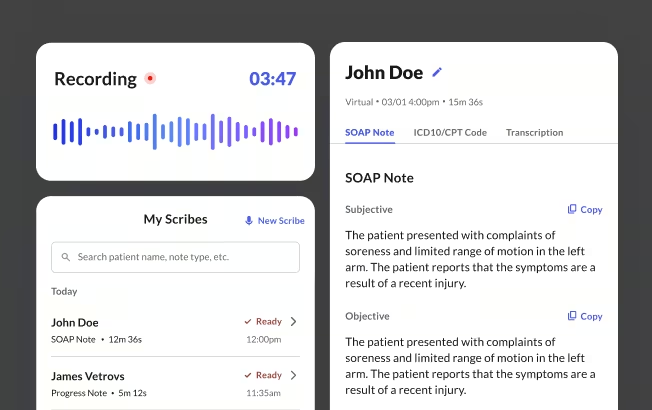
Record the session, in person or over telehealth, with Commure Scribe. A custom template can mirror the sections of this form, from exposure history to the diagnostic impression.
Within seconds after you click End Recording, a structured note appears, and suggested ICD-10 and CPT codes are generated. You always have the option to review and edit the draft before you finalize it.
Confirm the risk findings and the diagnosis in your own words. Then file the write-up with the rest of the assessment, and keep any process notes in their own file.
Commure Scribe is HIPAA compliant and SOC 2 certified. Audio recordings are stored and encrypted, and audio is not used for AI training. According to Commure, 90%+ of providers reduce clinical documentation time and digital fatigue.
Let the write-up follow the interview
If you would rather not type up each trauma assessment by hand after intake, Commure Scribe drafts the write-up from the session for you to review. Solo and small practices can start with a 7-day trial, no credit card required, and compare Commure Scribe pricing and plans.
This article is for informational and educational purposes only. It does not constitute legal, medical, or professional advice and does not guarantee diagnostic accuracy or regulatory compliance.
Trauma Assessment Template Template Download
Download a copy of this template
Thanks! Your trauma assessment template is ready.
Click to download

Frequently Asked Questions
Trauma assessment time depends on the tools you choose and how much history the client is ready to share. A short self-report and a focused interview can fit within one intake session. When you defer trauma details, that part of the history can continue in later sessions once the client feels safe.
Clients can expect questions about the kinds of stressful events they have faced and roughly when they happened. They also rate symptoms such as unwanted memories, trouble sleeping, and feeling on guard.⁶ Later questions cover daily life and safety, and clients can skip any question they prefer not to answer.
A PCL-5 score flags probable PTSD, and the diagnosis rests on a clinical interview. Studies that test PCL-5 cutoffs have used the CAPS-5 interview as the comparison standard.¹⁰ Record the score in the symptom measure section, then enter a diagnosis in the diagnostic impression section after your own interview.
HIPAA applies its privacy protections to all protected health information, whatever the type.¹² A completed trauma assessment follows the same disclosure rules as the rest of the clinical record. State mental health laws can add limits, so check your state's specific requirements before you release results.
Start by listing the instruments your practice uses in the screening and symptom sections. Then add the pieces your own workflow needs such as: telehealth fields for session modality and client location, the staff role that hands out screens, your state's consent and reporting language, and a map from each section to your EHR note fields
Sources
- Kilpatrick DG, Resnick HS, Milanak ME, Miller MW, Keyes KM, Friedman MJ. "National Estimates of Exposure to Traumatic Events and PTSD Prevalence Using DSM-IV and DSM-5 Criteria." Journal of Traumatic Stress, 2013. https://onlinelibrary.wiley.com/doi/abs/10.1002/jts.21848
- Center for Substance Abuse Treatment (US). "Screening and Assessment." Trauma-Informed Care in Behavioral Health Services, Treatment Improvement Protocol (TIP) Series, No. 57. Substance Abuse and Mental Health Services Administration (US), 2014. https://www.ncbi.nlm.nih.gov/books/NBK207188/
- National Institute of Mental Health. "Post-Traumatic Stress Disorder (PTSD)." Mental Health Information: Statistics. https://www.nimh.nih.gov/health/statistics/post-traumatic-stress-disorder-ptsd
- U.S. Department of Veterans Affairs, National Center for PTSD. "Primary Care PTSD Screen for DSM-5 (PC-PTSD-5)." Last updated August 27, 2026. https://www.ptsd.va.gov/professional/assessment/screens/pc-ptsd.asp
- U.S. Department of Veterans Affairs, National Center for PTSD. "Life Events Checklist for DSM-5 (LEC-5)." Last updated June 15, 2026. https://www.ptsd.va.gov/PTSD/professional/assessment/te-measures/life_events_checklist.asp
- U.S. Department of Veterans Affairs, National Center for PTSD. "PTSD Checklist for DSM-5 (PCL-5)." Last updated June 15, 2026. https://www.ptsd.va.gov/professional/assessment/adult-sr/ptsd-checklist.asp
- U.S. Department of Veterans Affairs, National Center for PTSD. "Clinician-Administered PTSD Scale for DSM-5 (CAPS-5)." Last updated August 24, 2026. https://www.ptsd.va.gov/professional/assessment/adult-int/caps.asp
- Swedo EA, Aslam MV, Dahlberg LL, Niolon PH, Guinn AS, Simon TR, Mercy JA. "Prevalence of Adverse Childhood Experiences Among U.S. Adults, Behavioral Risk Factor Surveillance System, 2011–2020." MMWR Morbidity and Mortality Weekly Report, 2023. https://www.cdc.gov/mmwr/volumes/72/wr/mm7226a2.htm
- Prins A, Bovin MJ, Smolenski DJ, Marx BP, Kimerling R, Jenkins-Guarnieri MA, Kaloupek DG, Schnurr PP, Kaiser AP, Leyva YE, Tiet QQ. "The Primary Care PTSD Screen for DSM-5 (PC-PTSD-5): Development and Evaluation Within a Veteran Primary Care Sample." Journal of General Internal Medicine, 2016. https://link.springer.com/article/10.1007/s11606-016-3703-5
- Bovin MJ, Marx BP. "The Problem With Overreliance on the PCL–5 as a Measure of PTSD Diagnostic Status." Clinical Psychology: Science and Practice, 2023. https://doi.org/10.1037/cps0000119
- Centers for Disease Control and Prevention, Center for Preparedness and Response, in collaboration with SAMHSA's National Center for Trauma-Informed Care. "6 Guiding Principles to a Trauma-Informed Approach." 2022. https://stacks.cdc.gov/view/cdc/138924/cdc_138924_DS1.pdf
- U.S. Department of Health and Human Services, Office for Civil Rights. "Does HIPAA provide extra protections for mental health information compared with other health information?" HIPAA FAQ 2088, content last reviewed September 12, 2017. https://www.hhs.gov/hipaa/for-professionals/faq/2088/does-hipaa-provide-extra-protections-mental-health-information-compared-other-health.html
- U.S. Department of Health and Human Services. "Fact Sheet 42 CFR Part 2 Final Rule." Last updated January 30, 2026. https://www.hhs.gov/hipaa/for-professionals/regulatory-initiatives/fact-sheet-42-cfr-part-2-final-rule/index.html